Q1HFZ0
Gene name |
Nsun2 |
Protein name |
RNA cytosine C(5)-methyltransferase NSUN2 |
Names |
Myc-induced SUN domain-containing protein, Misu, NOL1/NOP2/Sun domain family member 2, mRNA cytosine C(5)-methyltransferase, tRNA cytosine C(5)-methyltransferase |
Species |
Mus musculus (Mouse) |
KEGG Pathway |
mmu:28114 |
EC number |
2.1.1.203: Methyltransferases |
Protein Class |
|
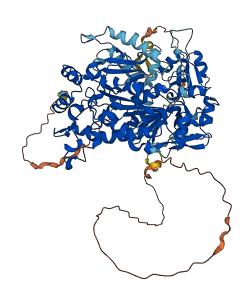
Descriptions
The autoinhibited protein was predicted that may have potential autoinhibitory elements via cis-regPred.
Autoinhibitory domains (AIDs)
Target domain |
|
Relief mechanism |
|
Assay |
cis-regPred |
Accessory elements
No accessory elements
Autoinhibited structure

Activated structure
1 structures for Q1HFZ0
| Entry ID | Method | Resolution | Chain | Position | Source |
|---|---|---|---|---|---|
| AF-Q1HFZ0-F1 | Predicted | AlphaFoldDB |
33 variants for Q1HFZ0
| Variant ID(s) | Position | Change | Description | Diseaes Association | Provenance |
|---|---|---|---|---|---|
| rs3404626102 | 93 | C>Y | No | EVA | |
| rs3389219875 | 102 | L>M | No | EVA | |
| rs256903620 | 145 | F>L | No | EVA | |
| rs3389293053 | 155 | S>Y | No | EVA | |
| rs3389291123 | 193 | Q>H | No | EVA | |
| rs3389288608 | 197 | M>T | No | EVA | |
| rs3389249627 | 247 | P>S | No | EVA | |
| rs3389275854 | 312 | E>K | No | EVA | |
| rs3404431090 | 321 | C>G | No | EVA | |
| rs3389249672 | 321 | C>Y | No | EVA | |
| rs3403880625 | 323 | L>M | No | EVA | |
| rs3404239759 | 323 | L>W | No | EVA | |
| rs3404491630 | 325 | P>H | No | EVA | |
| rs3402906295 | 344 | E>D | No | EVA | |
| rs255545143 | 363 | Q>* | No | EVA | |
| rs255545143 | 363 | Q>K | No | EVA | |
| rs3389300522 | 373 | W>C | No | EVA | |
| rs3389275917 | 376 | D>E | No | EVA | |
| rs3389219899 | 382 | Q>L | No | EVA | |
| rs256577523 | 456 | S>G | No | EVA | |
| rs3389293024 | 469 | S>P | No | EVA | |
| rs3389293044 | 480 | G>D | No | EVA | |
| rs13462868 | 482 | S>L | No | EVA | |
| rs3389219957 | 564 | K>E | No | EVA | |
| rs3389291079 | 573 | N>S | No | EVA | |
| rs3389288542 | 627 | K>R | No | EVA | |
| rs3389266406 | 640 | L>M | No | EVA | |
| rs3403882476 | 668 | D>A | No | EVA | |
| rs3389219888 | 714 | V>F | No | EVA | |
| rs232955249 | 719 | E>K | No | EVA | |
| rs251167079 | 720 | N>S | No | EVA | |
| rs3389275877 | 730 | E>D | No | EVA | |
| rs3389294077 | 754 | E>* | No | EVA |
No associated diseases with Q1HFZ0
1 regional properties for Q1HFZ0
| Type | Name | Position | InterPro Accession |
|---|---|---|---|
| domain | SAM-dependent methyltransferase RsmB/NOP2-type | 66 - 430 | IPR001678 |
Functions
| Description | ||
|---|---|---|
| EC Number | 2.1.1.203 | Methyltransferases |
| Subcellular Localization |
|
|
| PANTHER Family | ||
| PANTHER Subfamily | ||
| PANTHER Protein Class | ||
| PANTHER Pathway Category | No pathway information available | |
7 GO annotations of cellular component
| Name | Definition |
|---|---|
| chromatoid body | A ribonucleoprotein complex found in the cytoplasm of male germ cells, composed of exceedingly thin filaments that are consolidated into a compact mass or into dense strands of varying thickness that branch to form an irregular network. Contains mRNAs, miRNAs, and protein components involved in miRNA processing (such as Argonaute proteins and the endonuclease Dicer) and in RNA decay (such as the decapping enzyme DCP1a and GW182). |
| cytoplasm | The contents of a cell excluding the plasma membrane and nucleus, but including other subcellular structures. |
| extracellular exosome | A vesicle that is released into the extracellular region by fusion of the limiting endosomal membrane of a multivesicular body with the plasma membrane. Extracellular exosomes, also simply called exosomes, have a diameter of about 40-100 nm. |
| mitochondrion | A semiautonomous, self replicating organelle that occurs in varying numbers, shapes, and sizes in the cytoplasm of virtually all eukaryotic cells. It is notably the site of tissue respiration. |
| nucleolus | A small, dense body one or more of which are present in the nucleus of eukaryotic cells. It is rich in RNA and protein, is not bounded by a limiting membrane, and is not seen during mitosis. Its prime function is the transcription of the nucleolar DNA into 45S ribosomal-precursor RNA, the processing of this RNA into 5.8S, 18S, and 28S components of ribosomal RNA, and the association of these components with 5S RNA and proteins synthesized outside the nucleolus. This association results in the formation of ribonucleoprotein precursors; these pass into the cytoplasm and mature into the 40S and 60S subunits of the ribosome. |
| nucleus | A membrane-bounded organelle of eukaryotic cells in which chromosomes are housed and replicated. In most cells, the nucleus contains all of the cell's chromosomes except the organellar chromosomes, and is the site of RNA synthesis and processing. In some species, or in specialized cell types, RNA metabolism or DNA replication may be absent. |
| spindle | The array of microtubules and associated molecules that forms between opposite poles of a eukaryotic cell during mitosis or meiosis and serves to move the duplicated chromosomes apart. |
4 GO annotations of molecular function
| Name | Definition |
|---|---|
| methyltransferase activity | Catalysis of the transfer of a methyl group to an acceptor molecule. |
| mRNA (cytidine-5-)-methyltransferase activity | Catalysis of the reaction: a cytidine in mRNA + S-adenosyl-L-methionine = a 5-methylcytidine in mRNA + H(+) + S-adenosyl-L-homocysteine. |
| tRNA (cytosine-5-)-methyltransferase activity | Catalysis of the reaction: S-adenosyl-L-methionine + tRNA = S-adenosyl-L-homocysteine + tRNA containing 5-methylcytosine. |
| tRNA binding | Binding to a transfer RNA. |
11 GO annotations of biological process
| Name | Definition |
|---|---|
| cell division | The process resulting in division and partitioning of components of a cell to form more cells; may or may not be accompanied by the physical separation of a cell into distinct, individually membrane-bounded daughter cells. |
| hair follicle maturation | A developmental process, independent of morphogenetic (shape) change, that is required for a hair follicle to attain its fully functional state. |
| in utero embryonic development | The process whose specific outcome is the progression of the embryo in the uterus over time, from formation of the zygote in the oviduct, to birth. An example of this process is found in Mus musculus. |
| meiotic cell cycle checkpoint signaling | A signaling process that contributes to a meiotic cell cycle checkpoint that ensures accurate chromosome replication and segregation by preventing progression through a meiotic cell cycle until conditions are suitable for the cell to proceed to the next stage. |
| mRNA methylation | The posttranscriptional addition of methyl groups to specific residues in an mRNA molecule. |
| regulation of mRNA export from nucleus | Any process that modulates the frequency, rate or extent of the directed movement of mRNA from the nucleus to the cytoplasm. |
| regulation of stem cell differentiation | Any process that modulates the frequency, rate or extent of stem cell differentiation. |
| RNA methylation | Posttranscriptional addition of a methyl group to either a nucleotide or 2'-O ribose in a polyribonucleotide. Usually uses S-adenosylmethionine as a cofactor. |
| spermatid development | The process whose specific outcome is the progression of a spermatid over time, from its formation to the mature structure. |
| tRNA methylation | The posttranscriptional addition of methyl groups to specific residues in a tRNA molecule. |
| tRNA stabilization | Prevention of degradation of tRNA molecules. |
No homologous proteins in AiPD
| UniProt AC | Gene Name | Protein Name | Species | Evidence Code |
|---|---|---|---|---|
| No homologous proteins | ||||
| 10 | 20 | 30 | 40 | 50 | 60 |
| MGRRARGRRF | QQPPQPEGEE | DASDGGRKRG | QAGWEGGYPE | IVKENKLFEH | YYQELKIVPE |
| 70 | 80 | 90 | 100 | 110 | 120 |
| GEWDQFMESL | REPLPATLRI | TGYKSHAKEI | LHCLKNKYFK | ELEDLEVDGQ | KVEVPQPLSW |
| 130 | 140 | 150 | 160 | 170 | 180 |
| YPEELAWHTN | LSRKILRKSP | LLAKFHQFLV | SETESGNISR | QEAVSMIPPL | LLNVEPHHKI |
| 190 | 200 | 210 | 220 | 230 | 240 |
| LDMCAAPGSK | TTQLIEMLHA | DMSVPFPEGF | VIANDVDNKR | CYLLVHQAKR | LSSPCIMVVN |
| 250 | 260 | 270 | 280 | 290 | 300 |
| HDASSIPRLT | VDVDGRKEIL | FYDRILCDVP | CSGDGTMRKN | IDVWKKWTTL | NSLQLHGLQL |
| 310 | 320 | 330 | 340 | 350 | 360 |
| RIATRGAEQL | AEGGRMVYST | CSLNPVEDEA | VIAALLEKSE | GALELADVSA | ELPGLKWMPG |
| 370 | 380 | 390 | 400 | 410 | 420 |
| VSQWKVMTRD | GQWFADWHEV | PQGRHTQIRP | TMFPPTDLEK | LQAMHLERCL | RILPHHQNTG |
| 430 | 440 | 450 | 460 | 470 | 480 |
| GFFVAVLVKK | APMPWNKRQP | KVQNKSAEAR | EPRVSSHVAA | TEGNPSDQSE | LESQMITGAG |
| 490 | 500 | 510 | 520 | 530 | 540 |
| DSETAHNTEN | TESNEKKDGV | CGPPPSKKMK | LFGFKEDPFV | FIPEDDPLFP | PIEKFYALDP |
| 550 | 560 | 570 | 580 | 590 | 600 |
| SFPRMNLLTR | TTEGKKRQLY | MVSKELRNVL | LNNSEKMKVI | NTGIKVWCRN | NSGEEFDCAF |
| 610 | 620 | 630 | 640 | 650 | 660 |
| RLAQEGIYTL | YPFINSRIIT | VSMEDVKTLL | TQENPFFRKL | SSEAYSQVKD | LAKGSVVLKY |
| 670 | 680 | 690 | 700 | 710 | 720 |
| EPDSANPDTL | QCPIVLCGWR | GKASIRTFVP | KNERLHYLRM | MGLEVLGEKK | KEGVILTNEN |
| 730 | 740 | 750 | |||
| AASPEQPGDE | DAKQTAQDPC | VPDSVPGCDA | AAAEPSR |