Q1H0P3
Gene name |
fabV |
Protein name |
Enoyl-[acyl-carrier-protein] reductase [NADH] |
Names |
ENR |
Species |
Methylobacillus flagellatus (strain KT / ATCC 51484 / DSM 6875) |
KEGG Pathway |
mfa:Mfla_1676 |
EC number |
1.3.1.9: With NAD(+) or NADP(+) as acceptor |
Protein Class |
|
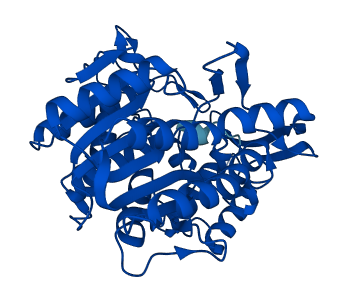
Descriptions
The autoinhibited protein was predicted that may have potential autoinhibitory elements via cis-regPred.
Autoinhibitory domains (AIDs)
Target domain |
|
Relief mechanism |
|
Assay |
cis-regPred |
Accessory elements
No accessory elements
Autoinhibited structure

Activated structure
1 structures for Q1H0P3
| Entry ID | Method | Resolution | Chain | Position | Source |
|---|---|---|---|---|---|
| AF-Q1H0P3-F1 | Predicted | AlphaFoldDB |
No variants for Q1H0P3
| Variant ID(s) | Position | Change | Description | Diseaes Association | Provenance |
|---|---|---|---|---|---|
| No variants for Q1H0P3 | |||||
No associated diseases with Q1H0P3
Functions
| Description | ||
|---|---|---|
| EC Number | 1.3.1.9 | With NAD(+) or NADP(+) as acceptor |
| Subcellular Localization |
|
|
| PANTHER Family | ||
| PANTHER Subfamily | ||
| PANTHER Protein Class | ||
| PANTHER Pathway Category | No pathway information available | |
No GO annotations of cellular component
| Name | Definition |
|---|---|
| No GO annotations for cellular component |
3 GO annotations of molecular function
| Name | Definition |
|---|---|
| enoyl-[acyl-carrier-protein] reductase (NADH) activity | Catalysis of the reaction: acyl- |
| enoyl-[acyl-carrier-protein] reductase activity | Catalysis of the reaction: acyl- + NAD(P)+ = trans-2,3-dehydroacyl- + NAD(P)H + H+. |
| NAD binding | Binding to nicotinamide adenine dinucleotide, a coenzyme involved in many redox and biosynthetic reactions; binding may be to either the oxidized form, NAD+, or the reduced form, NADH. |
1 GO annotations of biological process
| Name | Definition |
|---|---|
| fatty acid biosynthetic process | The chemical reactions and pathways resulting in the formation of a fatty acid, any of the aliphatic monocarboxylic acids that can be liberated by hydrolysis from naturally occurring fats and oils. Fatty acids are predominantly straight-chain acids of 4 to 24 carbon atoms, which may be saturated or unsaturated; branched fatty acids and hydroxy fatty acids also occur, and very long chain acids of over 30 carbons are found in waxes. |
No homologous proteins in AiPD
| UniProt AC | Gene Name | Protein Name | Species | Evidence Code |
|---|---|---|---|---|
| No homologous proteins | ||||
| 10 | 20 | 30 | 40 | 50 | 60 |
| MVIKPRVRGF | ICVTAHPTGC | EVNVKQQIDY | VKAQGPFHGP | KRVLVIGAST | GYGLAARISA |
| 70 | 80 | 90 | 100 | 110 | 120 |
| AFASGAATVG | VFLERPGEGN | KPGTAGWYNS | AAFHKFAEAE | GLYASSVNGD | AFSDAVKQQT |
| 130 | 140 | 150 | 160 | 170 | 180 |
| IDIIKRDLGQ | VDLVVYSLAA | PRRTHPKTGQ | VYNSTLKPIG | KTLRQRGLDT | DKEVIKENVI |
| 190 | 200 | 210 | 220 | 230 | 240 |
| EPATEEEIAN | TVAVMGGEDW | QMWIEALDQA | GVLADGAKTT | AFTYLGEKIT | HDIYWNGTIG |
| 250 | 260 | 270 | 280 | 290 | 300 |
| AAKKDLDQRV | LKIREQLAAR | GGDARVAVLK | ALVTQASSAI | PMMPLYLSLL | FKVMKKAGTH |
| 310 | 320 | 330 | 340 | 350 | 360 |
| EGCIEQVDGL | YRDSLYNDHP | IMDEEGRLRA | DYKELAPDIQ | AEVAALWDQV | TDENLYELTD |
| 370 | 380 | 390 | |||
| FKGYKSDFLR | LFGFGVEGVD | YEADVNPEVP | IRNLTQV |