Q1GAT4
Gene name |
divIB |
Protein name |
Cell division protein DivIB |
Names |
|
Species |
Lactobacillus delbrueckii subsp. bulgaricus (strain ATCC 11842 / DSM 20081 / BCRC 10696 / JCM 1002 / NBRC 13953 / NCIMB 11778 / NCTC 12712 / WDCM 00102 / Lb 14) |
KEGG Pathway |
ldb:Ldb0742 |
EC number |
|
Protein Class |
|
Descriptions
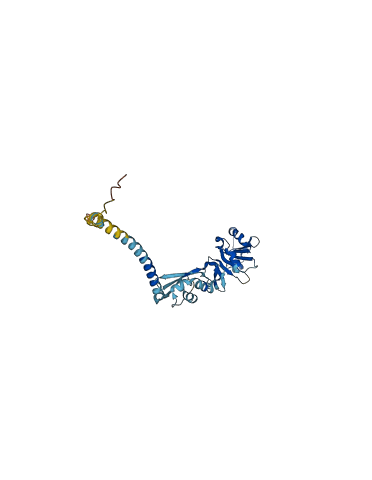
The autoinhibited protein was predicted that may have potential autoinhibitory elements via cis-regPred.
Autoinhibitory domains (AIDs)
Target domain |
|
Relief mechanism |
|
Assay |
cis-regPred |
Accessory elements
No accessory elements
Autoinhibited structure

Activated structure
1 structures for Q1GAT4
| Entry ID | Method | Resolution | Chain | Position | Source |
|---|---|---|---|---|---|
| AF-Q1GAT4-F1 | Predicted | AlphaFoldDB |
No variants for Q1GAT4
| Variant ID(s) | Position | Change | Description | Diseaes Association | Provenance |
|---|---|---|---|---|---|
| No variants for Q1GAT4 | |||||
No associated diseases with Q1GAT4
2 GO annotations of cellular component
| Name | Definition |
|---|---|
| cell division site | The eventual plane of cell division (also known as cell cleavage or cytokinesis) in a dividing cell. In Eukaryotes, the cleavage apparatus, composed of septin structures and the actomyosin contractile ring, forms along this plane, and the mitotic, or meiotic, spindle is aligned perpendicular to the division plane. In bacteria, the cell division site is generally located at mid-cell and is the site at which the cytoskeletal structure, the Z-ring, assembles. |
| integral component of plasma membrane | The component of the plasma membrane consisting of the gene products and protein complexes having at least some part of their peptide sequence embedded in the hydrophobic region of the membrane. |
No GO annotations of molecular function
| Name | Definition |
|---|---|
| No GO annotations for molecular function |
1 GO annotations of biological process
| Name | Definition |
|---|---|
| FtsZ-dependent cytokinesis | A cytokinesis process that involves a set of conserved proteins including FtsZ, and results in the formation of two similarly sized and shaped cells. |
No homologous proteins in AiPD
| UniProt AC | Gene Name | Protein Name | Species | Evidence Code |
|---|---|---|---|---|
| No homologous proteins | ||||
| 10 | 20 | 30 | 40 | 50 | 60 |
| MARKRITRRD | PEEELSKFLR | HEPGQGQETR | KLSSQLTSLK | KERRRGLLTR | LGSIMAVCLL |
| 70 | 80 | 90 | 100 | 110 | 120 |
| AIAFLTYYVS | PLADVSTVRV | LGADDLDGKS | MVEVAQIKAS | DKVVDALRGQ | KKISKKLAAK |
| 130 | 140 | 150 | 160 | 170 | 180 |
| YPEVASVTLS | VKGLNTLNMQ | VHERKVSGYI | KDGSSYREIL | ANGELGTKSL | AWREFDHDKP |
| 190 | 200 | 210 | 220 | 230 | 240 |
| LFISYSKQVA | LKTNLKIFNS | FPEYFKKQVK | MLSGNTRRKT | QMILVMKDGN | VIIGNTETIK |
| 250 | 260 | 270 | 280 | ||
| SKVKYYNSIK | QDLTTNSVID | MEVGAFTRPL | TSAEKKAYGL | S |