Q1DY54
Gene name |
NPL4 (CIMG_04759) |
Protein name |
Nuclear protein localization protein 4 |
Names |
|
Species |
Coccidioides immitis (strain RS) (Valley fever fungus) |
KEGG Pathway |
cim:CIMG_04759 |
EC number |
|
Protein Class |
|
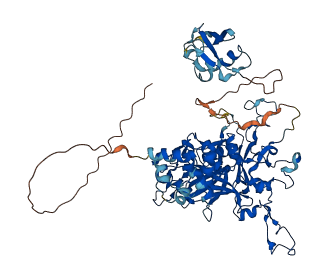
Descriptions
The autoinhibited protein was predicted that may have potential autoinhibitory elements via cis-regPred.
Autoinhibitory domains (AIDs)
Target domain |
|
Relief mechanism |
|
Assay |
cis-regPred |
Accessory elements
No accessory elements
Autoinhibited structure

Activated structure
1 structures for Q1DY54
| Entry ID | Method | Resolution | Chain | Position | Source |
|---|---|---|---|---|---|
| AF-Q1DY54-F1 | Predicted | AlphaFoldDB |
No variants for Q1DY54
| Variant ID(s) | Position | Change | Description | Diseaes Association | Provenance |
|---|---|---|---|---|---|
| No variants for Q1DY54 | |||||
No associated diseases with Q1DY54
Functions
3 GO annotations of cellular component
| Name | Definition |
|---|---|
| endoplasmic reticulum membrane | The lipid bilayer surrounding the endoplasmic reticulum. |
| nuclear membrane | Either of the lipid bilayers that surround the nucleus and form the nuclear envelope; excludes the intermembrane space. |
| perinuclear region of cytoplasm | Cytoplasm situated near, or occurring around, the nucleus. |
No GO annotations of molecular function
| Name | Definition |
|---|---|
| No GO annotations for molecular function |
3 GO annotations of biological process
| Name | Definition |
|---|---|
| mRNA transport | The directed movement of mRNA, messenger ribonucleic acid, into, out of or within a cell, or between cells, by means of some agent such as a transporter or pore. |
| protein transport | The directed movement of proteins into, out of or within a cell, or between cells, by means of some agent such as a transporter or pore. |
| ubiquitin-dependent protein catabolic process | The chemical reactions and pathways resulting in the breakdown of a protein or peptide by hydrolysis of its peptide bonds, initiated by the covalent attachment of a ubiquitin group, or multiple ubiquitin groups, to the protein. |
No homologous proteins in AiPD
| UniProt AC | Gene Name | Protein Name | Species | Evidence Code |
|---|---|---|---|---|
| No homologous proteins | ||||
| 10 | 20 | 30 | 40 | 50 | 60 |
| MAPPKPLILR | FESRNGQFRL | TVEPAELFPA | LLPKILSNLP | QNVDPTSIAL | SNQPIGTGGQ |
| 70 | 80 | 90 | 100 | 110 | 120 |
| ERKLSLLDGV | SIQQVGLKHG | DKLFIGYSEQ | STLVNGKSSN | TSAGNMQHIS | RRLNGAPVPE |
| 130 | 140 | 150 | 160 | 170 | 180 |
| QDLPAPPQPS | SPTALIKNPW | EVVQQSALDD | RLDKKDGKIP | RGRDLKMCRH | GPKGMCDYCM |
| 190 | 200 | 210 | 220 | 230 | 240 |
| PLEPYAPEYL | ADKKIKHLSF | HSYLRKVNSS | KNKPELGSSF | MPPLTEPYYR | VRKDCPSGHP |
| 250 | 260 | 270 | 280 | 290 | 300 |
| AWPEGICTKC | QPSAITLQPQ | EFRMVDHVEF | ASPDLINSLL | DFWRKSGSQR | LGFLYGTYEE |
| 310 | 320 | 330 | 340 | 350 | 360 |
| YSEVPLGVKA | VVQAIYEPPQ | VDEVDGITLR | EWENERDVDE | VAKLCGLEKV | GVIFTDLLDS |
| 370 | 380 | 390 | 400 | 410 | 420 |
| GLGDGTVICR | RHIDSYYLSS | LEVAFAARLQ | ARYPKPSKWS | ETGRFGSNFV | TCILSGDENG |
| 430 | 440 | 450 | 460 | 470 | 480 |
| AISISAYQAS | NSAVEMVRAD | IVEPSADPSV | MLVQRENELE | NADTGNARYI | PEVFYRKVNE |
| 490 | 500 | 510 | 520 | 530 | 540 |
| YGANVQENAK | PAFPVEYLFV | TLTHGFPTEP | SALFADTTFP | IENREVIGES | QDIRNVAKKL |
| 550 | 560 | 570 | 580 | 590 | 600 |
| LSRSDPDEAI | RAVSNFHLLC | FMHGLGILSK | EEEALLCTVA | RTHDPADGVQ | LINTPGWATL |
| 610 | 620 | 630 | 640 | 650 | |
| VTILQESGEP | PPKRSWPFQT | ESSSSNKNHT | RHVPLYPKTL | TSDSDQLAKR | FKGASLE |