Q19821
Gene name |
rom-1 |
Protein name |
Rhomboid-related protein 1 |
Names |
|
Species |
Caenorhabditis elegans |
KEGG Pathway |
cel:CELE_F26F4.3 |
EC number |
3.4.21.105: Serine endopeptidases |
Protein Class |
|
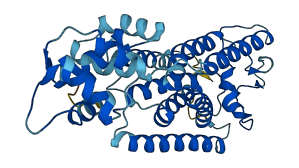
Descriptions
The autoinhibited protein was predicted that may have potential autoinhibitory elements via cis-regPred.
Autoinhibitory domains (AIDs)
Target domain |
|
Relief mechanism |
|
Assay |
cis-regPred |
Accessory elements
No accessory elements
Autoinhibited structure

Activated structure
1 structures for Q19821
| Entry ID | Method | Resolution | Chain | Position | Source |
|---|---|---|---|---|---|
| AF-Q19821-F1 | Predicted | AlphaFoldDB |
No variants for Q19821
| Variant ID(s) | Position | Change | Description | Diseaes Association | Provenance |
|---|---|---|---|---|---|
| No variants for Q19821 | |||||
No associated diseases with Q19821
1 regional properties for Q19821
| Type | Name | Position | InterPro Accession |
|---|---|---|---|
| domain | Peptidase S54, rhomboid domain | 162 - 309 | IPR022764 |
Functions
| Description | ||
|---|---|---|
| EC Number | 3.4.21.105 | Serine endopeptidases |
| Subcellular Localization |
|
|
| PANTHER Family | ||
| PANTHER Subfamily | ||
| PANTHER Protein Class | ||
| PANTHER Pathway Category | No pathway information available | |
1 GO annotations of cellular component
| Name | Definition |
|---|---|
| integral component of membrane | The component of a membrane consisting of the gene products and protein complexes having at least some part of their peptide sequence embedded in the hydrophobic region of the membrane. |
1 GO annotations of molecular function
| Name | Definition |
|---|---|
| serine-type endopeptidase activity | Catalysis of the hydrolysis of internal, alpha-peptide bonds in a polypeptide chain by a catalytic mechanism that involves a catalytic triad consisting of a serine nucleophile that is activated by a proton relay involving an acidic residue (e.g. aspartate or glutamate) and a basic residue (usually histidine). |
2 GO annotations of biological process
| Name | Definition |
|---|---|
| positive regulation of vulval development | Any process that activates or increases the frequency, rate or extent of development of the vulva. Vulval development is the process whose specific outcome is the progression of the egg-laying organ of female and hermaphrodite nematodes over time, from its formation to the mature structure. In nematodes, the vulva is formed from ventral epidermal cells during larval stages to give rise to a fully formed vulva in the adult. |
| proteolysis | The hydrolysis of proteins into smaller polypeptides and/or amino acids by cleavage of their peptide bonds. |
No homologous proteins in AiPD
| UniProt AC | Gene Name | Protein Name | Species | Evidence Code |
|---|---|---|---|---|
| No homologous proteins | ||||
| 10 | 20 | 30 | 40 | 50 | 60 |
| MFSSEGKFRK | TYRHQFNQLR | TGDETEIPMS | TLASRIETRK | IPLTNGQIHA | IKEAPDELVD |
| 70 | 80 | 90 | 100 | 110 | 120 |
| IDGFQKIVTS | KAAQRSTIKR | IMYDMADPIM | SDSQKIEVHS | YIDSYSWCPP | PIFMLLITII |
| 130 | 140 | 150 | 160 | 170 | 180 |
| QVGIFFFYWE | SDGGRSIWTD | CAGCFVHHNH | TAPGIFIFAP | KLRGEAWRFT | SYMFLHAGLN |
| 190 | 200 | 210 | 220 | 230 | 240 |
| HLLGNVIIQL | LVGIPLEVAH | KIWRIGPIYL | LAVTSGSLLQ | YAIDPNSLLV | GASAGVYALI |
| 250 | 260 | 270 | 280 | 290 | 300 |
| FAHVANVILN | WHEMPLRWIR | VLVLFVFIFL | DFGGAIHRRF | YTNDCDSVSH | LAHIAGAVTG |
| 310 | 320 | 330 | 340 | 350 | |
| LFFGYVVLYN | VVEHRIEKII | RYVCLFLYSA | FFATTIIFVI | VRQPYSKNLW | NNENCS |