Q18864
Gene name |
sft-4 |
Protein name |
Surfeit locus protein 4 homolog |
Names |
|
Species |
Caenorhabditis elegans |
KEGG Pathway |
cel:CELE_C54H2.5 |
EC number |
|
Protein Class |
|
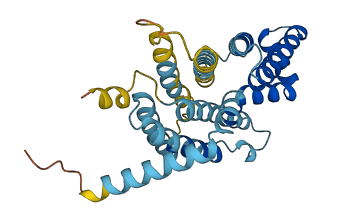
Descriptions
The autoinhibited protein was predicted that may have potential autoinhibitory elements via cis-regPred.
Autoinhibitory domains (AIDs)
Target domain |
|
Relief mechanism |
|
Assay |
cis-regPred |
Accessory elements
No accessory elements
Autoinhibited structure

Activated structure
1 structures for Q18864
| Entry ID | Method | Resolution | Chain | Position | Source |
|---|---|---|---|---|---|
| AF-Q18864-F1 | Predicted | AlphaFoldDB |
No variants for Q18864
| Variant ID(s) | Position | Change | Description | Diseaes Association | Provenance |
|---|---|---|---|---|---|
| No variants for Q18864 | |||||
No associated diseases with Q18864
No regional properties for Q18864
| Type | Name | Position | InterPro Accession |
|---|---|---|---|
| No domain, repeats, and functional sites for Q18864 | |||
6 GO annotations of cellular component
| Name | Definition |
|---|---|
| endoplasmic reticulum | The irregular network of unit membranes, visible only by electron microscopy, that occurs in the cytoplasm of many eukaryotic cells. The membranes form a complex meshwork of tubular channels, which are often expanded into slitlike cavities called cisternae. The ER takes two forms, rough (or granular), with ribosomes adhering to the outer surface, and smooth (with no ribosomes attached). |
| endoplasmic reticulum exit site | An endoplasmic reticulum part at which COPII-coated vesicles are produced. |
| endoplasmic reticulum membrane | The lipid bilayer surrounding the endoplasmic reticulum. |
| endoplasmic reticulum-Golgi intermediate compartment | A complex system of membrane-bounded compartments located between endoplasmic reticulum (ER) and the Golgi complex, with a distinctive membrane protein composition; involved in ER-to-Golgi and Golgi-to-ER transport. |
| integral component of membrane | The component of a membrane consisting of the gene products and protein complexes having at least some part of their peptide sequence embedded in the hydrophobic region of the membrane. |
| perinuclear region of cytoplasm | Cytoplasm situated near, or occurring around, the nucleus. |
1 GO annotations of molecular function
| Name | Definition |
|---|---|
| cargo receptor activity | Binding specifically to a substance (cargo) to deliver it to a transport vesicle. Cargo receptors span a membrane (either the plasma membrane or a vesicle membrane), binding simultaneously to cargo molecules and coat adaptors, to efficiently recruit soluble proteins to nascent vesicles. |
6 GO annotations of biological process
| Name | Definition |
|---|---|
| Golgi organization | A process that is carried out at the cellular level which results in the assembly, arrangement of constituent parts, or disassembly of the Golgi apparatus. |
| negative regulation of epidermal growth factor receptor signaling pathway | Any process that stops, prevents, or reduces the frequency, rate or extent of epidermal growth factor receptor signaling pathway activity. |
| negative regulation of vulval development | Any process that stops, prevents, or reduces the frequency, rate or extent of development of the vulva. Vulval development is the process whose specific outcome is the progression of the egg-laying organ of female and hermaphrodite nematodes over time, from its formation to the mature structure. In nematodes, the vulva is formed from ventral epidermal cells during larval stages to give rise to a fully formed vulva in the adult. |
| nematode larval development | The process whose specific outcome is the progression of the nematode larva over time, from its formation to the mature structure. Nematode larval development begins with the newly hatched first-stage larva (L1) and ends with the end of the last larval stage (for example the fourth larval stage (L4) in C. elegans). Each stage of nematode larval development is characterized by proliferation of specific cell lineages and an increase in body size without alteration of the basic body plan. Nematode larval stages are separated by molts in which each stage-specific exoskeleton, or cuticle, is shed and replaced anew. |
| positive regulation of protein catabolic process | Any process that activates or increases the frequency, rate or extent of the chemical reactions and pathways resulting in the breakdown of a protein by the destruction of the native, active configuration, with or without the hydrolysis of peptide bonds. |
| protein exit from endoplasmic reticulum | The directed movement of proteins from the endoplasmic reticulum. |
No homologous proteins in AiPD
| UniProt AC | Gene Name | Protein Name | Species | Evidence Code |
|---|---|---|---|---|
| No homologous proteins | ||||
| 10 | 20 | 30 | 40 | 50 | 60 |
| MNQFRAPGGQ | NEMLAKAEDA | AEDFFRKTRT | YLPHIARLCL | VSTFLEDGIR | MYFQWDDQKQ |
| 70 | 80 | 90 | 100 | 110 | 120 |
| FMQESWSCGW | FIATLFVIYN | FFGQFIPVLM | IMLRKKVLVA | CGILASIVIL | QTIAYHILWD |
| 130 | 140 | 150 | 160 | 170 | 180 |
| LKFLARNIAV | GGGLLLLLAE | TQEEKASLFA | GVPTMGDSNK | PKSYMLLAGR | VLLIFMFMSL |
| 190 | 200 | 210 | 220 | 230 | 240 |
| MHFEMSFMQV | LEIVVGFALI | TLVSIGYKTK | LSAIVLVIWL | FGLNLWLNAW | WTIPSDRFYR |
| 250 | 260 | 270 | |||
| DFMKYDFFQT | MSVIGGLLLV | IAYGPGGVSV | DDYKKRW |