Q17TI5
Gene name |
BRX |
Protein name |
Protein BREVIS RADIX |
Names |
AtBRX |
Species |
Arabidopsis thaliana (Mouse-ear cress) |
KEGG Pathway |
ath:AT1G31880 |
EC number |
|
Protein Class |
|
Descriptions
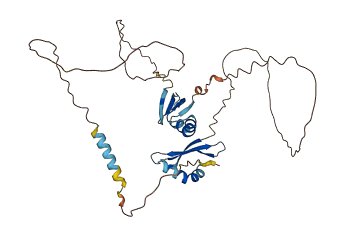
The autoinhibited protein was predicted that may have potential autoinhibitory elements via cis-regPred.
Autoinhibitory domains (AIDs)
Target domain |
|
Relief mechanism |
|
Assay |
cis-regPred |
Accessory elements
No accessory elements
Autoinhibited structure

Activated structure
1 structures for Q17TI5
| Entry ID | Method | Resolution | Chain | Position | Source |
|---|---|---|---|---|---|
| AF-Q17TI5-F1 | Predicted | AlphaFoldDB |
24 variants for Q17TI5
| Variant ID(s) | Position | Change | Description | Diseaes Association | Provenance |
|---|---|---|---|---|---|
| tmp_1_11447831_G_C | 10 | A>P | No | 1000Genomes | |
| ENSVATH14034290 | 17 | E>D | No | 1000Genomes | |
| tmp_1_11447874_C_A | 24 | T>N | No | 1000Genomes | |
| tmp_1_11448883_G_A | 58 | G>S | No | 1000Genomes | |
| tmp_1_11448904_A_C | 65 | K>Q | No | 1000Genomes | |
| ENSVATH01147254 | 70 | S>P | No | 1000Genomes | |
| ENSVATH12575604 | 73 | D>N | No | 1000Genomes | |
| ENSVATH14034294 | 75 | D>E | No | 1000Genomes | |
| ENSVATH01147256 | 103 | H>N | No | 1000Genomes | |
| ENSVATH04695465 | 124 | I>V | No | 1000Genomes | |
| ENSVATH04695466 | 125 | S>F | No | 1000Genomes | |
| tmp_1_11449103_T_C | 131 | V>A | No | 1000Genomes | |
| tmp_1_11449102_G_A | 131 | V>I | No | 1000Genomes | |
| ENSVATH01147260 | 137 | G>E | No | 1000Genomes | |
| ENSVATH12575796 | 141 | W>* | No | 1000Genomes | |
| 141 | W>del | strain: cv. Uk-1 [UniProt] | No | ||
| ENSVATH14034335 | 150 | H>Q | No | 1000Genomes | |
| ENSVATH12575797 | 158 | T>S | No | 1000Genomes | |
| ENSVATH04695470 | 222 | M>L | No | 1000Genomes | |
| ENSVATH12575800 | 251 | S>T | No | 1000Genomes | |
| tmp_1_11449756_C_A | 282 | S>R | No | 1000Genomes | |
| tmp_1_11449817_A_G | 303 | I>V | No | 1000Genomes | |
| ENSVATH00056929 | 310 | T>S | strain: cv. Uk-2 [UniProt] | No | 1000Genomes |
| tmp_1_11450022_A_G | 335 | N>S | No | 1000Genomes |
No associated diseases with Q17TI5
1 regional properties for Q17TI5
| Type | Name | Position | InterPro Accession |
|---|---|---|---|
| domain | Domain of unknown function DUF4515 | 84 - 265 | IPR032777 |
Functions
2 GO annotations of cellular component
| Name | Definition |
|---|---|
| nucleus | A membrane-bounded organelle of eukaryotic cells in which chromosomes are housed and replicated. In most cells, the nucleus contains all of the cell's chromosomes except the organellar chromosomes, and is the site of RNA synthesis and processing. In some species, or in specialized cell types, RNA metabolism or DNA replication may be absent. |
| plasma membrane | The membrane surrounding a cell that separates the cell from its external environment. It consists of a phospholipid bilayer and associated proteins. |
1 GO annotations of molecular function
| Name | Definition |
|---|---|
| identical protein binding | Binding to an identical protein or proteins. |
11 GO annotations of biological process
| Name | Definition |
|---|---|
| auxin export across the plasma membrane | The directed movement of auxins from inside of a cell, across the plasma membrane and into the extracellular region. |
| auxin-activated signaling pathway | The series of molecular signals generated by the binding of the plant hormone auxin to a receptor, and ending with modulation of a downstream cellular process, e.g. transcription. |
| cell differentiation | The process in which relatively unspecialized cells, e.g. embryonic or regenerative cells, acquire specialized structural and/or functional features that characterize the cells, tissues, or organs of the mature organism or some other relatively stable phase of the organism's life history. Differentiation includes the processes involved in commitment of a cell to a specific fate and its subsequent development to the mature state. |
| cytokinin-activated signaling pathway | The series of molecular signals generated by the binding of a cytokinin to a receptor, and ending with the regulation of a downstream cellular process, e.g. transcription. |
| lateral root development | The process whose specific outcome is the progression of the lateral root over time, from its formation to the mature structure. A lateral root is one formed from pericycle cells located on the xylem radius of the root, as opposed to the initiation of the main root from the embryo proper. |
| maintenance of root meristem identity | The process in which an organism retains a population of root meristem cells, preventing the commitment of all stem cell progeny to a differentiated cell fate. |
| phloem development | The formation of the principal food-conducting tissue of a vascular plant. |
| regulation of root development | Any process that modulates the frequency, rate or extent of root development. |
| response to abscisic acid | Any process that results in a change in state or activity of a cell or an organism (in terms of movement, secretion, enzyme production, gene expression, etc.) as a result of an abscisic acid stimulus. |
| root development | The process whose specific outcome is the progression of the root over time, from its formation to the mature structure. The root is the water- and mineral-absorbing part of a plant which is usually underground, does not bear leaves, tends to grow downwards and is typically derived from the radicle of the embryo. |
| sieve cell differentiation | The process in which a relatively unspecialized cell acquires specialized features of a sieve cell. A sieve cell is a type of sieve element that has relatively undifferentiated sieve areas (with narrow pores). The sieve areas are rather uniform in structure on all walls; that is, there are no sieve plates. Typical of gymnosperms and lower vascular plants. The sieve element is the cell in the phloem tissue concerned with mainly longitudinal conduction of food materials. |
4 homologous proteins in AiPD
| UniProt AC | Gene Name | Protein Name | Species | Evidence Code |
|---|---|---|---|---|
| Q84T65 | BRXL4 | Protein Brevis radix-like 4 | Oryza sativa subsp japonica (Rice) | PR |
| O82281 | BRXL1 | Protein Brevis radix-like 1 | Arabidopsis thaliana (Mouse-ear cress) | PR |
| Q8GYL9 | BRXL2 | Protein Brevis radix-like 2 | Arabidopsis thaliana (Mouse-ear cress) | PR |
| Q5HZ09 | BRXL3 | Protein Brevis radix-like 3 | Arabidopsis thaliana (Mouse-ear cress) | PR |
| 10 | 20 | 30 | 40 | 50 | 60 |
| MFSCIACTKA | DGGEEVEHGA | RGGTTPNTKE | AVKSLTIQIK | DMALKFSGAY | KQCKPCTGSS |
| 70 | 80 | 90 | 100 | 110 | 120 |
| SSPLKKGHRS | FPDYDNASEG | VPYPFMGGSA | GSTPAWDFTN | SSHHPAGRLE | SKFTSIYGND |
| 130 | 140 | 150 | 160 | 170 | 180 |
| RESISAQSCD | VVLDDDGPKE | WMAQVEPGVH | ITFASLPTGG | NDLKRIRFSR | EMFDKWQAQR |
| 190 | 200 | 210 | 220 | 230 | 240 |
| WWGENYDKIV | ELYNVQRFNR | QALQTPARSD | DQSQRDSTYS | KMDSARESKD | WTPRHNFRPP |
| 250 | 260 | 270 | 280 | 290 | 300 |
| GSVPHHFYGG | SSNYGPGSYH | GGPPMDAART | TTSSRDDPPS | MSNASEMQAE | WIEEDEPGVY |
| 310 | 320 | 330 | 340 | ||
| ITIRQLSDGT | RELRRVRFSR | ERFGEVHAKT | WWEQNRERIQ | TQYL |