Q17IE8
Gene name |
Cdk8 (AAEL002395) |
Protein name |
Cyclin-dependent kinase 8 |
Names |
Cell division protein kinase 8, Mediator complex subunit Cdk8, Mediator of RNA polymerase II transcription subunit Cdk8 |
Species |
Aedes aegypti (Yellowfever mosquito) (Culex aegypti) |
KEGG Pathway |
aag:5574480 |
EC number |
2.7.11.23: Protein-serine/threonine kinases |
Protein Class |
|
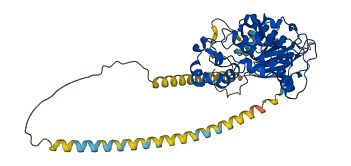
Descriptions
The autoinhibited protein was predicted that may have potential autoinhibitory elements via cis-regPred.
Autoinhibitory domains (AIDs)
Target domain |
|
Relief mechanism |
|
Assay |
cis-regPred |
Accessory elements
No accessory elements
Autoinhibited structure

Activated structure
1 structures for Q17IE8
| Entry ID | Method | Resolution | Chain | Position | Source |
|---|---|---|---|---|---|
| AF-Q17IE8-F1 | Predicted | AlphaFoldDB |
No variants for Q17IE8
| Variant ID(s) | Position | Change | Description | Diseaes Association | Provenance |
|---|---|---|---|---|---|
| No variants for Q17IE8 | |||||
No associated diseases with Q17IE8
Functions
| Description | ||
|---|---|---|
| EC Number | 2.7.11.23 | Protein-serine/threonine kinases |
| Subcellular Localization |
|
|
| PANTHER Family | ||
| PANTHER Subfamily | ||
| PANTHER Protein Class | ||
| PANTHER Pathway Category | No pathway information available | |
1 GO annotations of cellular component
| Name | Definition |
|---|---|
| nucleus | A membrane-bounded organelle of eukaryotic cells in which chromosomes are housed and replicated. In most cells, the nucleus contains all of the cell's chromosomes except the organellar chromosomes, and is the site of RNA synthesis and processing. In some species, or in specialized cell types, RNA metabolism or DNA replication may be absent. |
4 GO annotations of molecular function
| Name | Definition |
|---|---|
| ATP binding | Binding to ATP, adenosine 5'-triphosphate, a universally important coenzyme and enzyme regulator. |
| cyclin-dependent protein serine/threonine kinase activity | Cyclin-dependent catalysis of the reactions: ATP + protein serine = ADP + protein serine phosphate, and ATP + protein threonine = ADP + protein threonine phosphate. |
| protein serine kinase activity | Catalysis of the reactions: ATP + protein serine = ADP + protein serine phosphate. |
| RNA polymerase II CTD heptapeptide repeat kinase activity | Catalysis of the reaction: ATP + RNA polymerase II large subunit CTD heptapeptide repeat (YSPTSPS) = ADP + H+ + phosphorylated RNA polymerase II. |
2 GO annotations of biological process
| Name | Definition |
|---|---|
| G1/S transition of mitotic cell cycle | The mitotic cell cycle transition by which a cell in G1 commits to S phase. The process begins with the build up of G1 cyclin-dependent kinase (G1 CDK), resulting in the activation of transcription of G1 cyclins. The process ends with the positive feedback of the G1 cyclins on the G1 CDK which commits the cell to S phase, in which DNA replication is initiated. |
| protein phosphorylation | The process of introducing a phosphate group on to a protein. |
No homologous proteins in AiPD
| UniProt AC | Gene Name | Protein Name | Species | Evidence Code |
|---|---|---|---|---|
| No homologous proteins | ||||
| 10 | 20 | 30 | 40 | 50 | 60 |
| MDYEFKMKTQ | QERAKVEDLF | EYEGCKVGRG | TYGHVYKAHR | KESNDTKDYA | LKQIEGTGLS |
| 70 | 80 | 90 | 100 | 110 | 120 |
| MSACREIALL | RELKHPNVIN | LIRVFLSHTD | RKVWLLFDYA | EHDLWHIIKF | HRAAKATKKP |
| 130 | 140 | 150 | 160 | 170 | 180 |
| VMVPKGMVKS | LLYQILDGIH | YLHSNWVLHR | DLKPANILVM | GEGNERGRVK | IADMGFARLF |
| 190 | 200 | 210 | 220 | 230 | 240 |
| NAPLKPLADL | DPVVVTFWYR | APELLLGARH | YTKAIDIWAI | GCIFAELLTS | EPIFHCRQED |
| 250 | 260 | 270 | 280 | 290 | 300 |
| IKTSNPYHHD | QLDRIFNVMG | FPQDKDWEDI | RKMPEHHTLT | KDFKRSNYAN | CSLVKYMERH |
| 310 | 320 | 330 | 340 | 350 | 360 |
| KIKPDSKAFH | LLQKLLLMDP | NKRITSEQAM | QDPYFSEDPM | PTADVFAGCP | IPYPKREFLT |
| 370 | 380 | 390 | 400 | 410 | 420 |
| DEDQDDKGES | KRQQQQQQQQ | QANQQAQQNQ | QQQANHQNQQ | QNQQQQANQQ | NQQSQQQQQQ |
| 430 | 440 | 450 | 460 | 470 | 480 |
| QQMQQQQQAQ | AGGMDHSAAK | RVRMSGPNGQ | PGNGMNQQDY | QVQQAQQAAA | AAAAAQQQQQ |
| 490 | 500 | ||||
| QQQQQQMMFN | NQQQGGFQQR | Y |