Q16QL3
Gene name |
coq2 |
Protein name |
4-hydroxybenzoate polyprenyltransferase, mitochondrial |
Names |
4-HB polyprenyltransferase, Coenzyme Q biosynthesis protein 2, Para-hydroxybenzoate--polyprenyltransferase, PHB:PPT, PHB:polyprenyltransferase |
Species |
Aedes aegypti (Yellowfever mosquito) (Culex aegypti) |
KEGG Pathway |
|
EC number |
2.5.1.39: Transferring alkyl or aryl groups, other than methyl groups |
Protein Class |
|
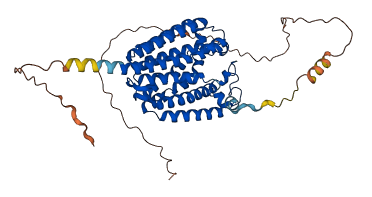
Descriptions
The autoinhibited protein was predicted that may have potential autoinhibitory elements via cis-regPred.
Autoinhibitory domains (AIDs)
Target domain |
|
Relief mechanism |
|
Assay |
cis-regPred |
Accessory elements
No accessory elements
Autoinhibited structure

Activated structure
1 structures for Q16QL3
| Entry ID | Method | Resolution | Chain | Position | Source |
|---|---|---|---|---|---|
| AF-Q16QL3-F1 | Predicted | AlphaFoldDB |
No variants for Q16QL3
| Variant ID(s) | Position | Change | Description | Diseaes Association | Provenance |
|---|---|---|---|---|---|
| No variants for Q16QL3 | |||||
No associated diseases with Q16QL3
1 regional properties for Q16QL3
| Type | Name | Position | InterPro Accession |
|---|---|---|---|
| conserved_site | UbiA prenyltransferase conserved site | 175 - 197 | IPR030470 |
Functions
| Description | ||
|---|---|---|
| EC Number | 2.5.1.39 | Transferring alkyl or aryl groups, other than methyl groups |
| Subcellular Localization |
|
|
| PANTHER Family | ||
| PANTHER Subfamily | ||
| PANTHER Protein Class | ||
| PANTHER Pathway Category | No pathway information available | |
4 GO annotations of cellular component
| Name | Definition |
|---|---|
| integral component of mitochondrial inner membrane | The component of the mitochondrial inner membrane consisting of the gene products having at least some part of their peptide sequence embedded in the hydrophobic region of the membrane. |
| mitochondrial inner membrane | The inner, i.e. lumen-facing, lipid bilayer of the mitochondrial envelope. It is highly folded to form cristae. |
| RNA polymerase I complex | RNA polymerase I, one of three nuclear DNA-directed RNA polymerases found in all eukaryotes, is a multisubunit complex; typically it produces rRNAs. Two large subunits comprise the most conserved portion including the catalytic site and share similarity with other eukaryotic and bacterial multisubunit RNA polymerases. The remainder of the complex is composed of smaller subunits (generally ten or more), some of which are also found in RNA polymerase III and others of which are also found in RNA polymerases II and III. Although the core is competent to mediate ribonucleic acid synthesis, it requires additional factors to select the appropriate template. |
| RNA polymerase III complex | RNA polymerase III, one of three nuclear DNA-directed RNA polymerases found in all eukaryotes, is a multisubunit complex; typically it produces 5S rRNA, tRNAs and some of the small nuclear RNAs. Two large subunits comprise the most conserved portion including the catalytic site and share similarity with other eukaryotic and bacterial multisubunit RNA polymerases. The remainder of the complex is composed of smaller subunits (generally ten or more), some of which are also found in RNA polymerase I and others of which are also found in RNA polymerases I and II. Although the core is competent to mediate ribonucleic acid synthesis, it requires additional factors to select the appropriate template. |
3 GO annotations of molecular function
| Name | Definition |
|---|---|
| 4-hydroxybenzoate decaprenyltransferase activity | Catalysis of the reaction: all-trans-decaprenyl diphosphate + 4-hydroxybenzoate = 3-decaprenyl-4-hydroxybenzoate + diphosphate. |
| 4-hydroxybenzoate nonaprenyltransferase activity | Catalysis of the reaction: p-hydroxybenzoate + solanesyl pyrophosphate = nonaprenyl-4-hydroxybenzoate + diphosphate. |
| 4-hydroxybenzoate octaprenyltransferase activity | Catalysis of the reaction: farnesylfarnesylgeranyl diphosphate + p-hydroxybenzoate = 3-octaprenyl-4-hydroxybenzoate + diphosphate. |
4 GO annotations of biological process
| Name | Definition |
|---|---|
| isoprenoid biosynthetic process | The chemical reactions and pathways resulting in the formation of an isoprenoid compound, isoprene (2-methylbuta-1,3-diene) or compounds containing or derived from linked isoprene (3-methyl-2-butenylene) residues. |
| transcription by RNA polymerase I | The synthesis of RNA from a DNA template by RNA polymerase I (RNAP I), originating at an RNAP I promoter. |
| transcription by RNA polymerase III | The synthesis of RNA from a DNA template by RNA polymerase III, originating at an RNAP III promoter. |
| ubiquinone biosynthetic process | The chemical reactions and pathways resulting in the formation of ubiquinone, a lipid-soluble electron-transporting coenzyme. |
No homologous proteins in AiPD
| UniProt AC | Gene Name | Protein Name | Species | Evidence Code |
|---|---|---|---|---|
| No homologous proteins | ||||
| 10 | 20 | 30 | 40 | 50 | 60 |
| MLRKLTSNSS | RWTTTHLGSL | WQEVGGHPIR | RGLILHHHCR | PLAAVSSGVI | LRQKEESRWS |
| 70 | 80 | 90 | 100 | 110 | 120 |
| PNSGGKLANL | RCWPEYRLHS | ATKRRTLGEL | VLRDYSSNNI | SDKKPEPKSL | LQSIVQNPYA |
| 130 | 140 | 150 | 160 | 170 | 180 |
| RLMRIDRPIG | SWLLFWPCGW | SIALSAPAGC | WPDLWTLTLF | GAGAFIMRGA | GCTINDMWDR |
| 190 | 200 | 210 | 220 | 230 | 240 |
| DIDGKVARTR | NRPLVAGELT | SADAWFFLGA | QLGVGLLILL | ELNWYSIVLG | ASSLGLVIIY |
| 250 | 260 | 270 | 280 | 290 | 300 |
| PLMKRITHWP | QLVLGMTFNW | GALLGWSATQ | GSVMWSACLP | LYVAGVCWTI | VYDTIYAHQD |
| 310 | 320 | 330 | 340 | 350 | 360 |
| KVDDALLGIK | STAIRFGDNT | KLWLSGFSTA | MIGGLVASGM | VCEQTWPYYS | AVGVISAHLA |
| 370 | 380 | 390 | 400 | 410 | 420 |
| HQIYSLNIDN | PTDCATKFIS | NHQVGLILFL | GIVLGTLYKG | YSQRAGKSST | TSSSSTSSSS |
| 430 | 440 | ||||
| SPSSGLLLAA | TNHHQPARQA | S |