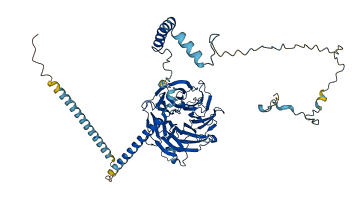
Descriptions
The autoinhibited protein was predicted that may have potential autoinhibitory elements via cis-regPred.
Autoinhibitory domains (AIDs)
Target domain |
|
Relief mechanism |
|
Assay |
cis-regPred |
Accessory elements
No accessory elements
Autoinhibited structure

Activated structure
1 structures for Q16960
| Entry ID | Method | Resolution | Chain | Position | Source |
|---|---|---|---|---|---|
| AF-Q16960-F1 | Predicted | AlphaFoldDB |
No variants for Q16960
| Variant ID(s) | Position | Change | Description | Diseaes Association | Provenance |
|---|---|---|---|---|---|
| No variants for Q16960 | |||||
No associated diseases with Q16960
5 regional properties for Q16960
| Type | Name | Position | InterPro Accession |
|---|---|---|---|
| repeat | WD40 repeat | 205 - 244 | IPR001680-1 |
| repeat | WD40 repeat | 250 - 292 | IPR001680-2 |
| repeat | WD40 repeat | 352 - 391 | IPR001680-3 |
| repeat | WD40 repeat | 395 - 435 | IPR001680-4 |
| repeat | WD40 repeat | 440 - 479 | IPR001680-5 |
4 GO annotations of cellular component
| Name | Definition |
|---|---|
| cilium | A specialized eukaryotic organelle that consists of a filiform extrusion of the cell surface and of some cytoplasmic parts. Each cilium is largely bounded by an extrusion of the cytoplasmic (plasma) membrane, and contains a regular longitudinal array of microtubules, anchored to a basal body. |
| cytoplasm | The contents of a cell excluding the plasma membrane and nucleus, but including other subcellular structures. |
| dynein complex | Any of several large complexes that contain two or three dynein heavy chains and several light chains, and have microtubule motor activity. |
| microtubule | Any of the long, generally straight, hollow tubes of internal diameter 12-15 nm and external diameter 24 nm found in a wide variety of eukaryotic cells; each consists (usually) of 13 protofilaments of polymeric tubulin, staggered in such a manner that the tubulin monomers are arranged in a helical pattern on the microtubular surface, and with the alpha/beta axes of the tubulin subunits parallel to the long axis of the tubule; exist in equilibrium with pool of tubulin monomers and can be rapidly assembled or disassembled in response to physiological stimuli; concerned with force generation, e.g. in the spindle. |
No GO annotations of molecular function
| Name | Definition |
|---|---|
| No GO annotations for molecular function |
No GO annotations of biological process
| Name | Definition |
|---|---|
| No GO annotations for biological process |
No homologous proteins in AiPD
| UniProt AC | Gene Name | Protein Name | Species | Evidence Code |
|---|---|---|---|---|
| No homologous proteins | ||||
| 10 | 20 | 30 | 40 | 50 | 60 |
| MEIVYVYTKK | RSEFGRQCNF | SDRPAELHVD | ILPDESLLSN | FIEKNPVDRG | IQCVQEMSEH |
| 70 | 80 | 90 | 100 | 110 | 120 |
| EINTERFETD | SRGINHMEGG | WPKDINPQEV | EQVLRFRKKV | EKDESYVTTI | QNLASSMEHT |
| 130 | 140 | 150 | 160 | 170 | 180 |
| IKQNNAIDIY | EDYFADLEIE | EVEETPSAKT | INVFRDPNEI | KRPATHLSWY | PDGPKKLAVA |
| 190 | 200 | 210 | 220 | 230 | 240 |
| YSSLEFQKTS | AETSMDSYIW | DIENPNKPEF | VLKPVSPLVC | LEYNPKDVHV | LIGGCYNGQV |
| 250 | 260 | 270 | 280 | 290 | 300 |
| AFWDTRKGSQ | AVEMSPVEHS | HHDPVYKTIW | LQSKTGTECF | SASTDGQVLW | WDMRKLGEPT |
| 310 | 320 | 330 | 340 | 350 | 360 |
| EKLIMDPSKK | GKMENAQGVI | SLEYEPTIPT | KFMVGTEQGT | IISCNRKAKT | PPEKIVAIYK |
| 370 | 380 | 390 | 400 | 410 | 420 |
| EHIGPVYSLQ | RNPFFPKNFL | TVGDWTARIW | SEDIRDSSIM | WTKYHMSYLT | DGCWSPVRPA |
| 430 | 440 | 450 | 460 | 470 | 480 |
| VFFTTKMDGS | LDVWDYLFKQ | KDPTLSLQVS | DDALHSLRVQ | DQGRLIATGS | NSGTTTLLEL |
| 490 | 500 | 510 | 520 | 530 | 540 |
| SSGLCTMQRN | EKALVTAMFE | RETKREKILE | SRQRELRLKR | QGASAQGQDD | DEEGGPDEEE |
| 550 | 560 | 570 | 580 | 590 | |
| DLVAAAEKEF | FQIVQADKKK | FAAQQAKLSE | QDNKIIEEAE | ENNGSEKKDT | ENGEKEG |