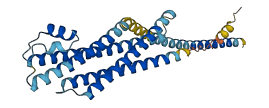
Descriptions
The autoinhibited protein was predicted that may have potential autoinhibitory elements via cis-regPred.
Autoinhibitory domains (AIDs)
Target domain |
|
Relief mechanism |
|
Assay |
cis-regPred |
Accessory elements
No accessory elements
Autoinhibited structure

Activated structure
1 structures for Q16932
| Entry ID | Method | Resolution | Chain | Position | Source |
|---|---|---|---|---|---|
| AF-Q16932-F1 | Predicted | AlphaFoldDB |
No variants for Q16932
| Variant ID(s) | Position | Change | Description | Diseaes Association | Provenance |
|---|---|---|---|---|---|
| No variants for Q16932 | |||||
No associated diseases with Q16932
1 GO annotations of cellular component
| Name | Definition |
|---|---|
| integral component of membrane | The component of a membrane consisting of the gene products and protein complexes having at least some part of their peptide sequence embedded in the hydrophobic region of the membrane. |
2 GO annotations of molecular function
| Name | Definition |
|---|---|
| SNAP receptor activity | Acting as a marker to identify a membrane and interacting selectively with one or more SNAREs on another membrane to mediate membrane fusion. |
| SNARE binding | Binding to a SNARE (soluble N-ethylmaleimide-sensitive factor attached protein receptor) protein. |
4 GO annotations of biological process
| Name | Definition |
|---|---|
| intracellular protein transport | The directed movement of proteins in a cell, including the movement of proteins between specific compartments or structures within a cell, such as organelles of a eukaryotic cell. |
| neurotransmitter transport | The directed movement of a neurotransmitter into, out of or within a cell, or between cells, by means of some agent such as a transporter or pore. Neurotransmitters are any chemical substance that is capable of transmitting (or inhibiting the transmission of) a nerve impulse from a neuron to another cell. |
| regulation of exocytosis | Any process that modulates the frequency, rate or extent of exocytosis. |
| vesicle-mediated transport | A cellular transport process in which transported substances are moved in membrane-bounded vesicles; transported substances are enclosed in the vesicle lumen or located in the vesicle membrane. The process begins with a step that directs a substance to the forming vesicle, and includes vesicle budding and coating. Vesicles are then targeted to, and fuse with, an acceptor membrane. |
No homologous proteins in AiPD
| UniProt AC | Gene Name | Protein Name | Species | Evidence Code |
|---|---|---|---|---|
| No homologous proteins | ||||
| 10 | 20 | 30 | 40 | 50 | 60 |
| MTKDRLAALK | AAQSDDDDND | DVAVTVDSSG | FMEEFFEQVD | EIREMIDKIA | SNVDEVKKKH |
| 70 | 80 | 90 | 100 | 110 | 120 |
| SAILSAPQTD | DKMKEELEEL | MSEIKKNANK | VRAKLKVIEQ | NIEQEEHTNK | SSADLRIRKT |
| 130 | 140 | 150 | 160 | 170 | 180 |
| QHATLSRKFV | EVMNDYNACQ | IDYRERCKGR | IKRQLAITGK | TTTNEELEDM | IESGNPAIFT |
| 190 | 200 | 210 | 220 | 230 | 240 |
| QGIIMETQQA | NETLADIEAR | HNDIMKLETS | IRDLHDMFMD | MAMLVESQGE | MIDRIEYNVE |
| 250 | 260 | 270 | 280 | ||
| QAVDYIETAK | MDTKKAVKYQ | SKARRKKIMI | LVCLAILIII | LVGVIGGTLG |