Q15QB4
Gene name |
lptD |
Protein name |
LPS-assembly protein LptD |
Names |
|
Species |
Pseudoalteromonas atlantica (strain T6c / ATCC BAA-1087) |
KEGG Pathway |
pat:Patl_3418 |
EC number |
|
Protein Class |
|
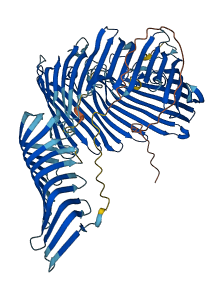
Descriptions
The autoinhibited protein was predicted that may have potential autoinhibitory elements via cis-regPred.
Autoinhibitory domains (AIDs)
Target domain |
|
Relief mechanism |
|
Assay |
cis-regPred |
Accessory elements
No accessory elements
Autoinhibited structure

Activated structure
1 structures for Q15QB4
| Entry ID | Method | Resolution | Chain | Position | Source |
|---|---|---|---|---|---|
| AF-Q15QB4-F1 | Predicted | AlphaFoldDB |
No variants for Q15QB4
| Variant ID(s) | Position | Change | Description | Diseaes Association | Provenance |
|---|---|---|---|---|---|
| No variants for Q15QB4 | |||||
No associated diseases with Q15QB4
1 GO annotations of cellular component
| Name | Definition |
|---|---|
| cell outer membrane | A lipid bilayer that forms the outermost membrane of the cell envelope; enriched in polysaccharide and protein; the outer leaflet of the membrane contains specific lipopolysaccharide structures. |
No GO annotations of molecular function
| Name | Definition |
|---|---|
| No GO annotations for molecular function |
3 GO annotations of biological process
| Name | Definition |
|---|---|
| Gram-negative-bacterium-type cell outer membrane assembly | The assembly of an outer membrane of the type formed in Gram-negative bacteria. This membrane is enriched in polysaccharide and protein, and the outer leaflet of the membrane contains specific lipopolysaccharide structures. |
| lipopolysaccharide transport | The directed movement of lipopolysaccharides into, out of or within a cell, or between cells, by means of some agent such as a transporter or pore. A lipopolysaccharide is any of a group of related, structurally complex components of the outer membrane of Gram-negative bacteria. Lipopolysaccharides consist three covalently linked regions, lipid A, core oligosaccharide, and an O side chain. Lipid A is responsible for the toxicity of the lipopolysaccharide. |
| response to organic substance | Any process that results in a change in state or activity of a cell or an organism (in terms of movement, secretion, enzyme production, gene expression, etc.) as a result of an organic substance stimulus. |
No homologous proteins in AiPD
| UniProt AC | Gene Name | Protein Name | Species | Evidence Code |
|---|---|---|---|---|
| No homologous proteins | ||||
| 10 | 20 | 30 | 40 | 50 | 60 |
| MKPLKLELNP | RDFNHYQAAF | LPYRMKIKQP | LHVLCFSVCS | LSAVAQETCP | APANTFVVEK |
| 70 | 80 | 90 | 100 | 110 | 120 |
| RLPNGQIQVI | SNMTSIQQDN | FAEFEGDVEI | TNKDSQIIAN | KAQIDRTTQQ | LIATGDVSYQ |
| 130 | 140 | 150 | 160 | 170 | 180 |
| NPQLSVTSQK | VLLNTQNNRM | EIADTQYELT | TLNARGQAEL | LVVDQTQGLE | LNGVTFSTCP |
| 190 | 200 | 210 | 220 | 230 | 240 |
| TGQEDWLVHA | DSITVKPDET | RGVARNAFFY | VQDIPIFYLP | YYSFPVTDAR | ETGLLFPQVG |
| 250 | 260 | 270 | 280 | 290 | 300 |
| SSSSTGFAYE | QPYYLNLDPQ | YDATITPRYM | TKRGLQLKTE | FRYLTENNSG | QIDIEYLPND |
| 310 | 320 | 330 | 340 | 350 | 360 |
| SDSTTNEDRY | FYRFTHKGAL | SDDWEVNVDF | NGLSDDNYIV | DLGSDYYNSA | DTHLFRTLGL |
| 370 | 380 | 390 | 400 | 410 | 420 |
| HYYSDALNVS | LQLRDFEILG | DHDDTYRALP | ELKLDYVTDL | PAGFKFDIHS | ELARFDNANG |
| 430 | 440 | 450 | 460 | 470 | 480 |
| TSPKATRAHI | APTLSLPLEN | SWGEFLAETS | IMHTVYRQED | IEGTDLSRDV | SRTLGQAKLY |
| 490 | 500 | 510 | 520 | 530 | 540 |
| GALVFERQAH | WFGDNVTQTL | EPRAQYLYTS | YEDQSDIGLY | DTTRLFNDFA | GLFRGQEFTG |
| 550 | 560 | 570 | 580 | 590 | 600 |
| LDRISDKNQV | TLGVTSRIID | EDNREQFKLS | LGQIFYLEDN | KVTAASKEDD | RSALAAELDW |
| 610 | 620 | 630 | 640 | 650 | 660 |
| RIGSKWLAHS | EVQVSTQTDK | VERSSVGLEY | RLARDKMLQI | NHRFVRDLSG | EQISQLGLTA |
| 670 | 680 | 690 | 700 | 710 | 720 |
| SWPIAQDWYW | VGRWYRDIDR | HRTIESYTGL | QYESCCWALR | IVAQRQLTSR | FDDDGLQSTD |
| 730 | 740 | 750 | |||
| EFDSGIAIQF | LFKGIGGDSS | GRDMLRDGLF | GYRQPYLLD |