Q145N7
Gene name |
ubiB |
Protein name |
Probable protein kinase UbiB |
Names |
Ubiquinone biosynthesis protein UbiB |
Species |
Paraburkholderia xenovorans (strain LB400) |
KEGG Pathway |
bxe:Bxe_A4047 |
EC number |
|
Protein Class |
|
Descriptions
The autoinhibited protein was predicted that may have potential autoinhibitory elements via cis-regPred.
Autoinhibitory domains (AIDs)
Target domain |
|
Relief mechanism |
|
Assay |
cis-regPred |
Accessory elements
No accessory elements
Autoinhibited structure

Activated structure
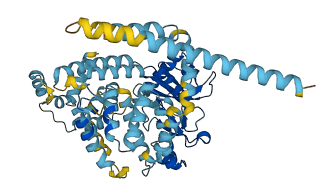
1 structures for Q145N7
| Entry ID | Method | Resolution | Chain | Position | Source |
|---|---|---|---|---|---|
| AF-Q145N7-F1 | Predicted | AlphaFoldDB |
No variants for Q145N7
| Variant ID(s) | Position | Change | Description | Diseaes Association | Provenance |
|---|---|---|---|---|---|
| No variants for Q145N7 | |||||
No associated diseases with Q145N7
2 GO annotations of cellular component
| Name | Definition |
|---|---|
| integral component of membrane | The component of a membrane consisting of the gene products and protein complexes having at least some part of their peptide sequence embedded in the hydrophobic region of the membrane. |
| plasma membrane | The membrane surrounding a cell that separates the cell from its external environment. It consists of a phospholipid bilayer and associated proteins. |
2 GO annotations of molecular function
| Name | Definition |
|---|---|
| ATP binding | Binding to ATP, adenosine 5'-triphosphate, a universally important coenzyme and enzyme regulator. |
| protein kinase activity | Catalysis of the phosphorylation of an amino acid residue in a protein, usually according to the reaction: a protein + ATP = a phosphoprotein + ADP. |
3 GO annotations of biological process
| Name | Definition |
|---|---|
| phosphorylation | The process of introducing a phosphate group into a molecule, usually with the formation of a phosphoric ester, a phosphoric anhydride or a phosphoric amide. |
| regulation of ubiquinone biosynthetic process | Any process that modulates the frequency, rate or extent of ubiquinone biosynthesis. Ubiquinone biosynthesis consists of the chemical reactions and pathways resulting in the formation of ubiquinone, a lipid-soluble electron-transporting coenzyme. |
| ubiquinone biosynthetic process | The chemical reactions and pathways resulting in the formation of ubiquinone, a lipid-soluble electron-transporting coenzyme. |
No homologous proteins in AiPD
| UniProt AC | Gene Name | Protein Name | Species | Evidence Code |
|---|---|---|---|---|
| No homologous proteins | ||||
| 10 | 20 | 30 | 40 | 50 | 60 |
| MRFLRFLKIF | FTVIRFGLDE | MMLSRVNDRR | VRLLLRITTI | GRKFDAPPGV | RLRLALESLG |
| 70 | 80 | 90 | 100 | 110 | 120 |
| PIFVKFGQVL | STRRDLLPVD | IANELAKLQD | QVPPFDSAVA | IGLVEKSLGA | PVDVLFDDFE |
| 130 | 140 | 150 | 160 | 170 | 180 |
| RVPVASASIA | QVHFATVKAG | QHAGKAVAVK | VLRPNMLPVI | DSDLALLRDI | AVWAERLWAD |
| 190 | 200 | 210 | 220 | 230 | 240 |
| GKRLKPREVV | AEFDKYLHDE | LDLMREAANG | SQLRRNFAGL | DLLLVPEMYW | EFCTPTVLVM |
| 250 | 260 | 270 | 280 | 290 | 300 |
| ERMVGVPISQ | VETLRAAGVD | IPKLAREGVE | IFFTQVFRDG | FFHADMHPGN | IQVSLDPAHF |
| 310 | 320 | 330 | 340 | 350 | 360 |
| GRYIALDFGI | IGALSDFDKN | YLAQNFLAFF | KRDYHRVATL | HLESGWVPPT | TRVEELESAI |
| 370 | 380 | 390 | 400 | 410 | 420 |
| RAVCEPYFDR | ALKDISLGQV | LMRLFSTSRR | FNVEIQPQLV | LLQKTMLNVE | GLGRSLDPEL |
| 430 | 440 | 450 | 460 | 470 | 480 |
| DLWKTAKPYL | ERWMNEQIGL | RGWYERLKIE | APQWSKTLPQ | LPRLIHHALA | ERHDHTRGAN |
| 490 | 500 | 510 | 520 | ||
| DEMIRQILLE | QKRTNRLLQG | LLLFGVAVGV | GAALARVFLA | LAYGG |