Q12745
Gene name |
SEC39 |
Protein name |
Protein transport protein SEC39 |
Names |
Dependent on SLY1-20 protein 3 |
Species |
Saccharomyces cerevisiae (strain ATCC 204508 / S288c) (Baker's yeast) |
KEGG Pathway |
sce:YLR440C |
EC number |
|
Protein Class |
|
Descriptions
The autoinhibited protein was predicted that may have potential autoinhibitory elements via cis-regPred.
Autoinhibitory domains (AIDs)
Target domain |
|
Relief mechanism |
|
Assay |
cis-regPred |
Accessory elements
No accessory elements
Autoinhibited structure

Activated structure
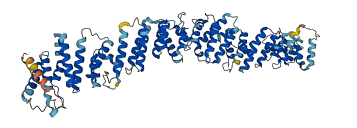
3 structures for Q12745
| Entry ID | Method | Resolution | Chain | Position | Source |
|---|---|---|---|---|---|
| 3K8P | X-ray | 260 A | D | 1-709 | PDB |
| 8EKI | EM | 450 A | D | 1-709 | PDB |
| AF-Q12745-F1 | Predicted | AlphaFoldDB |
29 variants for Q12745
| Variant ID(s) | Position | Change | Description | Diseaes Association | Provenance |
|---|---|---|---|---|---|
| s12-1017628 | 23 | K>E | No | SGRP | |
| s12-1017593 | 34 | K>N | No | SGRP | |
| s12-1017466 | 77 | V>I | No | SGRP | |
| s12-1017450 | 82 | S>N | No | SGRP | |
| s12-1017445 | 84 | S>G | No | SGRP | |
| s12-1017420 | 92 | S>N | No | SGRP | |
| s12-1017348 | 116 | T>I | No | SGRP | |
| s12-1017333 | 121 | E>V | No | SGRP | |
| s12-1017078 | 206 | G>E | No | SGRP | |
| s12-1017049 | 216 | D>N | No | SGRP | |
| s12-1017049 | 216 | D>Y | No | SGRP | |
| s12-1016979 | 239 | Q>R | No | SGRP | |
| s12-1016901 | 265 | D>G | No | SGRP | |
| s12-1016755 | 314 | I>L | No | SGRP | |
| s12-1016740 | 319 | T>A | No | SGRP | |
| s12-1016611 | 362 | L>I | No | SGRP | |
| s12-1016588 | 369 | K>N | No | SGRP | |
| s12-1016544 | 384 | V>A | No | SGRP | |
| s12-1016544 | 384 | V>D | No | SGRP | |
| s12-1016527 | 390 | D>H | No | SGRP | |
| s12-1016450 | 415 | E>D | No | SGRP | |
| s12-1016405 | 430 | N>K | No | SGRP | |
| s12-1016406 | 430 | N>T | No | SGRP | |
| s12-1016246 | 483 | K>N | No | SGRP | |
| s12-1016235 | 487 | L>W | No | SGRP | |
| s12-1016182 | 505 | H>Y | No | SGRP | |
| s12-1016009 | 562 | E>D | No | SGRP | |
| s12-1015908 | 596 | V>A | No | SGRP | |
| s12-1015595 | 700 | R>S | No | SGRP |
No associated diseases with Q12745
1 regional properties for Q12745
| Type | Name | Position | InterPro Accession |
|---|---|---|---|
| domain | Sec39 domain | 7 - 686 | IPR013244 |
4 GO annotations of cellular component
| Name | Definition |
|---|---|
| Dsl1/NZR complex | A multisubunit tethering complex, i.e. a protein complex involved in mediating the initial interaction between vesicles and the membranes with which they fuse, that is involved in trafficking from the Golgi apparatus to the ER. In Saccharomyces cerevisiae the Dsl1p complex contains Dsl1p, Tip20p, and Sec39p. |
| endoplasmic reticulum | The irregular network of unit membranes, visible only by electron microscopy, that occurs in the cytoplasm of many eukaryotic cells. The membranes form a complex meshwork of tubular channels, which are often expanded into slitlike cavities called cisternae. The ER takes two forms, rough (or granular), with ribosomes adhering to the outer surface, and smooth (with no ribosomes attached). |
| endoplasmic reticulum membrane | The lipid bilayer surrounding the endoplasmic reticulum. |
| nuclear envelope | The double lipid bilayer enclosing the nucleus and separating its contents from the rest of the cytoplasm; includes the intermembrane space, a gap of width 20-40 nm (also called the perinuclear space). |
1 GO annotations of molecular function
| Name | Definition |
|---|---|
| SNARE binding | Binding to a SNARE (soluble N-ethylmaleimide-sensitive factor attached protein receptor) protein. |
4 GO annotations of biological process
| Name | Definition |
|---|---|
| ER-dependent peroxisome organization | A process of peroxisome organization in which assembly or arrangement of constituent parts takes place in the endoplasmic reticulum. |
| protein transport | The directed movement of proteins into, out of or within a cell, or between cells, by means of some agent such as a transporter or pore. |
| retrograde vesicle-mediated transport, Golgi to endoplasmic reticulum | The directed movement of substances from the Golgi back to the endoplasmic reticulum, mediated by vesicles bearing specific protein coats such as COPI or COG. |
| vesicle-mediated transport | A cellular transport process in which transported substances are moved in membrane-bounded vesicles; transported substances are enclosed in the vesicle lumen or located in the vesicle membrane. The process begins with a step that directs a substance to the forming vesicle, and includes vesicle budding and coating. Vesicles are then targeted to, and fuse with, an acceptor membrane. |
No homologous proteins in AiPD
| UniProt AC | Gene Name | Protein Name | Species | Evidence Code |
|---|---|---|---|---|
| No homologous proteins | ||||
| 10 | 20 | 30 | 40 | 50 | 60 |
| MLEEQLYLLA | CIFASRADTR | NIKKLSTRLG | SQSKYLEILC | VLWPELDDPK | NLLFLRELEE |
| 70 | 80 | 90 | 100 | 110 | 120 |
| EVQSPEGEET | TDEDVIVELL | ESDSSLIPLI | ESDTTTRSNR | YHELQEFISK | KLNNKTLENF |
| 130 | 140 | 150 | 160 | 170 | 180 |
| EEWLRERILI | CNEMIPETPL | LYSVLWETAK | SKVLSTKFIG | WVEGVLKPLD | HLNKRLHLIF |
| 190 | 200 | 210 | 220 | 230 | 240 |
| KINEWEKMPD | SELFKIIFDG | VEDMQGYIGI | ADVIEDELAP | TLSYGKKWET | FITEFFNKQQ |
| 250 | 260 | 270 | 280 | 290 | 300 |
| FSLKSDTNYQ | LFIKLYYSLE | KGVKDNSEAS | RKLQSNVVDI | LFHNSENLFN | LSSLTHKLDE |
| 310 | 320 | 330 | 340 | 350 | 360 |
| LWSILSGFPD | EITIEEQKTI | TALEMKQFME | FFIKCSTKFS | FKEIFAITQE | EESAQLAHFS |
| 370 | 380 | 390 | 400 | 410 | 420 |
| SLCHEEFNKA | NEISSFLQAM | YETVLDISKD | DKIFTRISMD | EKLYSILEIL | LQMNEFAYIE |
| 430 | 440 | 450 | 460 | 470 | 480 |
| AIIERFDYSN | NTQIYELLVK | FFWHFFNNAS | NGLRKEPEMK | KASQTLQIIQ | KHMSQRAGTN |
| 490 | 500 | 510 | 520 | 530 | 540 |
| LTKLEVLLEI | SDKLSHYSIN | LNKSHNGARD | TAFKPSNILE | YRDCPLDIIS | NLLELNPRLY |
| 550 | 560 | 570 | 580 | 590 | 600 |
| KDLPTTKSLL | FGIYDSLSIN | REGQTGKVEV | DLMVLHIDYA | LVNLDFGTAY | ELGKQVFEIC |
| 610 | 620 | 630 | 640 | 650 | 660 |
| QEAGQHMMKA | LGDEHWLTFY | QMGKFVDPNW | VDNEIPTEII | VLQMSILGRL | LEVCPLEEVE |
| 670 | 680 | 690 | 700 | ||
| IVTSQWSTLE | LELSARDLVK | DKYALDGQND | NKSKVGGIAR | EIFHNVTNF |