Q12705
Gene name |
ppb1 (SPBC1346.01c, SPBP4H10.04) |
Protein name |
Serine/threonine-protein phosphatase 2B catalytic subunit |
Names |
|
Species |
Schizosaccharomyces pombe (strain 972 / ATCC 24843) (Fission yeast) |
KEGG Pathway |
spo:SPBP4H10.04 |
EC number |
3.1.3.16: Phosphoric monoester hydrolases |
Protein Class |
|
Descriptions
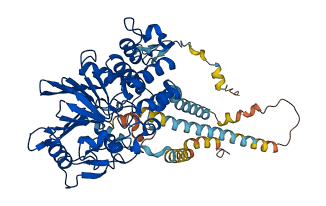
The autoinhibited protein was predicted that may have potential autoinhibitory elements via cis-regPred.
Autoinhibitory domains (AIDs)
Target domain |
|
Relief mechanism |
|
Assay |
cis-regPred |
Accessory elements
No accessory elements
Autoinhibited structure

Activated structure
1 structures for Q12705
| Entry ID | Method | Resolution | Chain | Position | Source |
|---|---|---|---|---|---|
| AF-Q12705-F1 | Predicted | AlphaFoldDB |
No variants for Q12705
| Variant ID(s) | Position | Change | Description | Diseaes Association | Provenance |
|---|---|---|---|---|---|
| No variants for Q12705 | |||||
No associated diseases with Q12705
4 regional properties for Q12705
Functions
| Description | ||
|---|---|---|
| EC Number | 3.1.3.16 | Phosphoric monoester hydrolases |
| Subcellular Localization |
|
|
| PANTHER Family | ||
| PANTHER Subfamily | ||
| PANTHER Protein Class | ||
| PANTHER Pathway Category | No pathway information available | |
6 GO annotations of cellular component
| Name | Definition |
|---|---|
| calcineurin complex | A heterodimeric calcium ion and calmodulin dependent protein phosphatase composed of catalytic and regulatory subunits; the regulatory subunit is very similar in sequence to calmodulin. |
| cell division site | The eventual plane of cell division (also known as cell cleavage or cytokinesis) in a dividing cell. In Eukaryotes, the cleavage apparatus, composed of septin structures and the actomyosin contractile ring, forms along this plane, and the mitotic, or meiotic, spindle is aligned perpendicular to the division plane. In bacteria, the cell division site is generally located at mid-cell and is the site at which the cytoskeletal structure, the Z-ring, assembles. |
| cytoplasm | The contents of a cell excluding the plasma membrane and nucleus, but including other subcellular structures. |
| cytosol | The part of the cytoplasm that does not contain organelles but which does contain other particulate matter, such as protein complexes. |
| mitotic actomyosin contractile ring | A cytoskeletal structure composed of actin filaments, myosin, and myosin-associated proteins that forms beneath the plasma membrane of many cells, including animal cells and yeast cells, in a plane perpendicular to the axis of the mitotic spindle, i.e. the cell division plane. Ring contraction is associated with centripetal growth of the membrane that divides the cytoplasm of the two future daughter cells. In animal cells, the mitotic contractile ring is located inside the plasma membrane at the location of the cleavage furrow. In budding fungal cells, e.g. mitotic S. cerevisiae cells, the mitotic contractile ring forms beneath the plasma membrane at the mother-bud neck before mitosis. |
| mitotic actomyosin contractile ring, intermediate layer | The region of the mitotic actomyosin ring in between the proximal layer and the actin filament layer. This region contains the accessory protein network, some actin filaments and connections between the proximal layer and the actin filament layer. |
6 GO annotations of molecular function
| Name | Definition |
|---|---|
| calcium-dependent protein serine/threonine phosphatase activity | Catalysis of the reactions: protein serine phosphate + H2O = protein serine + phosphate; and protein threonine phosphate + H2O = protein threonine + phosphate. These reactions require the presence of calcium ions. |
| calmodulin binding | Binding to calmodulin, a calcium-binding protein with many roles, both in the calcium-bound and calcium-free states. |
| calmodulin-dependent protein phosphatase activity | Catalysis of the reaction: protein serine/threonine phosphate + H2O = protein serine/threonine + phosphate, dependent on the presence of calcium-bound calmodulin. |
| metal ion binding | Binding to a metal ion. |
| myosin phosphatase activity | Catalysis of the reaction: phosphomyosin + H2O = myosin + phosphate. |
| phosphoprotein phosphatase activity | Catalysis of the reaction: a phosphoprotein + H2O = a protein + phosphate. Together with protein kinases, these enzymes control the state of phosphorylation of cellular proteins and thereby provide an important mechanism for regulating cellular activity. |
11 GO annotations of biological process
| Name | Definition |
|---|---|
| calcineurin-mediated signaling | Any intracellular signal transduction in which the signal is passed on within the cell by activation of a transcription factor as a consequence of dephosphorylation by Ca(2+)-activated calcineurin. The process begins with calcium-dependent activation of the phosphatase calcineurin. Calcineurin is a calcium- and calmodulin-dependent serine/threonine protein phosphatase with a conserved function in eukaryotic species from yeast to humans. In yeast and fungi, calcineurin regulates stress signaling and cell cycle, and sporulation and virulence in pathogenic fungi. In metazoans, calcineurin is involved in cell commitment, organogenesis and organ development and immune function of T-lymphocytes. By a conserved mechanism, calcineurin phosphatase activates fungal Crz1 and mammalian NFATc by dephosphorylation and translocation of these transcription factors to the nucleus to regulate gene expression. |
| cellular calcium ion homeostasis | Any process involved in the maintenance of an internal steady state of calcium ions at the level of a cell. |
| cellular response to calcium ion | Any process that results in a change in state or activity of a cell (in terms of movement, secretion, enzyme production, gene expression, etc.) as a result of a calcium ion stimulus. |
| fungal-type cell wall organization | A process that is carried out at the cellular level which results in the assembly, arrangement of constituent parts, or disassembly of the fungal-type cell wall. |
| fungal-type cell wall organization or biogenesis | A process that results in the biosynthesis of constituent macromolecules, assembly, arrangement of constituent parts, or disassembly of a fungal-type cell wall. |
| negative regulation of calcium ion import across plasma membrane | Any process that stops, prevents or reduces the frequency, rate or extent of calcium ion import across plasma membrane. |
| positive regulation of mitotic actomyosin contractile ring contraction | Any process that activates or increases the frequency, rate or extent of mitotic actomyosin contractile ring contraction. |
| positive regulation of mitotic division septum assembly | Any process that activates or increases the frequency, rate or extent of mitotic division septum formation. Division septum formation is the assembly and arrangement of a septum that spans the plasma membrane interface between progeny cells following cytokinesis. |
| regulation of cell morphogenesis | Any process that modulates the frequency, rate or extent of cell morphogenesis. Cell morphogenesis is the developmental process in which the shape of a cell is generated and organized. |
| regulation of cell shape | Any process that modulates the surface configuration of a cell. |
| regulation of endocytosis | Any process that modulates the frequency, rate or extent of endocytosis. |
No homologous proteins in AiPD
| UniProt AC | Gene Name | Protein Name | Species | Evidence Code |
|---|---|---|---|---|
| No homologous proteins | ||||
| 10 | 20 | 30 | 40 | 50 | 60 |
| MTSGPHNLED | PIVRAIRQKN | QAPSHDFTIF | VQEDGSSVST | LDRVVKNVQA | PATYIPTDVE |
| 70 | 80 | 90 | 100 | 110 | 120 |
| FFDINEPDKP | DLHFLRNHFI | REGRLSEEQT | LYIIKKATEI | LKSEDNLIEV | DAPVTVCGDI |
| 130 | 140 | 150 | 160 | 170 | 180 |
| HGQYYDLMKL | FEVGGNPANT | QYLFLGDYVD | RGYFSIECLL | YLWALKIWYP | KTLWLLRGNH |
| 190 | 200 | 210 | 220 | 230 | 240 |
| ECAHLTDYFT | FKLECTHKYN | IKVYEACLQS | FNALPLAAIM | NKQFLCVHGG | LSPELHTLND |
| 250 | 260 | 270 | 280 | 290 | 300 |
| IRMINRFCEP | PTHGLMCDLL | WSDPLEDFGS | EKSNKHFIHN | NVRGCSYFYS | YQAVCTFLEN |
| 310 | 320 | 330 | 340 | 350 | 360 |
| NNLLSVIRAH | EAQDVGYRMY | RKTKTTGFPS | LMTIFSAPNY | LDVYNNKAAV | LKYENNVMNI |
| 370 | 380 | 390 | 400 | 410 | 420 |
| RQFNCSPHPY | WLPNFMDVFT | WSLPFVGEKV | SEMLISMLNI | CSKEELYETD | LKESAPTQHK |
| 430 | 440 | 450 | 460 | 470 | 480 |
| QPAPSENENK | ADQEIDIEAR | RQIIKNKIMA | IGRISRVFSV | LREERESVSE | LKNVSGTQRL |
| 490 | 500 | 510 | 520 | 530 | 540 |
| PAGTLMLGAE | GIKNAINSFD | DARKLDIQNE | RLPPSNSRRR | STDLKAFEEV | MNSSEDDTSI |
| 550 | |||||
| DHLVERFADK | KSSL |