Q12445
Gene name |
POM34 (YLR018C) |
Protein name |
Nucleoporin POM34 |
Names |
Nuclear pore protein POM34, Pore membrane protein POM34 |
Species |
Saccharomyces cerevisiae (strain ATCC 204508 / S288c) (Baker's yeast) |
KEGG Pathway |
sce:YLR018C |
EC number |
|
Protein Class |
|
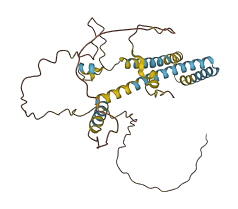
Descriptions
The autoinhibited protein was predicted that may have potential autoinhibitory elements via cis-regPred.
Autoinhibitory domains (AIDs)
Target domain |
|
Relief mechanism |
|
Assay |
cis-regPred |
Accessory elements
No accessory elements
Autoinhibited structure

Activated structure
2 structures for Q12445
| Entry ID | Method | Resolution | Chain | Position | Source |
|---|---|---|---|---|---|
| 8T9L | EM | 700 A | A/C | 1-299 | PDB |
| AF-Q12445-F1 | Predicted | AlphaFoldDB |
6 variants for Q12445
| Variant ID(s) | Position | Change | Description | Diseaes Association | Provenance |
|---|---|---|---|---|---|
| s12-179275 | 111 | L>V | No | SGRP | |
| s12-179249 | 119 | H>Q | No | SGRP | |
| s12-179194 | 138 | I>V | No | SGRP | |
| s12-179120 | 162 | D>E | No | SGRP | |
| s12-179028 | 193 | I>T | No | SGRP | |
| s12-178812 | 265 | N>S | No | SGRP |
No associated diseases with Q12445
No regional properties for Q12445
| Type | Name | Position | InterPro Accession |
|---|---|---|---|
| No domain, repeats, and functional sites for Q12445 | |||
5 GO annotations of cellular component
| Name | Definition |
|---|---|
| integral component of nuclear outer membrane | The component of the nuclear outer membrane consisting of the gene products having at least some part of their peptide sequence embedded in the hydrophobic region of the membrane. |
| nuclear envelope | The double lipid bilayer enclosing the nucleus and separating its contents from the rest of the cytoplasm; includes the intermembrane space, a gap of width 20-40 nm (also called the perinuclear space). |
| nuclear periphery | The portion of the nuclear lumen proximal to the inner nuclear membrane. |
| nuclear pore | A protein complex providing a discrete opening in the nuclear envelope of a eukaryotic cell, where the inner and outer nuclear membranes are joined. |
| nuclear pore transmembrane ring | A subcomplex of the nuclear pore complex (NPC) that spans the nuclear membrane and anchors the NPC to the nuclear envelope. In S. cerevisiae, the transmembrane ring is composed of Pom152p, Pom34p, and Ndc1p. In vertebrates, it is composed of Gp210, Ndc1, and Pom121. Components are arranged in 8-fold symmetrical 'spokes' around the central transport channel. A single 'spoke', can be isolated and is sometime referred to as the Ndc1 complex. |
1 GO annotations of molecular function
| Name | Definition |
|---|---|
| structural constituent of nuclear pore | The action of a molecule that contributes to the structural integrity of the nuclear pore complex, a protein-lined channel in the nuclear envelope that allows the transfer of macromolecules. |
5 GO annotations of biological process
| Name | Definition |
|---|---|
| mRNA transport | The directed movement of mRNA, messenger ribonucleic acid, into, out of or within a cell, or between cells, by means of some agent such as a transporter or pore. |
| nuclear pore organization | A process that is carried out at the cellular level which results in the assembly, arrangement of constituent parts, or disassembly of the nuclear pore. |
| nucleocytoplasmic transport | The directed movement of molecules between the nucleus and the cytoplasm. |
| protein import into nucleus | The directed movement of a protein from the cytoplasm to the nucleus. |
| spindle pole body duplication | Construction of a new spindle pole body. |
No homologous proteins in AiPD
| UniProt AC | Gene Name | Protein Name | Species | Evidence Code |
|---|---|---|---|---|
| No homologous proteins | ||||
| 10 | 20 | 30 | 40 | 50 | 60 |
| MKIQAGQLGL | DDNDVPGPLP | DTDSKPSSQS | QNDTPMFKLG | NFESPVLKEL | SRRTVNKEME |
| 70 | 80 | 90 | 100 | 110 | 120 |
| TQRIMTNVIA | FAFWNLLVKF | IKFFWNNTHV | GRQFCNRLSR | IHLYMLTFHT | LKKANIIYHT |
| 130 | 140 | 150 | 160 | 170 | 180 |
| TFSWLNAELL | DYLFHLLISL | NILFSLWKLL | STVKVSDLNL | TDRQKKLLGV | DMQSSVDTGL |
| 190 | 200 | 210 | 220 | 230 | 240 |
| QPQHPHYVST | SKISQMAQNK | THIPQTNLKN | HPAYLFKGLE | TPLKARQREM | AEEQTKLQSQ |
| 250 | 260 | 270 | 280 | 290 | |
| SLHTKNVFGT | LQRHSGISST | LVSANNDNNS | PHTPVTRKGY | IPSSKYAYMM | NSQSPRGKI |