Q12126
Gene name |
crk1 (mcs6, mop1, SPBC19F8.07) |
Protein name |
Serine/threonine-protein kinase crk1 |
Names |
Mitotic catastrophe suppressor 6 |
Species |
Schizosaccharomyces pombe (strain 972 / ATCC 24843) (Fission yeast) |
KEGG Pathway |
spo:SPBC19F8.07 |
EC number |
2.7.11.23: Protein-serine/threonine kinases |
Protein Class |
|
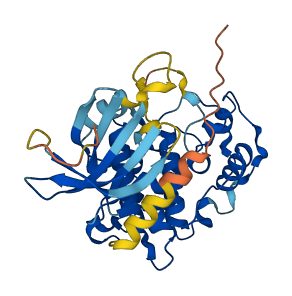
Descriptions
The autoinhibited protein was predicted that may have potential autoinhibitory elements via cis-regPred.
Autoinhibitory domains (AIDs)
Target domain |
|
Relief mechanism |
|
Assay |
cis-regPred |
Accessory elements
150-172 (Activation loop from InterPro)
Target domain |
11-292 (Protein kinase domain) |
Relief mechanism |
|
Assay |
|
Autoinhibited structure

Activated structure
1 structures for Q12126
| Entry ID | Method | Resolution | Chain | Position | Source |
|---|---|---|---|---|---|
| AF-Q12126-F1 | Predicted | AlphaFoldDB |
No variants for Q12126
| Variant ID(s) | Position | Change | Description | Diseaes Association | Provenance |
|---|---|---|---|---|---|
| No variants for Q12126 | |||||
No associated diseases with Q12126
Functions
| Description | ||
|---|---|---|
| EC Number | 2.7.11.23 | Protein-serine/threonine kinases |
| Subcellular Localization |
|
|
| PANTHER Family | ||
| PANTHER Subfamily | ||
| PANTHER Protein Class | ||
| PANTHER Pathway Category | No pathway information available | |
6 GO annotations of cellular component
| Name | Definition |
|---|---|
| chromatin | The ordered and organized complex of DNA, protein, and sometimes RNA, that forms the chromosome. |
| cyclin-dependent protein kinase activating kinase holoenzyme complex | A cyclin-dependent kinase activating kinase complex capable of activating cyclin-dependent kinases by threonine phosphorylation, thus regulating cell cycle progression. consists of a kinase, cyclin and optional assembly factors, in human CDK7, CCNH and MNAT1. CAK activity is itself regulated throughout the cell cycle by T-loop phosphorylation of its kinase component (CDK7 in human). Phosphorylation of serine residues during mitosis inactivates the enzyme. Also capable of CAK phosphorylating the carboxyl-terminal domain (CTD) of RNA polymerase II and other transcription activating proteins, as part of the general transcription factor TFIIH. |
| cytoplasm | The contents of a cell excluding the plasma membrane and nucleus, but including other subcellular structures. |
| cytosol | The part of the cytoplasm that does not contain organelles but which does contain other particulate matter, such as protein complexes. |
| nucleus | A membrane-bounded organelle of eukaryotic cells in which chromosomes are housed and replicated. In most cells, the nucleus contains all of the cell's chromosomes except the organellar chromosomes, and is the site of RNA synthesis and processing. In some species, or in specialized cell types, RNA metabolism or DNA replication may be absent. |
| transcription factor TFIIK complex | A transcription factor complex that forms part of the holo TFIIH complex. In Saccharomyces/human, TFIIK contains Ccl1p/Cyclin H, Tfb3p/MAT1 and Kin28p/CDK7. |
6 GO annotations of molecular function
| Name | Definition |
|---|---|
| ATP binding | Binding to ATP, adenosine 5'-triphosphate, a universally important coenzyme and enzyme regulator. |
| cyclin-dependent protein kinase activity | Cyclin-dependent catalysis of the phosphorylation of an amino acid residue in a protein, usually according to the reaction: a protein + ATP = a phosphoprotein + ADP. |
| cyclin-dependent protein serine/threonine kinase activity | Cyclin-dependent catalysis of the reactions: ATP + protein serine = ADP + protein serine phosphate, and ATP + protein threonine = ADP + protein threonine phosphate. |
| protein serine/threonine kinase activity | Catalysis of the reactions: ATP + protein serine = ADP + protein serine phosphate, and ATP + protein threonine = ADP + protein threonine phosphate. |
| RNA polymerase II CTD heptapeptide repeat kinase activity | Catalysis of the reaction: ATP + RNA polymerase II large subunit CTD heptapeptide repeat (YSPTSPS) = ADP + H+ + phosphorylated RNA polymerase II. |
| RNA polymerase II general transcription initiation factor activity | A general transcription initiation factor activity that contributes to transcription start site selection and transcription initiation of genes transcribed by RNA polymerase II. The general transcription factors for RNA polymerase II include TFIIB, TFIID, TFIIE, TFIIF, TFIIH and TATA-binding protein (TBP). In most species, RNA polymerase II transcribes all messenger RNAs (mRNAs), most untranslated regulatory RNAs, the majority of the snoRNAs, four of the five snRNAs (U1, U2, U4, and U5), and other small noncoding RNAs. For some small RNAs there is variability between species as to whether it is transcribed by RNA polymerase II or RNA polymerase III. However there are also rare exceptions, such as Trypanosoma brucei, where RNA polymerase I transcribes certain mRNAs in addition to its normal role in rRNA transcription. |
5 GO annotations of biological process
| Name | Definition |
|---|---|
| cell cycle | The progression of biochemical and morphological phases and events that occur in a cell during successive cell replication or nuclear replication events. Canonically, the cell cycle comprises the replication and segregation of genetic material followed by the division of the cell, but in endocycles or syncytial cells nuclear replication or nuclear division may not be followed by cell division. |
| cell division | The process resulting in division and partitioning of components of a cell to form more cells; may or may not be accompanied by the physical separation of a cell into distinct, individually membrane-bounded daughter cells. |
| phosphorylation of RNA polymerase II C-terminal domain | The process of introducing a phosphate group on to an amino acid residue in the C-terminal domain of RNA polymerase II. Typically, this occurs during the transcription cycle and results in production of an RNA polymerase II enzyme where the carboxy-terminal domain (CTD) of the largest subunit is extensively phosphorylated, often referred to as hyperphosphorylated or the II(0) form. Specific types of phosphorylation within the CTD are usually associated with specific regions of genes, though there are exceptions. The phosphorylation state regulates the association of specific complexes such as the capping enzyme or 3'-RNA processing machinery to the elongating RNA polymerase complex. |
| positive regulation of transcription by RNA polymerase II | Any process that activates or increases the frequency, rate or extent of transcription from an RNA polymerase II promoter. |
| protein phosphorylation | The process of introducing a phosphate group on to a protein. |
No homologous proteins in AiPD
| UniProt AC | Gene Name | Protein Name | Species | Evidence Code |
|---|---|---|---|---|
| No homologous proteins | ||||
| 10 | 20 | 30 | 40 | 50 | 60 |
| MDIEKSDKWT | YVKERKVGEG | TYAVVFLGRQ | KETNRRVAIK | KIKVGQFKDG | IDISALREIK |
| 70 | 80 | 90 | 100 | 110 | 120 |
| FLRESRHDNV | IELVDVFSTK | SNLNIILEFL | DSDLEMLIKD | KFIVFQPAHI | KSWMVMLLRG |
| 130 | 140 | 150 | 160 | 170 | 180 |
| LHHIHSRFIL | HRDLKPNNLL | ISSDGVLKLA | DFGLSRDFGT | PSHMSHQVIT | RWYRPPELFM |
| 190 | 200 | 210 | 220 | 230 | 240 |
| GCRSYGTGVD | MWSVGCIFAE | LMLRTPYLPG | ESDLDQLNVI | FRALGTPEPE | VIKSMQQLPN |
| 250 | 260 | 270 | 280 | 290 | 300 |
| YVEMKHIPPP | NGGMEALFSA | AGHEEIDLLK | MMLDYNPYRR | PTAQQALEHH | YFSALPKPTH |
| 310 | 320 | 330 | |||
| PSLLPRKGGE | EGIKHVSSDL | QRQNNFPMRA | NIKFV |