Q12021
Gene name |
RAD28 (YDR030C, YD9813.08c) |
Protein name |
Radiation-sensitive protein 28 |
Names |
|
Species |
Saccharomyces cerevisiae (strain ATCC 204508 / S288c) (Baker's yeast) |
KEGG Pathway |
sce:YDR030C |
EC number |
|
Protein Class |
|
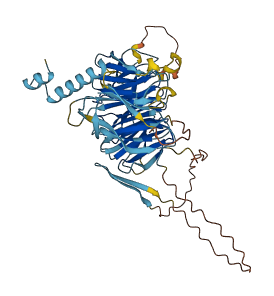
Descriptions
The autoinhibited protein was predicted that may have potential autoinhibitory elements via cis-regPred.
Autoinhibitory domains (AIDs)
Target domain |
|
Relief mechanism |
|
Assay |
cis-regPred |
Accessory elements
No accessory elements
Autoinhibited structure

Activated structure
1 structures for Q12021
| Entry ID | Method | Resolution | Chain | Position | Source |
|---|---|---|---|---|---|
| AF-Q12021-F1 | Predicted | AlphaFoldDB |
14 variants for Q12021
| Variant ID(s) | Position | Change | Description | Diseaes Association | Provenance |
|---|---|---|---|---|---|
| s04-503246 | 9 | V>L | No | SGRP | |
| s04-503209 | 21 | T>S | No | SGRP | |
| s04-503111 | 54 | T>A | No | SGRP | |
| s04-502925 | 116 | D>N | No | SGRP | |
| s04-502897 | 125 | Y>S | No | SGRP | |
| s04-502874 | 133 | N>D | No | SGRP | |
| s04-502864 | 136 | N>S | No | SGRP | |
| s04-502723 | 183 | S>F | No | SGRP | |
| s04-502475 | 266 | I>V | No | SGRP | |
| s04-502412 | 287 | Q>K | No | SGRP | |
| s04-502274 | 333 | R>G | No | SGRP | |
| s04-502094 | 393 | L>M | No | SGRP | |
| s04-501959 | 438 | V>I | No | SGRP | |
| s04-501914 | 453 | E>K | No | SGRP |
No associated diseases with Q12021
7 regional properties for Q12021
| Type | Name | Position | InterPro Accession |
|---|---|---|---|
| repeat | WD40 repeat | 52 - 85 | IPR001680-1 |
| repeat | WD40 repeat | 184 - 233 | IPR001680-2 |
| repeat | WD40 repeat | 280 - 316 | IPR001680-3 |
| repeat | WD40 repeat | 352 - 387 | IPR001680-4 |
| repeat | G-protein beta WD-40 repeat | 72 - 86 | IPR020472-1 |
| repeat | G-protein beta WD-40 repeat | 211 - 225 | IPR020472-2 |
| repeat | G-protein beta WD-40 repeat | 303 - 317 | IPR020472-3 |
3 GO annotations of cellular component
| Name | Definition |
|---|---|
| Cul4A-RING E3 ubiquitin ligase complex | A ubiquitin ligase complex in which a cullin from the Cul4A subfamily and a RING domain protein form the catalytic core; substrate specificity is conferred by an adaptor protein. |
| nucleotide-excision repair complex | Any complex formed of proteins that act in nucleotide-excision repair. |
| nucleus | A membrane-bounded organelle of eukaryotic cells in which chromosomes are housed and replicated. In most cells, the nucleus contains all of the cell's chromosomes except the organellar chromosomes, and is the site of RNA synthesis and processing. In some species, or in specialized cell types, RNA metabolism or DNA replication may be absent. |
No GO annotations of molecular function
| Name | Definition |
|---|---|
| No GO annotations for molecular function |
4 GO annotations of biological process
| Name | Definition |
|---|---|
| DNA repair | The process of restoring DNA after damage. Genomes are subject to damage by chemical and physical agents in the environment (e.g. UV and ionizing radiations, chemical mutagens, fungal and bacterial toxins, etc.) and by free radicals or alkylating agents endogenously generated in metabolism. DNA is also damaged because of errors during its replication. A variety of different DNA repair pathways have been reported that include direct reversal, base excision repair, nucleotide excision repair, photoreactivation, bypass, double-strand break repair pathway, and mismatch repair pathway. |
| proteasome-mediated ubiquitin-dependent protein catabolic process | The chemical reactions and pathways resulting in the breakdown of a protein or peptide by hydrolysis of its peptide bonds, initiated by the covalent attachment of ubiquitin, and mediated by the proteasome. |
| protein polyubiquitination | Addition of multiple ubiquitin groups to a protein, forming a ubiquitin chain. |
| transcription-coupled nucleotide-excision repair | The nucleotide-excision repair process that carries out preferential repair of DNA lesions on the actively transcribed strand of the DNA duplex. In addition, the transcription-coupled nucleotide-excision repair pathway is required for the recognition and repair of a small subset of lesions that are not recognized by the global genome nucleotide excision repair pathway. |
No homologous proteins in AiPD
| UniProt AC | Gene Name | Protein Name | Species | Evidence Code |
|---|---|---|---|---|
| No homologous proteins | ||||
| 10 | 20 | 30 | 40 | 50 | 60 |
| MDPFLEFRVG | NISLNEFYRR | TIQSEFERIL | EDPLSNMKNY | RFSKQSNYST | KEKTPLSIGV |
| 70 | 80 | 90 | 100 | 110 | 120 |
| NCLDIDDTGQ | VLLGGGDDGS | LSIWGLDESL | HRNDEGEQEL | INKRLNYIKR | QPHQSDDEPA |
| 130 | 140 | 150 | 160 | 170 | 180 |
| QIMGYKNKRT | RINDNNTMRL | VHSFQTQRNK | YRMYRQSSAA | VPVQRSHISN | KTDSPIGFSE |
| 190 | 200 | 210 | 220 | 230 | 240 |
| TLSETDSEAS | ISHHKYGITT | LKWYKADNGM | FFTGSNDKTV | KIWDTNRFEA | VQDINLGYKI |
| 250 | 260 | 270 | 280 | 290 | 300 |
| NQIDNNVVDD | SSLLVVASED | YYPRLIDLRT | MNSGVTALGM | GNQTRMQSEI | LCCKFNPVRE |
| 310 | 320 | 330 | 340 | 350 | 360 |
| QIIACGDMEG | GVKLWDLRMR | NRLYSELKRN | KNRFKTINND | DNDDQSDVYF | SSNQSKAHLR |
| 370 | 380 | 390 | 400 | 410 | 420 |
| CCSDIVWNSE | GSELCSVGMD | GKLNVWRPFT | EILQPEGLAS | YSQLGTQDLS | RIKYKKRVSR |
| 430 | 440 | 450 | 460 | 470 | 480 |
| RLLWFDKFLL | CITDNGEVEI | YNTEEKKLWN | KLEYPMVNQV | KKNQASHCQF | SSMIVQTNIM |
| 490 | 500 | ||||
| NSVGLKLFFG | TNNNTVSDGG | SIFECS |