Q11133
Gene name |
|
Protein name |
Interstitial collagenase |
Names |
Matrix metalloproteinase-1, MMP-1, TC1 |
Species |
Lithobates catesbeianus (American bullfrog) (Rana catesbeiana) |
KEGG Pathway |
|
EC number |
3.4.24.7: Metalloendopeptidases |
Protein Class |
|
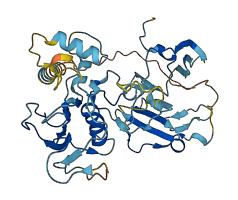
Descriptions
The autoinhibited protein was predicted that may have potential autoinhibitory elements via cis-regPred.
Autoinhibitory domains (AIDs)
Target domain |
|
Relief mechanism |
|
Assay |
cis-regPred |
Accessory elements
No accessory elements
Autoinhibited structure

Activated structure
1 structures for Q11133
| Entry ID | Method | Resolution | Chain | Position | Source |
|---|---|---|---|---|---|
| AF-Q11133-F1 | Predicted | AlphaFoldDB |
No variants for Q11133
| Variant ID(s) | Position | Change | Description | Diseaes Association | Provenance |
|---|---|---|---|---|---|
| No variants for Q11133 | |||||
No associated diseases with Q11133
1 regional properties for Q11133
| Type | Name | Position | InterPro Accession |
|---|---|---|---|
| conserved_site | Eukaryotic translation initiation factor 4E (eIF-4E), conserved site | 110 - 133 | IPR019770 |
Functions
| Description | ||
|---|---|---|
| EC Number | 3.4.24.7 | Metalloendopeptidases |
| Subcellular Localization |
|
|
| PANTHER Family | ||
| PANTHER Subfamily | ||
| PANTHER Protein Class | ||
| PANTHER Pathway Category | No pathway information available | |
2 GO annotations of cellular component
| Name | Definition |
|---|---|
| extracellular matrix | A structure lying external to one or more cells, which provides structural support, biochemical or biomechanical cues for cells or tissues. |
| extracellular region | The space external to the outermost structure of a cell. For cells without external protective or external encapsulating structures this refers to space outside of the plasma membrane. This term covers the host cell environment outside an intracellular parasite. |
3 GO annotations of molecular function
| Name | Definition |
|---|---|
| metalloendopeptidase activity | Catalysis of the hydrolysis of internal, alpha-peptide bonds in a polypeptide chain by a mechanism in which water acts as a nucleophile, one or two metal ions hold the water molecule in place, and charged amino acid side chains are ligands for the metal ions. |
| serine-type endopeptidase activity | Catalysis of the hydrolysis of internal, alpha-peptide bonds in a polypeptide chain by a catalytic mechanism that involves a catalytic triad consisting of a serine nucleophile that is activated by a proton relay involving an acidic residue (e.g. aspartate or glutamate) and a basic residue (usually histidine). |
| zinc ion binding | Binding to a zinc ion (Zn). |
2 GO annotations of biological process
| Name | Definition |
|---|---|
| collagen catabolic process | The proteolytic chemical reactions and pathways resulting in the breakdown of collagen in the extracellular matrix, usually carried out by proteases secreted by nearby cells. |
| proteolysis | The hydrolysis of proteins into smaller polypeptides and/or amino acids by cleavage of their peptide bonds. |
No homologous proteins in AiPD
| UniProt AC | Gene Name | Protein Name | Species | Evidence Code |
|---|---|---|---|---|
| No homologous proteins | ||||
| 10 | 20 | 30 | 40 | 50 | 60 |
| MLSGLWSSIL | ALLGVFLQSV | GEFRAETQEQ | DVEIVQKYLK | NYYNSDKRNS | GLVVEILKQF |
| 70 | 80 | 90 | 100 | 110 | 120 |
| FGLKVTGKPD | AETLVMKQST | CGVPDVGEYV | LTPGNPRWEN | THLTYRIENY | TPDLVSPLTF |
| 130 | 140 | 150 | 160 | 170 | 180 |
| TKVSEGQADI | MISFVRGDHR | DKYPFDGPGG | NLAHASQPGP | GIGGDAHFDE | YERWTKNFQD |
| 190 | 200 | 210 | 220 | 230 | 240 |
| YNLYRVAAHE | LGHSLGLSHS | TDIGALMYPT | YLRGDVQLSQ | DDIDGPSGNP | VQPRGPQTPQ |
| 250 | 260 | 270 | 280 | 290 | 300 |
| VCDSKLTFDA | ITTVRGELMF | FKMRTNRFYP | EVELGLQAAY | EMADRDEVRF | FKGNKYWAVS |
| 310 | 320 | 330 | 340 | 350 | 360 |
| GQDVLYGYPK | DIHSSFGFPT | GVAHECWSYD | EYKQSMDTGY | ADEFPGDAVF | QKFFHGTRQY |
| 370 | 380 | ||||
| QFDLKTKRIL | TLQKANSWFN | CRKN |