Descriptions
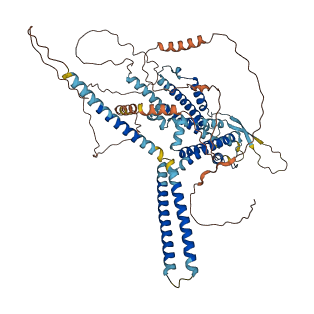
The autoinhibited protein was predicted that may have potential autoinhibitory elements via cis-regPred.
Autoinhibitory domains (AIDs)
Target domain |
|
Relief mechanism |
|
Assay |
cis-regPred |
Accessory elements
No accessory elements
Autoinhibited structure

Activated structure
1 structures for Q11122
| Entry ID | Method | Resolution | Chain | Position | Source |
|---|---|---|---|---|---|
| AF-Q11122-F1 | Predicted | AlphaFoldDB |
No variants for Q11122
| Variant ID(s) | Position | Change | Description | Diseaes Association | Provenance |
|---|---|---|---|---|---|
| No variants for Q11122 | |||||
No associated diseases with Q11122
4 GO annotations of cellular component
| Name | Definition |
|---|---|
| integral component of membrane | The component of a membrane consisting of the gene products and protein complexes having at least some part of their peptide sequence embedded in the hydrophobic region of the membrane. |
| neuron projection | A prolongation or process extending from a nerve cell, e.g. an axon or dendrite. |
| neuronal cell body | The portion of a neuron that includes the nucleus, but excludes cell projections such as axons and dendrites. |
| plasma membrane | The membrane surrounding a cell that separates the cell from its external environment. It consists of a phospholipid bilayer and associated proteins. |
2 GO annotations of molecular function
| Name | Definition |
|---|---|
| calmodulin binding | Binding to calmodulin, a calcium-binding protein with many roles, both in the calcium-bound and calcium-free states. |
| small conductance calcium-activated potassium channel activity | Enables the transmembrane transfer of potassium by a channel with a unit conductance of 2 to 20 picoSiemens that opens in response to stimulus by internal calcium ions. Small conductance calcium-activated potassium channels are more sensitive to calcium than are large conductance calcium-activated potassium channels. Transport by a channel involves catalysis of facilitated diffusion of a solute (by an energy-independent process) involving passage through a transmembrane aqueous pore or channel, without evidence for a carrier-mediated mechanism. |
2 GO annotations of biological process
| Name | Definition |
|---|---|
| ion transport | The directed movement of charged atoms or small charged molecules into, out of or within a cell, or between cells, by means of some agent such as a transporter or pore. |
| potassium ion transmembrane transport | A process in which a potassium ion is transported from one side of a membrane to the other. |
No homologous proteins in AiPD
| UniProt AC | Gene Name | Protein Name | Species | Evidence Code |
|---|---|---|---|---|
| No homologous proteins | ||||
| 10 | 20 | 30 | 40 | 50 | 60 |
| MERPNSRLHC | HPETHTYKCT | VQPYFPLHTH | ATTVYGNVTK | HRPSLGTLQA | GDTLHARRFL |
| 70 | 80 | 90 | 100 | 110 | 120 |
| SDKRRSYRNR | SLGPTIASAP | SVEQEDYRTP | RPSFDSNGYV | GKSFDFSSAQ | HGLTASESNA |
| 130 | 140 | 150 | 160 | 170 | 180 |
| LVKVSADFLR | LNGSRQQFKN | LLSARKKLGS | LPPAYTRIDY | SRESLDSHSA | RGIPNHHGPV |
| 190 | 200 | 210 | 220 | 230 | 240 |
| ITVEDTGSQL | RINNIKPSVN | QHLLESSCSF | EKTMVTQCES | NGSVTSHNTS | SAFQRNNSRY |
| 250 | 260 | 270 | 280 | 290 | 300 |
| GVPIDSTAVK | QVYRVRSERL | TNRVRITDRS | LYLALFGVIL | MLVESEITAE | KFYGVSKTHW |
| 310 | 320 | 330 | 340 | 350 | 360 |
| ISQSLRVGVT | CSTIALLYHI | ILYHLNDIVL | ELVDCGADDW | RVVVTTERVI | QFCIEFICCG |
| 370 | 380 | 390 | 400 | 410 | 420 |
| ICPLPGSGEM | KWTFIEPSLH | KDGPSEERTV | QTRNVDVPVD | VILSCFMLCR | SYLFARFMVL |
| 430 | 440 | 450 | 460 | 470 | 480 |
| HSKQFQDAST | RTLAALNRIQ | VNFSFVIKTS | LDQQPVLFLT | TFTFIFWIIM | SWMFVQCERY |
| 490 | 500 | 510 | 520 | 530 | 540 |
| GFSGKNPQSI | LYSNSLWFIA | ITFMLNGYGD | IVPQTNAGRF | IAIFVGVVGA | VISSILIAVI |
| 550 | 560 | 570 | 580 | 590 | 600 |
| SRNILLSQGQ | RNVNNFMYDS | KLAREHKEAA | ARVLQHTWHI | HKCLQGSDGG | NRRLRTYQRK |
| 610 | 620 | 630 | 640 | 650 | 660 |
| FLKAIHKFRS | VKSEMREFSE | NNSQNNPQMT | RLVTDMHTSM | QRLLNVQDEM | RMQIEVLQQS |
| 670 | 680 | 690 | |||
| VRNHYMHSTP | NVPHLQGLTS | SPVPSDRYDN | RF |