Q10Y85
Gene name |
rimO |
Protein name |
Ribosomal protein S12 methylthiotransferase RimO |
Names |
S12 MTTase, S12 methylthiotransferase, Ribosomal protein S12 (aspartate-C(3))-methylthiotransferase, Ribosome maturation factor RimO |
Species |
Trichodesmium erythraeum (strain IMS101) |
KEGG Pathway |
ter:Tery_3733 |
EC number |
2.8.4.4: Transferring alkylthio groups |
Protein Class |
|
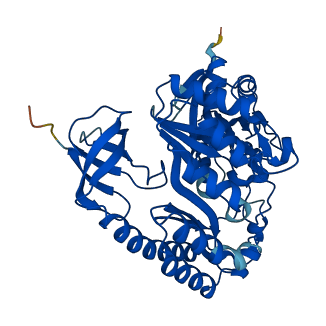
Descriptions
The autoinhibited protein was predicted that may have potential autoinhibitory elements via cis-regPred.
Autoinhibitory domains (AIDs)
Target domain |
|
Relief mechanism |
|
Assay |
cis-regPred |
Accessory elements
No accessory elements
Autoinhibited structure

Activated structure
1 structures for Q10Y85
| Entry ID | Method | Resolution | Chain | Position | Source |
|---|---|---|---|---|---|
| AF-Q10Y85-F1 | Predicted | AlphaFoldDB |
No variants for Q10Y85
| Variant ID(s) | Position | Change | Description | Diseaes Association | Provenance |
|---|---|---|---|---|---|
| No variants for Q10Y85 | |||||
No associated diseases with Q10Y85
6 regional properties for Q10Y85
| Type | Name | Position | InterPro Accession |
|---|---|---|---|
| domain | TRAM domain | 372 - 438 | IPR002792 |
| domain | Elp3/MiaA/NifB-like, radical SAM core domain | 144 - 361 | IPR006638 |
| domain | Radical SAM | 140 - 370 | IPR007197 |
| domain | Methylthiotransferase, N-terminal | 5 - 116 | IPR013848 |
| conserved_site | Methylthiotransferase, conserved site | 148 - 168 | IPR020612 |
| domain | RimO, TRAM domain | 375 - 437 | IPR041582 |
Functions
| Description | ||
|---|---|---|
| EC Number | 2.8.4.4 | Transferring alkylthio groups |
| Subcellular Localization |
|
|
| PANTHER Family | ||
| PANTHER Subfamily | ||
| PANTHER Protein Class | ||
| PANTHER Pathway Category | No pathway information available | |
1 GO annotations of cellular component
| Name | Definition |
|---|---|
| cytoplasm | The contents of a cell excluding the plasma membrane and nucleus, but including other subcellular structures. |
3 GO annotations of molecular function
| Name | Definition |
|---|---|
| 4 iron, 4 sulfur cluster binding | Binding to a 4 iron, 4 sulfur (4Fe-4S) cluster; this cluster consists of four iron atoms, with the inorganic sulfur atoms found between the irons and acting as bridging ligands. |
| metal ion binding | Binding to a metal ion. |
| protein methylthiotransferase activity | Catalysis of the reaction: 2 S-adenosyl-L-methionine + a |
2 GO annotations of biological process
| Name | Definition |
|---|---|
| peptidyl-L-beta-methylthioaspartic acid biosynthetic process from peptidyl-aspartic acid | The modification of peptidyl-aspartic acid to form peptidyl-L-beta-methylthioaspartic acid, typical of bacterial ribosomal protein S12. |
| tRNA modification | The covalent alteration of one or more nucleotides within a tRNA molecule to produce a tRNA molecule with a sequence that differs from that coded genetically. |
No homologous proteins in AiPD
| UniProt AC | Gene Name | Protein Name | Species | Evidence Code |
|---|---|---|---|---|
| No homologous proteins | ||||
| 10 | 20 | 30 | 40 | 50 | 60 |
| MSTKPTIAFT | HLGCEKNRID | TEHIIGLLVQ | AGYEVDANEE | LADYVVVNTC | SFIQAAREES |
| 70 | 80 | 90 | 100 | 110 | 120 |
| VKTLVELAEA | NKKIVIAGCM | AQHFPEELLA | ELPEAIALVG | TGDYHKIVDV | MQRVEKGDRV |
| 130 | 140 | 150 | 160 | 170 | 180 |
| KEVTAEPTYI | ADETTPRYRT | TSEGVAYVRI | AEGCDYRCAF | CIIPHLRGKA | RSRTIESIVV |
| 190 | 200 | 210 | 220 | 230 | 240 |
| EAQKLADQGV | KEIILISQIT | TNYGIDIYGQ | PKLADLLEAL | GKVDIPWIRM | HYAYPTGLTP |
| 250 | 260 | 270 | 280 | 290 | 300 |
| KVITAIQDTP | NILPYLDLPL | QHSHPEILRA | MNRPWQGQVN | DDIIKRIKTA | MPNAVLRTSF |
| 310 | 320 | 330 | 340 | 350 | 360 |
| IVGFPGETEE | HHSHLVEFVK | RHEFDHVGVF | TFSPEEGTPA | YNLPNQLPQE | VMDARRQEIM |
| 370 | 380 | 390 | 400 | 410 | 420 |
| EVQQSISWQQ | NQKLVGQLVD | VLIEQENPQT | GELIGRSPRF | SPEVDGLIYV | KGEARLGCIV |
| 430 | 440 | ||||
| PVMITDADIY | DLYGCLISSA | A |