Q10VG2
Gene name |
ndhH |
Protein name |
NAD(P)H-quinone oxidoreductase subunit H |
Names |
NAD(P)H dehydrogenase subunit H, NADH-plastoquinone oxidoreductase subunit H, NDH-1 subunit H, NDH-H |
Species |
Trichodesmium erythraeum (strain IMS101) |
KEGG Pathway |
ter:Tery_4815 |
EC number |
|
Protein Class |
|
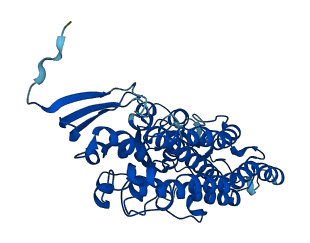
Descriptions
The autoinhibited protein was predicted that may have potential autoinhibitory elements via cis-regPred.
Autoinhibitory domains (AIDs)
Target domain |
|
Relief mechanism |
|
Assay |
cis-regPred |
Accessory elements
No accessory elements
Autoinhibited structure

Activated structure
1 structures for Q10VG2
| Entry ID | Method | Resolution | Chain | Position | Source |
|---|---|---|---|---|---|
| AF-Q10VG2-F1 | Predicted | AlphaFoldDB |
No variants for Q10VG2
| Variant ID(s) | Position | Change | Description | Diseaes Association | Provenance |
|---|---|---|---|---|---|
| No variants for Q10VG2 | |||||
No associated diseases with Q10VG2
1 GO annotations of cellular component
| Name | Definition |
|---|---|
| plasma membrane-derived thylakoid membrane | The pigmented membrane of a plasma membrane-derived thylakoid. |
3 GO annotations of molecular function
| Name | Definition |
|---|---|
| NAD binding | Binding to nicotinamide adenine dinucleotide, a coenzyme involved in many redox and biosynthetic reactions; binding may be to either the oxidized form, NAD+, or the reduced form, NADH. |
| oxidoreductase activity, acting on NAD(P)H, quinone or similar compound as acceptor | Catalysis of an oxidation-reduction (redox) reaction in which NADH or NADPH acts as a hydrogen or electron donor and reduces a quinone or a similar acceptor molecule. |
| quinone binding | Binding to a quinone, any member of a class of diketones derivable from aromatic compounds by conversion of two CH groups into CO groups with any necessary rearrangement of double bonds. |
1 GO annotations of biological process
| Name | Definition |
|---|---|
| photosynthesis, light reaction | The light reactions of photosynthesis, which take place in photosystems II and I. Light energy is harvested and used to power the transfer of electrons among a series of electron donors and acceptors. The final electron acceptor is NADP+, which is reduced to NADPH. NADPH generated from light reactions is used in sugar synthesis in dark reactions. Light reactions also generate a proton motive force across the thylakoid membrane, and the proton gradient is used to synthesize ATP. There are two chemical reactions involved in the light reactions: water oxidation in photosystem II, and NADP reduction in photosystem I. |
No homologous proteins in AiPD
| UniProt AC | Gene Name | Protein Name | Species | Evidence Code |
|---|---|---|---|---|
| No homologous proteins | ||||
| 10 | 20 | 30 | 40 | 50 | 60 |
| MSQIQTRTEP | MVINMGPHHP | SMHGVLRLIV | TLDGEDVIDC | EPVIGYLHRG | MEKIAENRTN |
| 70 | 80 | 90 | 100 | 110 | 120 |
| TMFVPYVSRW | DYAAGMFNEA | VTVNAPEQLA | DIAVPKRASY | IRVIMLELNR | IANHLLWLGP |
| 130 | 140 | 150 | 160 | 170 | 180 |
| FLADVGAQTP | FFYIFREREM | IYDLWEAATG | YRMVNNNYFR | IGGVAADLPY | GWVDKCEDFC |
| 190 | 200 | 210 | 220 | 230 | 240 |
| DYFLPKVDEY | ERLITNNPIF | RRRIMGLGVI | SREEAINWGL | SGPMLRASGV | KWDLRKVDHY |
| 250 | 260 | 270 | 280 | 290 | 300 |
| ECYDDFDWEV | HWEKDGDCLA | RYLVRIREMR | ESVNIIRQAI | KGLPGGPYEN | LEAKRMAEGP |
| 310 | 320 | 330 | 340 | 350 | 360 |
| KSEWNDFDYQ | FLGKKIPPTF | KIPKGEHYVR | IESGKGEIGI | YIIGDNNIFP | WRFKIRAADF |
| 370 | 380 | 390 | |||
| VNLQIFPHIL | QGAKVADLVA | ILGSIDIIMG | SVDR |