Q10292
Gene name |
mek1 (SPAC14C4.03) |
Protein name |
Meiosis-specific serine/threonine-protein kinase mek1 |
Names |
|
Species |
Schizosaccharomyces pombe (strain 972 / ATCC 24843) (Fission yeast) |
KEGG Pathway |
spo:SPAC14C4.03 |
EC number |
2.7.11.1: Protein-serine/threonine kinases |
Protein Class |
|
Descriptions
The autoinhibited protein was predicted that may have potential autoinhibitory elements via cis-regPred.
Autoinhibitory domains (AIDs)
Target domain |
|
Relief mechanism |
|
Assay |
cis-regPred |
Accessory elements
302-324 (Activation loop from InterPro)
Target domain |
160-421 (Protein kinase domain) |
Relief mechanism |
|
Assay |
|
Autoinhibited structure

Activated structure
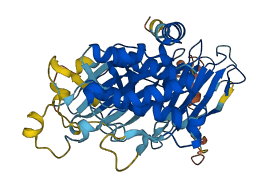
1 structures for Q10292
| Entry ID | Method | Resolution | Chain | Position | Source |
|---|---|---|---|---|---|
| AF-Q10292-F1 | Predicted | AlphaFoldDB |
6 variants for Q10292
| Variant ID(s) | Position | Change | Description | Diseaes Association | Provenance |
|---|---|---|---|---|---|
| I_5231219_G_A | 27 | S>N | No | Jeffares_SNPs | |
| I_5231464_G_A | 95 | M>I | No | Jeffares_SNPs | |
| I_5231712_T_C | 178 | M>T | No | Jeffares_SNPs | |
| I_5232235_G_A | 336 | R>K | No | Jeffares_SNPs | |
| I_5232342_G_A | 372 | A>T | No | Jeffares_SNPs | |
| I_5232508_G_A | 427 | R>H | No | Jeffares_SNPs |
No associated diseases with Q10292
4 regional properties for Q10292
Functions
| Description | ||
|---|---|---|
| EC Number | 2.7.11.1 | Protein-serine/threonine kinases |
| Subcellular Localization |
|
|
| PANTHER Family | ||
| PANTHER Subfamily | ||
| PANTHER Protein Class | ||
| PANTHER Pathway Category | No pathway information available | |
4 GO annotations of cellular component
| Name | Definition |
|---|---|
| cytoplasm | The contents of a cell excluding the plasma membrane and nucleus, but including other subcellular structures. |
| cytosol | The part of the cytoplasm that does not contain organelles but which does contain other particulate matter, such as protein complexes. |
| linear element | A proteinaceous scaffold associated with fission yeast chromosomes during meiotic prophase. Linear elements consist of a protein complex, LinE, with four main structural components (Rec10, Rec25, Rec27, and Mug20 in S. pombe) associated with chromatin. The resulting structure is related to but not equivalent to the synaptonemal complex. |
| nucleus | A membrane-bounded organelle of eukaryotic cells in which chromosomes are housed and replicated. In most cells, the nucleus contains all of the cell's chromosomes except the organellar chromosomes, and is the site of RNA synthesis and processing. In some species, or in specialized cell types, RNA metabolism or DNA replication may be absent. |
3 GO annotations of molecular function
| Name | Definition |
|---|---|
| ATP binding | Binding to ATP, adenosine 5'-triphosphate, a universally important coenzyme and enzyme regulator. |
| protein serine kinase activity | Catalysis of the reactions: ATP + protein serine = ADP + protein serine phosphate. |
| protein serine/threonine kinase activity | Catalysis of the reactions: ATP + protein serine = ADP + protein serine phosphate, and ATP + protein threonine = ADP + protein threonine phosphate. |
5 GO annotations of biological process
| Name | Definition |
|---|---|
| meiotic recombination checkpoint signaling | A signaling process that contributes to a meiotic recombination checkpoint, that acts during late prophase I (pachytene) and prevents segregation of homologous chromosomes until recombination is completed, ensuring proper distribution of the genetic material to the gametes. |
| positive regulation of initiation of premeiotic DNA replication | Any process that activates or increases the frequency, rate or extent of initiation of premeiotic DNA replication. |
| positive regulation of reciprocal meiotic recombination | Any process that increases the frequency, rate or extent of recombination during meiosis. Reciprocal meiotic recombination is the cell cycle process in which double strand breaks are formed and repaired through a double Holliday junction intermediate. |
| protein phosphorylation | The process of introducing a phosphate group on to a protein. |
| reciprocal meiotic recombination | The cell cycle process in which double strand breaks are formed and repaired through a single or double Holliday junction intermediate. This results in the equal exchange of genetic material between non-sister chromatids in a pair of homologous chromosomes. These reciprocal recombinant products ensure the proper segregation of homologous chromosomes during meiosis I and create genetic diversity. |
No homologous proteins in AiPD
| UniProt AC | Gene Name | Protein Name | Species | Evidence Code |
|---|---|---|---|---|
| No homologous proteins | ||||
| 10 | 20 | 30 | 40 | 50 | 60 |
| MDFLSHAMLS | RSESTQILCE | LSQIDESTMD | PQYTEDDVLA | RLFVFSSSSP | QTVLNVKKYE |
| 70 | 80 | 90 | 100 | 110 | 120 |
| DVSVGRSNTC | NYQLLQFTAS | YKHFRVYSVL | IDDDMDPLVY | CEDQSSNGTF | LNHRLIGKGN |
| 130 | 140 | 150 | 160 | 170 | 180 |
| SVLLSDGDIL | DVRHCASFLF | QQKYTTDNDF | HHEYAGERFN | ITQRLLGIGG | FSRIYMAMDN |
| 190 | 200 | 210 | 220 | 230 | 240 |
| NTGGQYACKI | IDKKKISTKR | FFEDHEMTIL | RKLDHPNIIK | VNMEYNSETQ | FFIFEEMVTG |
| 250 | 260 | 270 | 280 | 290 | 300 |
| GDLFSYLTKL | GTVPEVTTLF | IMFQILQGLK | YLHEQNIIHR | DLKLENILIA | SSSDTIFRII |
| 310 | 320 | 330 | 340 | 350 | 360 |
| LTDFGVARCM | QKGKRLSTFV | GTPEYTAPEI | QRLKGRSQVE | KENSSGYGKE | VDLWSLGVIM |
| 370 | 380 | 390 | 400 | 410 | 420 |
| FLLLSGNSPS | FADGVKEKQV | DFRDPVWKSV | SRQAKDLISN | LLKTNPPDRF | TVKQCLSHPW |
| 430 | 440 | ||||
| FARHSSRLTK | LYETRILKPL | KHSRL |