Q10267
Gene name |
upf3 (SPAC13G7.03) |
Protein name |
Nonsense-mediated mRNA decay protein 3 |
Names |
Up-frameshift suppressor 3 |
Species |
Schizosaccharomyces pombe (strain 972 / ATCC 24843) (Fission yeast) |
KEGG Pathway |
spo:SPAC13G7.03 |
EC number |
|
Protein Class |
|
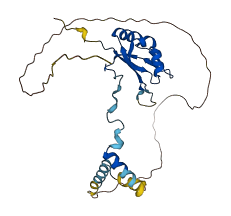
Descriptions
The autoinhibited protein was predicted that may have potential autoinhibitory elements via cis-regPred.
Autoinhibitory domains (AIDs)
Target domain |
|
Relief mechanism |
|
Assay |
cis-regPred |
Accessory elements
No accessory elements
Autoinhibited structure

Activated structure
1 structures for Q10267
| Entry ID | Method | Resolution | Chain | Position | Source |
|---|---|---|---|---|---|
| AF-Q10267-F1 | Predicted | AlphaFoldDB |
7 variants for Q10267
| Variant ID(s) | Position | Change | Description | Diseaes Association | Provenance |
|---|---|---|---|---|---|
| I_2299124_C_T | 49 | A>V | No | Jeffares_SNPs | |
| I_2299132_G_A | 52 | G>S | No | Jeffares_SNPs | |
| I_2299593_C_T | 169 | S>L | No | Jeffares_SNPs | |
| I_2299701_C_T | 205 | S>F | No | Jeffares_SNPs | |
| I_2299791_C_A | 235 | T>N | No | Jeffares_SNPs | |
| I_2299856_A_T | 257 | K>* | No | Jeffares_SNPs | |
| I_2299907_A_C | 274 | T>P | No | Jeffares_SNPs |
No associated diseases with Q10267
1 regional properties for Q10267
| Type | Name | Position | InterPro Accession |
|---|---|---|---|
| domain | UPF3 domain | 12 - 160 | IPR005120 |
2 GO annotations of cellular component
| Name | Definition |
|---|---|
| cytoplasm | The contents of a cell excluding the plasma membrane and nucleus, but including other subcellular structures. |
| nucleolus | A small, dense body one or more of which are present in the nucleus of eukaryotic cells. It is rich in RNA and protein, is not bounded by a limiting membrane, and is not seen during mitosis. Its prime function is the transcription of the nucleolar DNA into 45S ribosomal-precursor RNA, the processing of this RNA into 5.8S, 18S, and 28S components of ribosomal RNA, and the association of these components with 5S RNA and proteins synthesized outside the nucleolus. This association results in the formation of ribonucleoprotein precursors; these pass into the cytoplasm and mature into the 40S and 60S subunits of the ribosome. |
1 GO annotations of molecular function
| Name | Definition |
|---|---|
| mRNA binding | Binding to messenger RNA (mRNA), an intermediate molecule between DNA and protein. mRNA includes UTR and coding sequences, but does not contain introns. |
3 GO annotations of biological process
| Name | Definition |
|---|---|
| nuclear-transcribed mRNA catabolic process, 3'-5' exonucleolytic nonsense-mediated decay | The chemical reactions and pathways resulting in the breakdown of the nuclear-transcribed mRNA transcript body of an mRNA in which an amino-acid codon has changed to a nonsense codon; occurs when the 3' end is not protected by a 3'-poly(A) tail; degradation proceeds in the 3' to 5' direction. |
| nuclear-transcribed mRNA catabolic process, nonsense-mediated decay | The nonsense-mediated decay pathway for nuclear-transcribed mRNAs degrades mRNAs in which an amino-acid codon has changed to a nonsense codon; this prevents the translation of such mRNAs into truncated, and potentially harmful, proteins. |
| positive regulation of translation | Any process that activates or increases the frequency, rate or extent of the chemical reactions and pathways resulting in the formation of proteins by the translation of mRNA or circRNA. |
No homologous proteins in AiPD
| UniProt AC | Gene Name | Protein Name | Species | Evidence Code |
|---|---|---|---|---|
| No homologous proteins | ||||
| 10 | 20 | 30 | 40 | 50 | 60 |
| MAPDISKKRL | PCKVLVFNLP | PTLPEQVFLQ | SINSFLPHVE | WHRFSKGKAT | VGTRSELLSF |
| 70 | 80 | 90 | 100 | 110 | 120 |
| AYLKFQSATA | VQEFFRVYQG | HTFIDKKNNT | YRAIVTIAPY | QKIPPSKVKA | DSLEGSLEQD |
| 130 | 140 | 150 | 160 | 170 | 180 |
| PKFQEFKVQR | ESYSQTASND | DVIEKLQTST | PLLQYLAEKK | NAVVEKGKSK | PSKKSVKAKK |
| 190 | 200 | 210 | 220 | 230 | 240 |
| KLRLAEKPAS | NNSKAGKSSQ | ESKKSSKAPA | ESAAAVIKED | KVSDRKKSKK | KPKKTPVSNS |
| 250 | 260 | 270 | |||
| TASQASENAS | DKKTKEKKSS | GKQKIASKKK | DQLTTDNV |