Q10107
Gene name |
mra1 |
Protein name |
Ribosomal RNA small subunit methyltransferase mra1 |
Names |
18S rRNA (pseudouridine-N1)-methyltransferase, Multicopy suppressor of ras1-deficiency protein |
Species |
Schizosaccharomyces pombe (strain 972 / ATCC 24843) (Fission yeast) |
KEGG Pathway |
spo:SPAC18G6.07c |
EC number |
|
Protein Class |
|
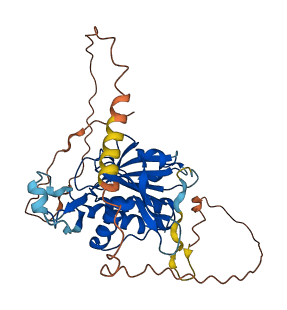
Descriptions
The autoinhibited protein was predicted that may have potential autoinhibitory elements via cis-regPred.
Autoinhibitory domains (AIDs)
Target domain |
|
Relief mechanism |
|
Assay |
cis-regPred |
Accessory elements
No accessory elements
Autoinhibited structure

Activated structure
1 structures for Q10107
| Entry ID | Method | Resolution | Chain | Position | Source |
|---|---|---|---|---|---|
| AF-Q10107-F1 | Predicted | AlphaFoldDB |
4 variants for Q10107
| Variant ID(s) | Position | Change | Description | Diseaes Association | Provenance |
|---|---|---|---|---|---|
| I_2231274_C_T | 47 | E>K | No | Jeffares_SNPs | |
| I_2231165_A_G | 83 | I>T | No | Jeffares_SNPs | |
| I_2231132_A_G | 94 | I>T | No | Jeffares_SNPs | |
| I_2231127_T_C | 96 | N>D | No | Jeffares_SNPs |
No associated diseases with Q10107
No regional properties for Q10107
| Type | Name | Position | InterPro Accession |
|---|---|---|---|
| No domain, repeats, and functional sites for Q10107 | |||
4 GO annotations of cellular component
| Name | Definition |
|---|---|
| cytosol | The part of the cytoplasm that does not contain organelles but which does contain other particulate matter, such as protein complexes. |
| nucleolus | A small, dense body one or more of which are present in the nucleus of eukaryotic cells. It is rich in RNA and protein, is not bounded by a limiting membrane, and is not seen during mitosis. Its prime function is the transcription of the nucleolar DNA into 45S ribosomal-precursor RNA, the processing of this RNA into 5.8S, 18S, and 28S components of ribosomal RNA, and the association of these components with 5S RNA and proteins synthesized outside the nucleolus. This association results in the formation of ribonucleoprotein precursors; these pass into the cytoplasm and mature into the 40S and 60S subunits of the ribosome. |
| nucleus | A membrane-bounded organelle of eukaryotic cells in which chromosomes are housed and replicated. In most cells, the nucleus contains all of the cell's chromosomes except the organellar chromosomes, and is the site of RNA synthesis and processing. In some species, or in specialized cell types, RNA metabolism or DNA replication may be absent. |
| small-subunit processome | A large ribonucleoprotein complex that is an early preribosomal complex. In S. cerevisiae, it has a size of 80S and consists of the 35S pre-rRNA, early-associating ribosomal proteins most of which are part of the small ribosomal subunit, the U3 snoRNA and associated proteins. |
2 GO annotations of molecular function
| Name | Definition |
|---|---|
| rRNA (pseudouridine) methyltransferase activity | Catalysis of the transfer of a methyl group from S-adenosyl-L-methionine to a pseudouridine residue in an rRNA molecule. |
| rRNA binding | Binding to a ribosomal RNA. |
2 GO annotations of biological process
| Name | Definition |
|---|---|
| response to pheromone | Any process that results in a change in state or activity of a cell or an organism (in terms of movement, secretion, enzyme production, gene expression, etc.) as a result of a pheromone stimulus. |
| rRNA base methylation | The addition of a methyl group to an atom in the nucleoside base portion of a nucleotide residue in an rRNA molecule. |
No homologous proteins in AiPD
| UniProt AC | Gene Name | Protein Name | Species | Evidence Code |
|---|---|---|---|---|
| No homologous proteins | ||||
| 10 | 20 | 30 | 40 | 50 | 60 |
| MPTYSKRKSR | GSLEVSEKTN | QPKFIKRSQS | SETITSGETA | SELMQDEKEQ | SNGAVGSIED |
| 70 | 80 | 90 | 100 | 110 | 120 |
| EELQRLRENQ | ASVEALSKKP | ESIDRELGVE | ALEIDNVVKS | DEEKEDPNGA | SSKTVKARPL |
| 130 | 140 | 150 | 160 | 170 | 180 |
| PAGSVHRVTT | HMAPIPARSI | GSHDTTTQRL | IVVLDQACLE | IYKVGKAKDA | KYQLLNCDDH |
| 190 | 200 | 210 | 220 | 230 | 240 |
| QGILKKLNRN | IAQARPDITH | QCLLTLLDSP | LNKAGRLQVY | IHTAKKVLIE | VNPSVRIPRT |
| 250 | 260 | 270 | 280 | 290 | 300 |
| FKRFSGLMVQ | LLHKLSIRSV | NGNEKLLKVI | KNPVTDYLPP | NCRKATLSFD | APTVPPRKYL |
| 310 | 320 | 330 | 340 | 350 | |
| ETLQPNQSVC | IAIGAMAHGP | DDFSDGWVDE | KISISDYPLS | ASIACSKFLH | SMEDFLGIV |