Q10078
Gene name |
ppk13 (SPAC3H1.13) |
Protein name |
Serine/threonine-protein kinase ppk13 |
Names |
|
Species |
Schizosaccharomyces pombe (strain 972 / ATCC 24843) (Fission yeast) |
KEGG Pathway |
spo:SPAC3H1.13 |
EC number |
2.7.11.1: Protein-serine/threonine kinases |
Protein Class |
|
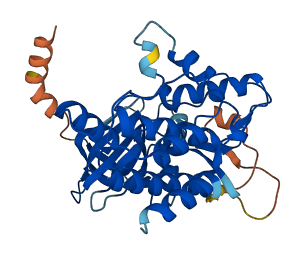
Descriptions
The autoinhibited protein was predicted that may have potential autoinhibitory elements via cis-regPred.
Autoinhibitory domains (AIDs)
Target domain |
|
Relief mechanism |
|
Assay |
cis-regPred |
Accessory elements
212-244 (Activation loop from InterPro)
Target domain |
32-344 (Protein kinase domain) |
Relief mechanism |
|
Assay |
|
Autoinhibited structure

Activated structure
1 structures for Q10078
| Entry ID | Method | Resolution | Chain | Position | Source |
|---|---|---|---|---|---|
| AF-Q10078-F1 | Predicted | AlphaFoldDB |
4 variants for Q10078
| Variant ID(s) | Position | Change | Description | Diseaes Association | Provenance |
|---|---|---|---|---|---|
| I_1965191_A_G | 7 | N>D | No | Jeffares_SNPs | |
| I_1965449_G_A | 80 | D>N | No | Jeffares_SNPs | |
| I_1965488_A_T | 93 | S>C | No | Jeffares_SNPs | |
| I_1965859_C_T | 203 | H>Y | No | Jeffares_SNPs |
No associated diseases with Q10078
Functions
| Description | ||
|---|---|---|
| EC Number | 2.7.11.1 | Protein-serine/threonine kinases |
| Subcellular Localization |
|
|
| PANTHER Family | ||
| PANTHER Subfamily | ||
| PANTHER Protein Class | ||
| PANTHER Pathway Category | No pathway information available | |
4 GO annotations of cellular component
| Name | Definition |
|---|---|
| cytoplasm | The contents of a cell excluding the plasma membrane and nucleus, but including other subcellular structures. |
| endoplasmic reticulum | The irregular network of unit membranes, visible only by electron microscopy, that occurs in the cytoplasm of many eukaryotic cells. The membranes form a complex meshwork of tubular channels, which are often expanded into slitlike cavities called cisternae. The ER takes two forms, rough (or granular), with ribosomes adhering to the outer surface, and smooth (with no ribosomes attached). |
| Golgi apparatus | A membrane-bound cytoplasmic organelle of the endomembrane system that further processes the core oligosaccharides (e.g. N-glycans) added to proteins in the endoplasmic reticulum and packages them into membrane-bound vesicles. The Golgi apparatus operates at the intersection of the secretory, lysosomal, and endocytic pathways. |
| vacuole | A closed structure, found only in eukaryotic cells, that is completely surrounded by unit membrane and contains liquid material. Cells contain one or several vacuoles, that may have different functions from each other. Vacuoles have a diverse array of functions. They can act as a storage organelle for nutrients or waste products, as a degradative compartment, as a cost-effective way of increasing cell size, and as a homeostatic regulator controlling both turgor pressure and pH of the cytosol. |
3 GO annotations of molecular function
| Name | Definition |
|---|---|
| ATP binding | Binding to ATP, adenosine 5'-triphosphate, a universally important coenzyme and enzyme regulator. |
| protein serine kinase activity | Catalysis of the reactions: ATP + protein serine = ADP + protein serine phosphate. |
| protein serine/threonine kinase activity | Catalysis of the reactions: ATP + protein serine = ADP + protein serine phosphate, and ATP + protein threonine = ADP + protein threonine phosphate. |
4 GO annotations of biological process
| Name | Definition |
|---|---|
| protein phosphorylation | The process of introducing a phosphate group on to a protein. |
| regulation of vacuole fusion, non-autophagic | Any process that modulates the frequency, rate or extent of the fusion of two vacuole membranes to form a single vacuole. |
| signaling | The entirety of a process in which information is transmitted within a biological system. This process begins with an active signal and ends when a cellular response has been triggered. |
| vacuolar protein processing | Protein processing that takes place in the vacuole. Most protein processing in the vacuole represents proteolytic cleavage of precursors to form active enzymes. |
No homologous proteins in AiPD
| UniProt AC | Gene Name | Protein Name | Species | Evidence Code |
|---|---|---|---|---|
| No homologous proteins | ||||
| 10 | 20 | 30 | 40 | 50 | 60 |
| MQNLWKNALD | TLSPYISNLF | DNDVVCINNE | RYRIQKLLGE | GGFAFVYLVQ | NVSNEKLYAL |
| 70 | 80 | 90 | 100 | 110 | 120 |
| KKIKCSFGNK | GIKKAMKEAD | YHRKFKSNYL | LKSYTHQLVK | EADGSEFVYI | LFPYFAKGSV |
| 130 | 140 | 150 | 160 | 170 | 180 |
| AQVIRNCDIE | GSYISEKRIL | VWCSCLCKAL | QYLHENVAGD | SPKQPEVNDL | IMFDEPQVPQ |
| 190 | 200 | 210 | 220 | 230 | 240 |
| NTSNNNLVSY | IHGDIKPDNL | LLHENSREIV | LTDFGSICLV | PIFASNNSEA | IAIQDKASEN |
| 250 | 260 | 270 | 280 | 290 | 300 |
| CTMPFRAPEL | FHVKAGSTIT | EKADIWSFGC | TLYTIMFHAS | PFEREVSQGG | SLALAVCNAQ |
| 310 | 320 | 330 | 340 | ||
| YSFPRKHPYS | TLLCEIVEAC | LQREPNKRPS | ARELLSKIDL | QINQ |