Q0VDU3
Gene name |
Gpr15 |
Protein name |
G-protein coupled receptor 15 |
Names |
|
Species |
Mus musculus (Mouse) |
KEGG Pathway |
mmu:71223 |
EC number |
|
Protein Class |
|
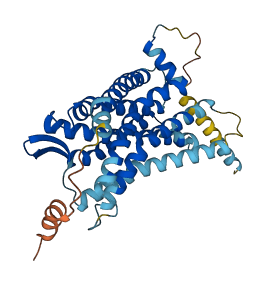
Descriptions
The autoinhibited protein was predicted that may have potential autoinhibitory elements via cis-regPred.
Autoinhibitory domains (AIDs)
Target domain |
|
Relief mechanism |
|
Assay |
cis-regPred |
Accessory elements
No accessory elements
Autoinhibited structure

Activated structure
1 structures for Q0VDU3
| Entry ID | Method | Resolution | Chain | Position | Source |
|---|---|---|---|---|---|
| AF-Q0VDU3-F1 | Predicted | AlphaFoldDB |
19 variants for Q0VDU3
| Variant ID(s) | Position | Change | Description | Diseaes Association | Provenance |
|---|---|---|---|---|---|
| rs4190659 | 22 | F>I | No | EVA | |
| rs3389419605 | 40 | Y>H | No | EVA | |
| rs49804614 | 49 | V>L | No | EVA | |
| rs46861384 | 56 | I>V | No | EVA | |
| rs3389419606 | 68 | I>F | No | EVA | |
| rs3389437997 | 72 | I>V | No | EVA | |
| rs3389418597 | 82 | F>L | No | EVA | |
| rs3389419616 | 103 | S>F | No | EVA | |
| rs3389401791 | 128 | S>C | No | EVA | |
| rs3389336920 | 134 | A>G | No | EVA | |
| rs248528197 | 147 | R>K | No | EVA | |
| rs223670699 | 156 | V>I | No | EVA | |
| rs3389401773 | 164 | L>R | No | EVA | |
| rs3389415629 | 206 | V>A | No | EVA | |
| rs3389401785 | 238 | K>R | No | EVA | |
| rs235081572 | 278 | E>D | No | EVA | |
| rs49394985 | 325 | N>D | No | EVA | |
| rs3389422769 | 326 | F>I | No | EVA | |
| rs51076043 | 330 | T>P | No | EVA |
No associated diseases with Q0VDU3
1 regional properties for Q0VDU3
| Type | Name | Position | InterPro Accession |
|---|---|---|---|
| domain | GPCR, rhodopsin-like, 7TM | 50 - 302 | IPR017452 |
4 GO annotations of cellular component
| Name | Definition |
|---|---|
| cytoplasm | The contents of a cell excluding the plasma membrane and nucleus, but including other subcellular structures. |
| endosome | A vacuole to which materials ingested by endocytosis are delivered. |
| integral component of membrane | The component of a membrane consisting of the gene products and protein complexes having at least some part of their peptide sequence embedded in the hydrophobic region of the membrane. |
| plasma membrane | The membrane surrounding a cell that separates the cell from its external environment. It consists of a phospholipid bilayer and associated proteins. |
3 GO annotations of molecular function
| Name | Definition |
|---|---|
| coreceptor activity | Combining with an extracellular or intracellular messenger, and in cooperation with a nearby primary receptor, initiating a change in cell activity. |
| G protein-coupled receptor activity | Combining with an extracellular signal and transmitting the signal across the membrane by activating an associated G-protein; promotes the exchange of GDP for GTP on the alpha subunit of a heterotrimeric G-protein complex. |
| virus receptor activity | Combining with a virus component and mediating entry of the virus into the cell. |
4 GO annotations of biological process
| Name | Definition |
|---|---|
| angiogenesis | Blood vessel formation when new vessels emerge from the proliferation of pre-existing blood vessels. |
| G protein-coupled receptor signaling pathway | The series of molecular signals initiated by a ligand binding to its receptor, in which the activated receptor promotes the exchange of GDP for GTP on the alpha-subunit of an associated heterotrimeric G-protein complex. The GTP-bound activated alpha-G-protein then dissociates from the beta- and gamma-subunits to further transmit the signal within the cell. The pathway begins with receptor-ligand interaction, and ends with regulation of a downstream cellular process. The pathway can start from the plasma membrane, Golgi or nuclear membrane. |
| T cell migration | The movement of a T cell within or between different tissues and organs of the body. |
| viral entry into host cell | The process that occurs after viral attachment by which a virus, or viral nucleic acid, breaches the plasma membrane or cell envelope and enters the host cell. The process ends when the viral nucleic acid is released into the host cell cytoplasm. |
| 10 | 20 | 30 | 40 | 50 | 60 |
| MEPATALLIV | DYYDYTSPDP | PFLETPSHLS | YTSVFLPIFY | TVVFLTGVVG | NFILMIALHF |
| 70 | 80 | 90 | 100 | 110 | 120 |
| KRGNRRLIDI | FIINLAASDF | IFLVTVPLWM | DKEASLGLWR | TGSFLCKGSS | YVISVNMHCS |
| 130 | 140 | 150 | 160 | 170 | 180 |
| VFLLTCMSMD | RYLAIMHPAL | AKRLRRRSSA | YAVCAVVWII | SCVLGLPTLL | SRELTHIEGK |
| 190 | 200 | 210 | 220 | 230 | 240 |
| PYCAEKKPTS | LKLMWGLVAL | ITTFFVPLLS | IVTCYCCITR | RLCAHYQQSG | KHNKKLKKSI |
| 250 | 260 | 270 | 280 | 290 | 300 |
| KIVIIAVAAF | TVSWVPFNTF | KLLAIVSGFQ | PEGLFHSEAL | QLAMNVTGPL | AFASSCVNPL |
| 310 | 320 | 330 | 340 | 350 | |
| IYYVFDSYIR | RAIVRCLCPC | LKTHNFGSST | ETSDSHLTKA | LSNFIHAEDF | IRRRKRSVSL |