Q0VA61
Gene name |
hyou1 |
Protein name |
Hypoxia up-regulated protein 1 |
Names |
|
Species |
Xenopus tropicalis (Western clawed frog) (Silurana tropicalis) |
KEGG Pathway |
xtr:779444 |
EC number |
|
Protein Class |
|
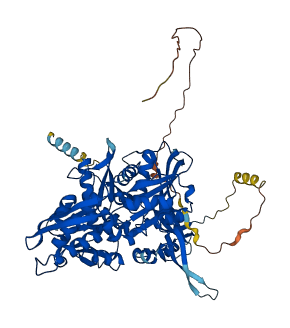
Descriptions
The autoinhibited protein was predicted that may have potential autoinhibitory elements via cis-regPred.
Autoinhibitory domains (AIDs)
Target domain |
|
Relief mechanism |
|
Assay |
cis-regPred |
Accessory elements
No accessory elements
Autoinhibited structure

Activated structure
1 structures for Q0VA61
| Entry ID | Method | Resolution | Chain | Position | Source |
|---|---|---|---|---|---|
| AF-Q0VA61-F1 | Predicted | AlphaFoldDB |
No variants for Q0VA61
| Variant ID(s) | Position | Change | Description | Diseaes Association | Provenance |
|---|---|---|---|---|---|
| No variants for Q0VA61 | |||||
No associated diseases with Q0VA61
1 regional properties for Q0VA61
| Type | Name | Position | InterPro Accession |
|---|---|---|---|
| conserved_site | Heat shock protein 70, conserved site | 368 - 382 | IPR018181 |
2 GO annotations of cellular component
| Name | Definition |
|---|---|
| endoplasmic reticulum chaperone complex | A protein complex that is located in the endoplasmic reticulum and is composed of chaperone proteins, including BiP, GRP94; CaBP1, protein disulfide isomerase (PDI), ERdj3, cyclophilin B, ERp72, GRP170, UDP-glucosyltransferase, and SDF2-L1. |
| endoplasmic reticulum lumen | The volume enclosed by the membranes of the endoplasmic reticulum. |
2 GO annotations of molecular function
| Name | Definition |
|---|---|
| ATP binding | Binding to ATP, adenosine 5'-triphosphate, a universally important coenzyme and enzyme regulator. |
| ATP-dependent protein folding chaperone | Binding to a protein or a protein-containing complex to assist the protein folding process, driven by ATP hydrolysis. |
2 GO annotations of biological process
| Name | Definition |
|---|---|
| cellular response to hypoxia | Any process that results in a change in state or activity of a cell (in terms of movement, secretion, enzyme production, gene expression, etc.) as a result of a stimulus indicating lowered oxygen tension. Hypoxia, defined as a decline in O2 levels below normoxic levels of 20.8 - 20.95%, results in metabolic adaptation at both the cellular and organismal level. |
| negative regulation of hypoxia-induced intrinsic apoptotic signaling pathway | Any process that stops, prevents or reduces the frequency, rate or extent of hypoxia-induced intrinsic apoptotic signaling pathway. |
1 homologous proteins in AiPD
| UniProt AC | Gene Name | Protein Name | Species | Evidence Code |
|---|---|---|---|---|
| Q9JKR6 | Hyou1 | Hypoxia up-regulated protein 1 | Mus musculus (Mouse) | PR |
| 10 | 20 | 30 | 40 | 50 | 60 |
| MRPLVCVFTM | FLLALLSSNT | ESVAVMSVDM | GSEWMKIAIV | KPGVPMEIVL | NKESRRKTPV |
| 70 | 80 | 90 | 100 | 110 | 120 |
| AIALKENERL | FGDSALGMAV | KNPKVTFRYF | QDLLGKRADN | PHVKAFEARF | PEYQLVKDEH |
| 130 | 140 | 150 | 160 | 170 | 180 |
| RETVLFKLSE | ELTYSPEELL | GMMLNYSRSL | AEEFAEQPVK | DVVITVPAFF | NQAERRAVLQ |
| 190 | 200 | 210 | 220 | 230 | 240 |
| AAQLSDLKVL | QLINDNTAVA | LNYGVFRRKD | INATAQNIMF | YEMGSRSTIC | TIVTYQSVKT |
| 250 | 260 | 270 | 280 | 290 | 300 |
| KDSGMQPQLQ | IRGVGFDRTL | GGIEMDLRLR | DHLAKLFNEQ | KKSKKDVREN | QRAMSKLLKE |
| 310 | 320 | 330 | 340 | 350 | 360 |
| ANRVKTILSA | NNDHMAQIEG | LMDDIDFKAK | VTRQELEDLC | ADLFNRVSAP | VQHALSSAEM |
| 370 | 380 | 390 | 400 | 410 | 420 |
| KMEEIDQVIL | VGGATRVPKV | QELLLKVVGK | EELGKNINAD | EAAAMGAVYQ | AAALSKAFKV |
| 430 | 440 | 450 | 460 | 470 | 480 |
| KPFIVRDAAI | FPIQVEFTRE | VEEEDHSKSL | KHNKRILFQR | LAPYPQRKVI | TFNRYTDNFA |
| 490 | 500 | 510 | 520 | 530 | 540 |
| FSINYGDLSY | LGPDDLKVFG | SLNLTTVKLN | GVGESFQKRS | DYESKGIKAH | FNMDESGLLT |
| 550 | 560 | 570 | 580 | 590 | 600 |
| LDRVEAVFET | VVDEKPEQES | TLTKLGNTIS | SLFGGGSSVP | ETKENATDSV | QEEDEVPTEP |
| 610 | 620 | 630 | 640 | ||
| TKEEEQESAD | AADKQKDKEK | GTTATNEEEE | GKKEEEKSEP | QEE |