Q0UPV4
Gene name |
PSF3 (SNOG_06210) |
Protein name |
DNA replication complex GINS protein PSF3 |
Names |
|
Species |
Phaeosphaeria nodorum (strain SN15 / ATCC MYA-4574 / FGSC 10173) (Glume blotch fungus) (Parastagonospora nodorum) |
KEGG Pathway |
pno:SNOG_06210 |
EC number |
|
Protein Class |
|
Descriptions
The autoinhibited protein was predicted that may have potential autoinhibitory elements via cis-regPred.
Autoinhibitory domains (AIDs)
Target domain |
|
Relief mechanism |
|
Assay |
cis-regPred |
Accessory elements
No accessory elements
Autoinhibited structure

Activated structure
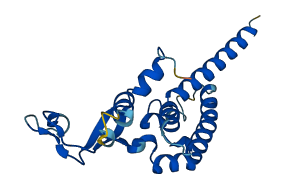
1 structures for Q0UPV4
| Entry ID | Method | Resolution | Chain | Position | Source |
|---|---|---|---|---|---|
| AF-Q0UPV4-F1 | Predicted | AlphaFoldDB |
No variants for Q0UPV4
| Variant ID(s) | Position | Change | Description | Diseaes Association | Provenance |
|---|---|---|---|---|---|
| No variants for Q0UPV4 | |||||
No associated diseases with Q0UPV4
4 GO annotations of cellular component
| Name | Definition |
|---|---|
| chromatin | The ordered and organized complex of DNA, protein, and sometimes RNA, that forms the chromosome. |
| CMG complex | A protein complex that contains the GINS complex, Cdc45p, and the heterohexameric MCM complex, and that is involved in unwinding DNA during replication. |
| GINS complex | A heterotetrameric protein complex that associates with replication origins, where it is required for the initiation of DNA replication, and with replication forks. |
| replication fork protection complex | A protein complex conserved in eukaryotes and associated with the replication fork; the complex stabilizes stalled replication forks and is thought to be involved in coordinating leading- and lagging-strand synthesis and in replication checkpoint signaling. |
No GO annotations of molecular function
| Name | Definition |
|---|---|
| No GO annotations for molecular function |
3 GO annotations of biological process
| Name | Definition |
|---|---|
| DNA unwinding involved in DNA replication | The process in which interchain hydrogen bonds between two strands of DNA are broken or 'melted', generating unpaired template strands for DNA replication. |
| double-strand break repair via break-induced replication | The error-free repair of a double-strand break in DNA in which the centromere-proximal end of a broken chromosome searches for a homologous region in an intact chromosome. DNA synthesis initiates from the 3' end of the invading DNA strand, using the intact chromosome as the template, and progresses to the end of the chromosome. |
| mitotic DNA replication initiation | Any DNA replication initiation involved in mitotic cell cycle DNA replication. |
No homologous proteins in AiPD
| UniProt AC | Gene Name | Protein Name | Species | Evidence Code |
|---|---|---|---|---|
| No homologous proteins | ||||
| 10 | 20 | 30 | 40 | 50 | 60 |
| MSSYYSVDAI | LTDAQKVPCT | FELTVPGLGF | LEGNMSGDMK | QGSKVELPLW | LGEMLALSQS |
| 70 | 80 | 90 | 100 | 110 | 120 |
| LNTSSLVTLD | PPSALSPRVL | NALKADPRTV | DLRALAPHFY | DLGARILELF | EEEKMIEVLS |
| 130 | 140 | 150 | 160 | 170 | |
| DTFKARAAVI | ADQAHNPRGA | LGEGADFMRG | LDENERQLFR | AAHDSAKAAR | TWMTDLKRK |