Q0ULD0
Gene name |
EGD1 (SNOG_07434) |
Protein name |
Nascent polypeptide-associated complex subunit beta |
Names |
NAC-beta, Beta-NAC |
Species |
Phaeosphaeria nodorum (strain SN15 / ATCC MYA-4574 / FGSC 10173) (Glume blotch fungus) (Parastagonospora nodorum) |
KEGG Pathway |
pno:SNOG_07434 |
EC number |
|
Protein Class |
|
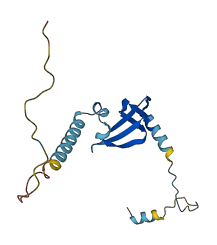
Descriptions
The autoinhibited protein was predicted that may have potential autoinhibitory elements via cis-regPred.
Autoinhibitory domains (AIDs)
Target domain |
|
Relief mechanism |
|
Assay |
cis-regPred |
Accessory elements
No accessory elements
Autoinhibited structure

Activated structure
1 structures for Q0ULD0
| Entry ID | Method | Resolution | Chain | Position | Source |
|---|---|---|---|---|---|
| AF-Q0ULD0-F1 | Predicted | AlphaFoldDB |
No variants for Q0ULD0
| Variant ID(s) | Position | Change | Description | Diseaes Association | Provenance |
|---|---|---|---|---|---|
| No variants for Q0ULD0 | |||||
No associated diseases with Q0ULD0
No regional properties for Q0ULD0
| Type | Name | Position | InterPro Accession |
|---|---|---|---|
| No domain, repeats, and functional sites for Q0ULD0 | |||
4 GO annotations of cellular component
| Name | Definition |
|---|---|
| cytosol | The part of the cytoplasm that does not contain organelles but which does contain other particulate matter, such as protein complexes. |
| nascent polypeptide-associated complex | A heterodimeric protein complex that can reversibly bind to ribosomes, and is located in direct proximity to newly synthesized polypeptide chains as they emerge from the ribosome. |
| nucleus | A membrane-bounded organelle of eukaryotic cells in which chromosomes are housed and replicated. In most cells, the nucleus contains all of the cell's chromosomes except the organellar chromosomes, and is the site of RNA synthesis and processing. In some species, or in specialized cell types, RNA metabolism or DNA replication may be absent. |
| polysomal ribosome | A ribosome bound to mRNA that forms part of a polysome. |
No GO annotations of molecular function
| Name | Definition |
|---|---|
| No GO annotations for molecular function |
1 GO annotations of biological process
| Name | Definition |
|---|---|
| protein transport | The directed movement of proteins into, out of or within a cell, or between cells, by means of some agent such as a transporter or pore. |
No homologous proteins in AiPD
| UniProt AC | Gene Name | Protein Name | Species | Evidence Code |
|---|---|---|---|---|
| No homologous proteins | ||||
| 10 | 20 | 30 | 40 | 50 | 60 |
| MDQAKLARMQ | ASVRIGGKGT | PRRKVKKVHK | SSGTDDKKLQ | TALKKLNVQP | IQAIEEVNMF |
| 70 | 80 | 90 | 100 | 110 | 120 |
| KSDGNVIHFS | APKVHASVPS | NTFAIYGNGE | DKELTELVPG | ILNQLGPDSL | ASLRKLAESY |
| 130 | 140 | 150 | |||
| QSMQKEKGED | GDKKDDDDED | DDDIPELVAG | DNFESKTEVE |