Q0STN1
Gene name |
uppP |
Protein name |
Undecaprenyl-diphosphatase |
Names |
Bacitracin resistance protein, Undecaprenyl pyrophosphate phosphatase |
Species |
Clostridium perfringens (strain SM101 / Type A) |
KEGG Pathway |
cpr:CPR_1204 |
EC number |
3.6.1.27: In phosphorus-containing anhydrides |
Protein Class |
|
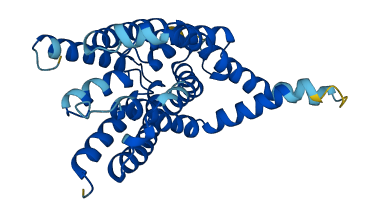
Descriptions
The autoinhibited protein was predicted that may have potential autoinhibitory elements via cis-regPred.
Autoinhibitory domains (AIDs)
Target domain |
|
Relief mechanism |
|
Assay |
cis-regPred |
Accessory elements
No accessory elements
Autoinhibited structure

Activated structure
1 structures for Q0STN1
| Entry ID | Method | Resolution | Chain | Position | Source |
|---|---|---|---|---|---|
| AF-Q0STN1-F1 | Predicted | AlphaFoldDB |
No variants for Q0STN1
| Variant ID(s) | Position | Change | Description | Diseaes Association | Provenance |
|---|---|---|---|---|---|
| No variants for Q0STN1 | |||||
No associated diseases with Q0STN1
No regional properties for Q0STN1
| Type | Name | Position | InterPro Accession |
|---|---|---|---|
| No domain, repeats, and functional sites for Q0STN1 | |||
Functions
| Description | ||
|---|---|---|
| EC Number | 3.6.1.27 | In phosphorus-containing anhydrides |
| Subcellular Localization |
|
|
| PANTHER Family | ||
| PANTHER Subfamily | ||
| PANTHER Protein Class | ||
| PANTHER Pathway Category | No pathway information available | |
2 GO annotations of cellular component
| Name | Definition |
|---|---|
| integral component of membrane | The component of a membrane consisting of the gene products and protein complexes having at least some part of their peptide sequence embedded in the hydrophobic region of the membrane. |
| plasma membrane | The membrane surrounding a cell that separates the cell from its external environment. It consists of a phospholipid bilayer and associated proteins. |
1 GO annotations of molecular function
| Name | Definition |
|---|---|
| undecaprenyl-diphosphatase activity | Catalysis of the reaction: di-trans,octa-cis-undecaprenyl diphosphate + H2O = di-trans,octa-cis-undecaprenyl phosphate + H+ + phosphate. |
5 GO annotations of biological process
| Name | Definition |
|---|---|
| cell wall organization | A process that results in the assembly, arrangement of constituent parts, or disassembly of the cell wall, the rigid or semi-rigid envelope lying outside the cell membrane of plant, fungal and most prokaryotic cells, maintaining their shape and protecting them from osmotic lysis. |
| dephosphorylation | The process of removing one or more phosphoric (ester or anhydride) residues from a molecule. |
| peptidoglycan biosynthetic process | The chemical reactions and pathways resulting in the formation of peptidoglycans, any of a class of glycoconjugates found in bacterial cell walls. |
| regulation of cell shape | Any process that modulates the surface configuration of a cell. |
| response to antibiotic | Any process that results in a change in state or activity of a cell or an organism (in terms of movement, secretion, enzyme production, gene expression, etc.) as a result of an antibiotic stimulus. An antibiotic is a chemical substance produced by a microorganism which has the capacity to inhibit the growth of or to kill other microorganisms. |
No homologous proteins in AiPD
| UniProt AC | Gene Name | Protein Name | Species | Evidence Code |
|---|---|---|---|---|
| No homologous proteins | ||||
| 10 | 20 | 30 | 40 | 50 | 60 |
| MGIDFLFILK | ALIIAIVEGL | TEFVPVSSTG | HMILVGDLIH | FNTQSGGFPE | MYEVVIQLGA |
| 70 | 80 | 90 | 100 | 110 | 120 |
| ILAVVVLYWR | KISSSVVEFL | SYIFSFIGLK | ASGDKRKYEK | RLAESKTGFR | FGINVIIGTI |
| 130 | 140 | 150 | 160 | 170 | 180 |
| PAAILGLLFH | DEIKEYLFST | KTVAIGFIVG | GILLIVIENN | FRKRAKRSKI | VKDIDKMTYG |
| 190 | 200 | 210 | 220 | 230 | 240 |
| QSLLVGCFQC | LSLWPGMSRS | ASTIMGGWIS | GLSTTVATEF | TFFLAIPAMV | GASGLDLFKF |
| 250 | 260 | 270 | 280 | 290 | 300 |
| DYSQMNATNL | ISLILGFIVA | FIVSLVVIDK | FINYLKKKPM | RIFAIYRVFA | GIVLAILIFT |
| KVIS |