Q0HUR9
Gene name |
opgG |
Protein name |
Glucans biosynthesis protein G |
Names |
|
Species |
Shewanella sp (strain MR-7) |
KEGG Pathway |
shm:Shewmr7_2148 |
EC number |
|
Protein Class |
|
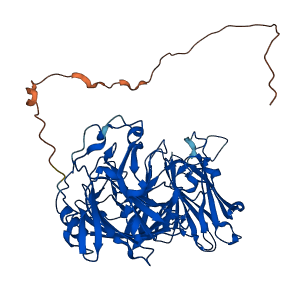
Descriptions
The autoinhibited protein was predicted that may have potential autoinhibitory elements via cis-regPred.
Autoinhibitory domains (AIDs)
Target domain |
|
Relief mechanism |
|
Assay |
cis-regPred |
Accessory elements
No accessory elements
Autoinhibited structure

Activated structure
1 structures for Q0HUR9
| Entry ID | Method | Resolution | Chain | Position | Source |
|---|---|---|---|---|---|
| AF-Q0HUR9-F1 | Predicted | AlphaFoldDB |
No variants for Q0HUR9
| Variant ID(s) | Position | Change | Description | Diseaes Association | Provenance |
|---|---|---|---|---|---|
| No variants for Q0HUR9 | |||||
No associated diseases with Q0HUR9
1 regional properties for Q0HUR9
| Type | Name | Position | InterPro Accession |
|---|---|---|---|
| domain | Glucan biosynthesis, periplasmic, MdoG C-terminal | 72 - 543 | IPR007444 |
1 GO annotations of cellular component
| Name | Definition |
|---|---|
| periplasmic space | The region between the inner (cytoplasmic) and outer membrane (Gram-negative Bacteria) or cytoplasmic membrane and cell wall (Fungi and Gram-positive Bacteria). |
2 GO annotations of molecular function
| Name | Definition |
|---|---|
| carbohydrate binding | Binding to a carbohydrate, which includes monosaccharides, oligosaccharides and polysaccharides as well as substances derived from monosaccharides by reduction of the carbonyl group (alditols), by oxidation of one or more hydroxy groups to afford the corresponding aldehydes, ketones, or carboxylic acids, or by replacement of one or more hydroxy group(s) by a hydrogen atom. Cyclitols are generally not regarded as carbohydrates. |
| catalytic activity | Catalysis of a biochemical reaction at physiological temperatures. In biologically catalyzed reactions, the reactants are known as substrates, and the catalysts are naturally occurring macromolecular substances known as enzymes. Enzymes possess specific binding sites for substrates, and are usually composed wholly or largely of protein, but RNA that has catalytic activity (ribozyme) is often also regarded as enzymatic. |
1 GO annotations of biological process
| Name | Definition |
|---|---|
| glucan biosynthetic process | The chemical reactions and pathways resulting in the formation of glucans, polysaccharides consisting only of glucose residues. |
No homologous proteins in AiPD
| UniProt AC | Gene Name | Protein Name | Species | Evidence Code |
|---|---|---|---|---|
| No homologous proteins | ||||
| 10 | 20 | 30 | 40 | 50 | 60 |
| MVSLLRCQSF | KPSSSLICSL | ALSAAFALSS | SAFAEETKPA | ENKPATPVVS | PPKATAQPAN |
| 70 | 80 | 90 | 100 | 110 | 120 |
| KNQVRFTKTG | TFDGDSVVKL | ARKLASKPYV | VLKDPLPAGL | AKLSYDEYRD | IRFNPVSSIW |
| 130 | 140 | 150 | 160 | 170 | 180 |
| RDQGLPFQMQ | MFHRGFYFQD | LIEIAIVEAN | QATHLAYEPK | YFTAGEVITQ | ALPNDDIGYS |
| 190 | 200 | 210 | 220 | 230 | 240 |
| GFRIHNQLNT | NGVYDELMVF | QGASYFRALG | KGNSYGLSAR | GLALKTADPE | GEEFPIFRAF |
| 250 | 260 | 270 | 280 | 290 | 300 |
| WVERPSYDSN | LIVVHALLDS | PSVAGAYRFS | VRPGDNTQID | VEATLFPRVE | LSKVGLAPST |
| 310 | 320 | 330 | 340 | 350 | 360 |
| SMFLHSLNGR | HDTDDFRPEV | HDSDGLLMFN | GRGEHLWRPL | ANPRQLQVSA | FSDNSPQGFG |
| 370 | 380 | 390 | 400 | 410 | 420 |
| LIQRERNYAS | YQDLEAHYER | RPSLWIEPVG | NWGQGAVVLT | EIPTESEIHD | NIVSFWKPRQ |
| 430 | 440 | 450 | 460 | 470 | 480 |
| PIPAGSEYHF | AYRMNWGDEP | VAKTNSVVVS | RTASGRADIA | KATPRRLFVV | DYHLNGAMPD |
| 490 | 500 | 510 | 520 | 530 | 540 |
| ELPLAKVESS | GGVIANVVIA | RNAANNGYRL | AFELEPEDKD | LIELRAELKF | STPRQVETWL |
| YRWTL |