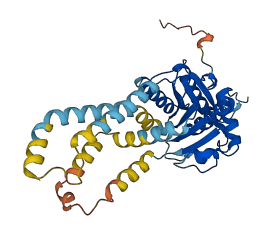
Descriptions
The autoinhibited protein was predicted that may have potential autoinhibitory elements via cis-regPred.
Autoinhibitory domains (AIDs)
Target domain |
|
Relief mechanism |
|
Assay |
cis-regPred |
Accessory elements
No accessory elements
Autoinhibited structure

Activated structure
1 structures for Q0CNR4
| Entry ID | Method | Resolution | Chain | Position | Source |
|---|---|---|---|---|---|
| AF-Q0CNR4-F1 | Predicted | AlphaFoldDB |
No variants for Q0CNR4
| Variant ID(s) | Position | Change | Description | Diseaes Association | Provenance |
|---|---|---|---|---|---|
| No variants for Q0CNR4 | |||||
No associated diseases with Q0CNR4
No regional properties for Q0CNR4
| Type | Name | Position | InterPro Accession |
|---|---|---|---|
| No domain, repeats, and functional sites for Q0CNR4 | |||
1 GO annotations of cellular component
| Name | Definition |
|---|---|
| GET complex | An endoplasmic reticulum protein-containing complex that is conserved in eukaryotics and that mediates the insertion of tail-anchored proteins into the ER membrane. In yeast, includes Get1p, Get2p and Get3p proteins. |
7 GO annotations of molecular function
| Name | Definition |
|---|---|
| ATP binding | Binding to ATP, adenosine 5'-triphosphate, a universally important coenzyme and enzyme regulator. |
| ATP hydrolysis activity | Catalysis of the reaction: ATP + H2O = ADP + H+ phosphate. ATP hydrolysis is used in some reactions as an energy source, for example to catalyze a reaction or drive transport against a concentration gradient. |
| guanyl-nucleotide exchange factor activity | Stimulates the exchange of GDP to GTP on a signaling GTPase, changing its conformation to its active form. Guanine nucleotide exchange factors (GEFs) act by stimulating the release of guanosine diphosphate (GDP) to allow binding of guanosine triphosphate (GTP), which is more abundant in the cell under normal cellular physiological conditions. |
| identical protein binding | Binding to an identical protein or proteins. |
| metal ion binding | Binding to a metal ion. |
| protein folding chaperone | Binding to a protein or a protein-containing complex to assist the protein folding process. |
| unfolded protein binding | Binding to an unfolded protein. |
6 GO annotations of biological process
| Name | Definition |
|---|---|
| pheromone-dependent signal transduction involved in conjugation with cellular fusion | A signal transduction process resulting in the relay, amplification or dampening of a signal generated in response to pheromone exposure in organisms that undergo conjugation with cellular fusion. An example of this process is found in Saccharomyces cerevisiae. |
| post-translational protein targeting to endoplasmic reticulum membrane | The targeting of proteins to a membrane that occurs after their translation. Some secretory proteins exhibit posttranslational transport into the endoplasmic reticulum (ER) lumen: they are synthesized in their entirety on free cytosolic ribosomes and then released into the cytosol, where they are bound by chaperones which keep them in an unfolded state, and subsequently are translocated across the ER membrane. |
| protein insertion into ER membrane | The process that results in incorporation of a protein into an endoplasmic reticulum (ER) membrane. It depends on specific topogenic sequences of amino acids that ensure that a protein acquires the proper orientation during its insertion into the ER membrane. |
| response to heat | Any process that results in a change in state or activity of a cell or an organism (in terms of movement, secretion, enzyme production, gene expression, etc.) as a result of a heat stimulus, a temperature stimulus above the optimal temperature for that organism. |
| response to metal ion | Any process that results in a change in state or activity of a cell or an organism (in terms of movement, secretion, enzyme production, gene expression, etc.) as a result of a metal ion stimulus. |
| retrograde vesicle-mediated transport, Golgi to endoplasmic reticulum | The directed movement of substances from the Golgi back to the endoplasmic reticulum, mediated by vesicles bearing specific protein coats such as COPI or COG. |
No homologous proteins in AiPD
| UniProt AC | Gene Name | Protein Name | Species | Evidence Code |
|---|---|---|---|---|
| No homologous proteins | ||||
| 10 | 20 | 30 | 40 | 50 | 60 |
| MSSTAVVHDD | DLMEPSLQSI | VNQKTLRWIF | VGGKGGVGKT | TTSCSLAIQL | AKVRKSVLLI |
| 70 | 80 | 90 | 100 | 110 | 120 |
| STDPAHNLSD | AFGQKFGKEA | RLVDGFTNLS | AMEIDPNGSI | QDLLASGDAQ | QDDPMAGLGV |
| 130 | 140 | 150 | 160 | 170 | 180 |
| NNMMQDLAFS | IPGVDEAMSF | AEVLKQVKSL | SYEVIVFDTA | PTGHTLRFLQ | FPTVLEKALA |
| 190 | 200 | 210 | 220 | 230 | 240 |
| KLSQLSSQFG | PMLNSILGAR | GGLPGGQNLD | ELLQKMESLR | ETISEVNSQF | KDADLTTFVC |
| 250 | 260 | 270 | 280 | 290 | 300 |
| VCIAEFLSLY | ETERMIQELT | SYSIDTHAIV | VNQLLFPKDG | SECDQCNARR | KMQKKYLEQI |
| 310 | 320 | 330 | |||
| EELYEDFNVV | RMPLLVEEVR | GKEKLEKFSD | MLVHPYVPPN |