Descriptions
The autoinhibited protein was predicted that may have potential autoinhibitory elements via cis-regPred.
Autoinhibitory domains (AIDs)
Target domain |
|
Relief mechanism |
|
Assay |
cis-regPred |
Accessory elements
No accessory elements
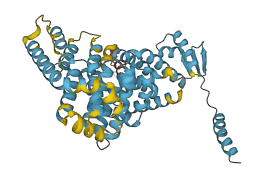
Autoinhibited structure

Activated structure
1 structures for Q0CNR3
| Entry ID | Method | Resolution | Chain | Position | Source |
|---|---|---|---|---|---|
| AF-Q0CNR3-F1 | Predicted | AlphaFoldDB |
No variants for Q0CNR3
| Variant ID(s) | Position | Change | Description | Diseaes Association | Provenance |
|---|---|---|---|---|---|
| No variants for Q0CNR3 | |||||
No associated diseases with Q0CNR3
4 GO annotations of cellular component
| Name | Definition |
|---|---|
| cytosol | The part of the cytoplasm that does not contain organelles but which does contain other particulate matter, such as protein complexes. |
| eukaryotic 43S preinitiation complex | A protein complex composed of the 40S ribosomal subunit plus eIF1A, eIF3, and eIF2-GTP-bound methionyl-initiator methionine tRNA. |
| eukaryotic 48S preinitiation complex | A protein complex composed of the small ribosomal subunit, eIF3, eIF1A, methionyl-initiatior methionine and a capped mRNA. The complex is initially positioned at the 5'-end of the capped mRNA. |
| eukaryotic translation initiation factor 3 complex, eIF3e | An eukaryotic translation initiation factor 3 complex that contains the PCI-domain protein eIF3e. |
1 GO annotations of molecular function
| Name | Definition |
|---|---|
| translation initiation factor activity | Functions in the initiation of ribosome-mediated translation of mRNA into a polypeptide. |
3 GO annotations of biological process
| Name | Definition |
|---|---|
| eukaryotic translation initiation factor 3 complex assembly | The aggregation, arrangement and bonding together of a set of components to form the eukaryotic translation initiation factor 3 complex. |
| formation of cytoplasmic translation initiation complex | Joining of the large subunit, with release of IF2/eIF2 and IF3/eIF3. This leaves the functional ribosome at the AUG, with the methionyl/formyl-methionyl-tRNA positioned at the P site. |
| positive regulation of proteasomal ubiquitin-dependent protein catabolic process | Any process that activates or increases the frequency, rate or extent of the breakdown of a protein or peptide by hydrolysis of its peptide bonds, initiated by the covalent attachment of ubiquitin, and mediated by the proteasome. |
No homologous proteins in AiPD
| UniProt AC | Gene Name | Protein Name | Species | Evidence Code |
|---|---|---|---|---|
| No homologous proteins | ||||
| 10 | 20 | 30 | 40 | 50 | 60 |
| MAANVPPSAE | TLLSGAAAHP | PKTAEEIANQ | YDLLPKLIPY | LDRHLVFPLL | EFSSGQDDDK |
| 70 | 80 | 90 | 100 | 110 | 120 |
| EVVRAKYELL | KHTNMTDYVA | NLWKEINNSD | TIPDEFVKKR | EEVLAKLENY | QEESSKITEL |
| 130 | 140 | 150 | 160 | 170 | 180 |
| LQDEAVVGNL | RSDKVANLRF | LEEQHGVTLD | MVNSLYDYGR | FQYSCGSYGT | AAELLYQFRV |
| 190 | 200 | 210 | 220 | 230 | 240 |
| LSTDNDKVAS | ATWGKLASEI | LTTSWEGAME | EVQKVKESIE | TRLFNNPLGQ | LENRSWLIHW |
| 250 | 260 | 270 | 280 | 290 | 300 |
| SLFPFFNYDP | ARDVLTDLFF | SPAYINTIQT | NCPWILRYLA | AAVITNRNRA | HKNSSAYQKQ |
| 310 | 320 | 330 | 340 | 350 | 360 |
| LKDLIRVVRQ | EGYEYSDPIT | DFVKALYIDF | DFEEAQKKLG | EAEDVLRSDF | FLVSAADAFV |
| 370 | 380 | 390 | 400 | 410 | 420 |
| EAARHLISES | YCKIHQRIDI | KDLSTRLGLN | QDEGEKWIVN | LIRDTRVDAK | IDYKEGTVIM |
| 430 | 440 | ||||
| NHPPQSVYQQ | VIEKTKGAFF | RTQVLR |