Q0CGJ9
Gene name |
sub2 (ATEG_07193) |
Protein name |
ATP-dependent RNA helicase sub2 |
Names |
|
Species |
Aspergillus terreus (strain NIH 2624 / FGSC A1156) |
KEGG Pathway |
|
EC number |
3.6.4.13: Acting on ATP; involved in cellular and subcellular movement |
Protein Class |
|
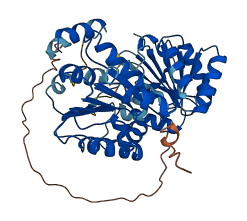
Descriptions
The autoinhibited protein was predicted that may have potential autoinhibitory elements via cis-regPred.
Autoinhibitory domains (AIDs)
Target domain |
|
Relief mechanism |
|
Assay |
cis-regPred |
Accessory elements
No accessory elements
Autoinhibited structure

Activated structure
1 structures for Q0CGJ9
| Entry ID | Method | Resolution | Chain | Position | Source |
|---|---|---|---|---|---|
| AF-Q0CGJ9-F1 | Predicted | AlphaFoldDB |
No variants for Q0CGJ9
| Variant ID(s) | Position | Change | Description | Diseaes Association | Provenance |
|---|---|---|---|---|---|
| No variants for Q0CGJ9 | |||||
No associated diseases with Q0CGJ9
Functions
| Description | ||
|---|---|---|
| EC Number | 3.6.4.13 | Acting on ATP; involved in cellular and subcellular movement |
| Subcellular Localization |
|
|
| PANTHER Family | ||
| PANTHER Subfamily | ||
| PANTHER Protein Class | ||
| PANTHER Pathway Category | No pathway information available | |
1 GO annotations of cellular component
| Name | Definition |
|---|---|
| spliceosomal complex | Any of a series of ribonucleoprotein complexes that contain snRNA(s) and small nuclear ribonucleoproteins (snRNPs), and are formed sequentially during the spliceosomal splicing of one or more substrate RNAs, and which also contain the RNA substrate(s) from the initial target RNAs of splicing, the splicing intermediate RNA(s), to the final RNA products. During cis-splicing, the initial target RNA is a single, contiguous RNA transcript, whether mRNA, snoRNA, etc., and the released products are a spliced RNA and an excised intron, generally as a lariat structure. During trans-splicing, there are two initial substrate RNAs, the spliced leader RNA and a pre-mRNA. |
4 GO annotations of molecular function
| Name | Definition |
|---|---|
| ATP binding | Binding to ATP, adenosine 5'-triphosphate, a universally important coenzyme and enzyme regulator. |
| ATP hydrolysis activity | Catalysis of the reaction: ATP + H2O = ADP + H+ phosphate. ATP hydrolysis is used in some reactions as an energy source, for example to catalyze a reaction or drive transport against a concentration gradient. |
| RNA binding | Binding to an RNA molecule or a portion thereof. |
| RNA helicase activity | Unwinding of an RNA helix, driven by ATP hydrolysis. |
3 GO annotations of biological process
| Name | Definition |
|---|---|
| mRNA processing | Any process involved in the conversion of a primary mRNA transcript into one or more mature mRNA(s) prior to translation into polypeptide. |
| mRNA transport | The directed movement of mRNA, messenger ribonucleic acid, into, out of or within a cell, or between cells, by means of some agent such as a transporter or pore. |
| RNA splicing | The process of removing sections of the primary RNA transcript to remove sequences not present in the mature form of the RNA and joining the remaining sections to form the mature form of the RNA. |
No homologous proteins in AiPD
| UniProt AC | Gene Name | Protein Name | Species | Evidence Code |
|---|---|---|---|---|
| No homologous proteins | ||||
| 10 | 20 | 30 | 40 | 50 | 60 |
| MSHEEDLIDY | SDEELQTTDA | AATTAAPAAN | GAPAKTGDLT | VTGGRSDKKG | SYVGIHSTGF |
| 70 | 80 | 90 | 100 | 110 | 120 |
| RDFLLKGELL | RAITDCGFEH | PSEVCIPTAI | LNVDVLCQAK | SGLGKTAVFV | LTTLHQLEPV |
| 130 | 140 | 150 | 160 | 170 | 180 |
| PGECSVLVMC | HTRELAYQIK | NEYARFSKYL | PDVKTAVFYG | GTPIQKDIEV | LSNKESYPNI |
| 190 | 200 | 210 | 220 | 230 | 240 |
| VVGTPGRLNA | LVREKKLSLR | NVKAFVLDEC | DKMLDQIDMR | RDVQEIFRAT | PADKQVMMFS |
| 250 | 260 | 270 | 280 | 290 | 300 |
| ATLSQEIRPI | CKKFMRNPLE | VYVDDDTKLT | LHGLQQYYIK | LSESEKNRKL | NDLLDNLEFN |
| 310 | 320 | 330 | 340 | 350 | 360 |
| QVIIFVKSTQ | RANELDKLLR | ECNFPSIAVH | SGVSQEERIK | RYKEFKEFNK | RICVATDVFG |
| 370 | 380 | 390 | 400 | 410 | 420 |
| RGIDIERINL | AINYDLPADA | DSYLHRVGRA | GRFGTKGLSI | SFVSSEDDEK | VLKDIEKRFE |
| 430 | |||||
| VALPEYPEGG | VDSSTYMA |