Q09924
Gene name |
tif224 (SPAC21E11.06) |
Protein name |
Probable translation initiation factor eIF-2B subunit delta |
Names |
eIF-2B GDP-GTP exchange factor subunit delta |
Species |
Schizosaccharomyces pombe (strain 972 / ATCC 24843) (Fission yeast) |
KEGG Pathway |
spo:SPAC21E11.06 |
EC number |
|
Protein Class |
|
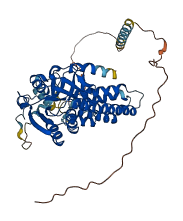
Descriptions
The autoinhibited protein was predicted that may have potential autoinhibitory elements via cis-regPred.
Autoinhibitory domains (AIDs)
Target domain |
|
Relief mechanism |
|
Assay |
cis-regPred |
Accessory elements
No accessory elements
Autoinhibited structure

Activated structure
4 structures for Q09924
| Entry ID | Method | Resolution | Chain | Position | Source |
|---|---|---|---|---|---|
| 5B04 | X-ray | 299 A | G/H | 1-467 | PDB |
| 6JLY | X-ray | 350 A | G/H | 1-467 | PDB |
| 6JLZ | X-ray | 335 A | G/H | 1-467 | PDB |
| AF-Q09924-F1 | Predicted | AlphaFoldDB |
3 variants for Q09924
| Variant ID(s) | Position | Change | Description | Diseaes Association | Provenance |
|---|---|---|---|---|---|
| I_4257977_T_C | 81 | V>A | No | Jeffares_SNPs | |
| I_4258455_A_T | 240 | E>D | No | Jeffares_SNPs | |
| I_4258486_A_G | 251 | I>V | No | Jeffares_SNPs |
No associated diseases with Q09924
No regional properties for Q09924
| Type | Name | Position | InterPro Accession |
|---|---|---|---|
| No domain, repeats, and functional sites for Q09924 | |||
2 GO annotations of cellular component
| Name | Definition |
|---|---|
| cytosol | The part of the cytoplasm that does not contain organelles but which does contain other particulate matter, such as protein complexes. |
| eukaryotic translation initiation factor 2B complex | A multisubunit guanine nucleotide exchange factor which catalyzes the exchange of GDP bound to initiation factor eIF2 for GTP, generating active eIF2-GTP. In humans, it is composed of five subunits, alpha, beta, delta, gamma and epsilon. |
2 GO annotations of molecular function
| Name | Definition |
|---|---|
| guanyl-nucleotide exchange factor activity | Stimulates the exchange of GDP to GTP on a signaling GTPase, changing its conformation to its active form. Guanine nucleotide exchange factors (GEFs) act by stimulating the release of guanosine diphosphate (GDP) to allow binding of guanosine triphosphate (GTP), which is more abundant in the cell under normal cellular physiological conditions. |
| translation initiation factor activity | Functions in the initiation of ribosome-mediated translation of mRNA into a polypeptide. |
1 GO annotations of biological process
| Name | Definition |
|---|---|
| cytoplasmic translational initiation | The process preceding formation of the peptide bond between the first two amino acids of a protein in the cytoplasm. This includes the formation of a complex of the ribosome, mRNA or circRNA, and an initiation complex that contains the first aminoacyl-tRNA. |
No homologous proteins in AiPD
| UniProt AC | Gene Name | Protein Name | Species | Evidence Code |
|---|---|---|---|---|
| No homologous proteins | ||||
| 10 | 20 | 30 | 40 | 50 | 60 |
| MGFSAEQAKK | DGKDQSPVSE | SSSVGGTSPA | TASSVVSPNE | PKLSGKEAKA | LKKARKQASR |
| 70 | 80 | 90 | 100 | 110 | 120 |
| RAKAEAAAAN | NPPGVSEEKK | VAIPNKNSNQ | QKKASKQNPQ | NSPETDANLQ | EKKIFEEKQV |
| 130 | 140 | 150 | 160 | 170 | 180 |
| SIFSHLDWRR | RRTTENIPKD | IHPAVIRLGL | KLANYKIFGS | NQRCIDLLKT | FKIVIQDYQT |
| 190 | 200 | 210 | 220 | 230 | 240 |
| PYGTTLSRHL | TTHINSQIAY | LVSTRPLSIS | MGNAIRFLKL | EISVLDIDLT | DDEGKELLLE |
| 250 | 260 | 270 | 280 | 290 | 300 |
| KIDSYIRDRI | IIAGQVIVQA | ATEKIQDGDV | ILTYLHSSTV | NDVLIHAKNV | GKKFRVVVVD |
| 310 | 320 | 330 | 340 | 350 | 360 |
| SRPEFEGRVC | LKLLTEHGIE | CTYVMISALS | YIMQEVTKIF | LGGHAMLSNG | ALYSRAGTSL |
| 370 | 380 | 390 | 400 | 410 | 420 |
| ISLLGHESNV | PVIACCESYK | FTERIQLDSL | VYNELAPGDQ | LVNMGVDDFE | EKPGVLANWK |
| 430 | 440 | 450 | 460 | ||
| SVKNLKLLSL | KYDVTPPRLI | TVCVCEMGLL | PSTSVPAIIN | EFKQVYA |