Q09727
Gene name |
mrp20 (SPAC31A2.08) |
Protein name |
54S ribosomal protein L23, mitochondrial |
Names |
|
Species |
Schizosaccharomyces pombe (strain 972 / ATCC 24843) (Fission yeast) |
KEGG Pathway |
spo:SPAC31A2.08 |
EC number |
|
Protein Class |
|
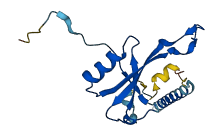
Descriptions
The autoinhibited protein was predicted that may have potential autoinhibitory elements via cis-regPred.
Autoinhibitory domains (AIDs)
Target domain |
|
Relief mechanism |
|
Assay |
cis-regPred |
Accessory elements
No accessory elements
Autoinhibited structure

Activated structure
1 structures for Q09727
| Entry ID | Method | Resolution | Chain | Position | Source |
|---|---|---|---|---|---|
| AF-Q09727-F1 | Predicted | AlphaFoldDB |
No variants for Q09727
| Variant ID(s) | Position | Change | Description | Diseaes Association | Provenance |
|---|---|---|---|---|---|
| No variants for Q09727 | |||||
No associated diseases with Q09727
5 regional properties for Q09727
| Type | Name | Position | InterPro Accession |
|---|---|---|---|
| domain | SpoVT-AbrB domain | 7 - 52 | IPR007159-1 |
| domain | SpoVT-AbrB domain | 83 - 126 | IPR007159-2 |
| domain | MraZ domain | 84 - 134 | IPR020603 |
| domain | MraZ, N-terminal | 6 - 61 | IPR035642 |
| domain | MraZ, C-terminal | 75 - 134 | IPR035644 |
2 GO annotations of cellular component
| Name | Definition |
|---|---|
| mitochondrial large ribosomal subunit | The larger of the two subunits of a mitochondrial ribosome. Two sites on the ribosomal large subunit are involved in translation: the aminoacyl site (A site) and peptidyl site (P site). |
| mitochondrion | A semiautonomous, self replicating organelle that occurs in varying numbers, shapes, and sizes in the cytoplasm of virtually all eukaryotic cells. It is notably the site of tissue respiration. |
1 GO annotations of molecular function
| Name | Definition |
|---|---|
| structural constituent of ribosome | The action of a molecule that contributes to the structural integrity of the ribosome. |
1 GO annotations of biological process
| Name | Definition |
|---|---|
| mitochondrial translation | The chemical reactions and pathways resulting in the formation of a protein in a mitochondrion. This is a ribosome-mediated process in which the information in messenger RNA (mRNA) is used to specify the sequence of amino acids in the protein; the mitochondrion has its own ribosomes and transfer RNAs, and uses a genetic code that differs from the nuclear code. |
No homologous proteins in AiPD
| UniProt AC | Gene Name | Protein Name | Species | Evidence Code |
|---|---|---|---|---|
| No homologous proteins | ||||
| 10 | 20 | 30 | 40 | 50 | 60 |
| MSKIAGKRLV | YFPNITFTLC | RGLNLQPKFA | VFRVPLHVNK | FDVRDYLQHV | YNLKVVSVKS |
| 70 | 80 | 90 | 100 | 110 | 120 |
| RIYQGKLFRN | QLGQVKRPQS | EKRVIVEMEE | PFVYPNAPND | LKDWQEGELL | PDGSNVKTLS |
| 130 | 140 | 150 | 160 | ||
| RYPKVLEQVD | MKRVNEELSK | LQDKQILESQ | QKIARLLKKK | Y |