Q09325
Gene name |
Mgat1 (Gnt1) |
Protein name |
Alpha-1,3-mannosyl-glycoprotein 2-beta-N-acetylglucosaminyltransferase |
Names |
N-glycosyl-oligosaccharide-glycoprotein N-acetylglucosaminyltransferase I, GNT-I, GlcNAc-T I |
Species |
Rattus norvegicus (Rat) |
KEGG Pathway |
rno:81519 |
EC number |
2.4.1.101: Hexosyltransferases |
Protein Class |
|
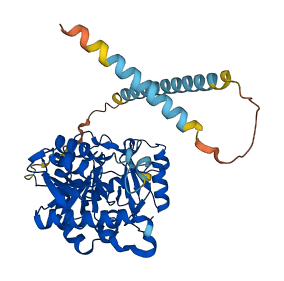
Descriptions
The autoinhibited protein was predicted that may have potential autoinhibitory elements via cis-regPred.
Autoinhibitory domains (AIDs)
Target domain |
|
Relief mechanism |
|
Assay |
cis-regPred |
Accessory elements
No accessory elements
Autoinhibited structure

Activated structure
1 structures for Q09325
| Entry ID | Method | Resolution | Chain | Position | Source |
|---|---|---|---|---|---|
| AF-Q09325-F1 | Predicted | AlphaFoldDB |
1 variants for Q09325
| Variant ID(s) | Position | Change | Description | Diseaes Association | Provenance |
|---|---|---|---|---|---|
| rs3321764496 | 218 | P>Q | No | EVA |
No associated diseases with Q09325
Functions
| Description | ||
|---|---|---|
| EC Number | 2.4.1.101 | Hexosyltransferases |
| Subcellular Localization |
|
|
| PANTHER Family | ||
| PANTHER Subfamily | ||
| PANTHER Protein Class | ||
| PANTHER Pathway Category | No pathway information available | |
4 GO annotations of cellular component
| Name | Definition |
|---|---|
| Golgi apparatus | A membrane-bound cytoplasmic organelle of the endomembrane system that further processes the core oligosaccharides (e.g. N-glycans) added to proteins in the endoplasmic reticulum and packages them into membrane-bound vesicles. The Golgi apparatus operates at the intersection of the secretory, lysosomal, and endocytic pathways. |
| Golgi membrane | The lipid bilayer surrounding any of the compartments of the Golgi apparatus. |
| integral component of membrane | The component of a membrane consisting of the gene products and protein complexes having at least some part of their peptide sequence embedded in the hydrophobic region of the membrane. |
| perinuclear region of cytoplasm | Cytoplasm situated near, or occurring around, the nucleus. |
3 GO annotations of molecular function
| Name | Definition |
|---|---|
| acetylglucosaminyltransferase activity | Catalysis of the transfer of an N-acetylglucosaminyl residue from UDP-N-acetyl-glucosamine to a sugar. |
| alpha-1,3-mannosylglycoprotein 2-beta-N-acetylglucosaminyltransferase activity | Catalysis of the reaction: 3-(alpha-D-mannosyl)-beta-D-mannosyl-R + UDP-N-acetyl-alpha-D-glucosamine = 3-(2--alpha-D-mannosyl)-beta-D-mannosyl-R + H(+) + UDP. |
| manganese ion binding | Binding to a manganese ion (Mn). |
5 GO annotations of biological process
| Name | Definition |
|---|---|
| in utero embryonic development | The process whose specific outcome is the progression of the embryo in the uterus over time, from formation of the zygote in the oviduct, to birth. An example of this process is found in Mus musculus. |
| protein glycosylation | A protein modification process that results in the addition of a carbohydrate or carbohydrate derivative unit to a protein amino acid, e.g. the addition of glycan chains to proteins. |
| protein N-linked glycosylation | A protein glycosylation process in which a carbohydrate or carbohydrate derivative unit is added to a protein via the N4 atom of peptidyl-asparagine, the omega-N of arginine, or the N1' atom peptidyl-tryptophan. |
| protein N-linked glycosylation via asparagine | The glycosylation of protein via the N4 atom of peptidyl-asparagine forming N4-glycosyl-L-asparagine; the most common form is N-acetylglucosaminyl asparagine; N-acetylgalactosaminyl asparagine and N4 glucosyl asparagine also occur. This modification typically occurs in extracellular peptides with an N-X-(ST) motif. Partial modification has been observed to occur with cysteine, rather than serine or threonine, in the third position; secondary structure features are important, and proline in the second or fourth positions inhibits modification. |
| UDP-N-acetylglucosamine catabolic process | The chemical reactions and pathways resulting in the breakdown of UDP-N-acetylglucosamine, a substance composed of N-acetylglucosamine, a common structural unit of oligosaccharides, in glycosidic linkage with uridine diphosphate. |
3 homologous proteins in AiPD
| UniProt AC | Gene Name | Protein Name | Species | Evidence Code |
|---|---|---|---|---|
| P26572 | MGAT1 | Alpha-1,3-mannosyl-glycoprotein 2-beta-N-acetylglucosaminyltransferase | Homo sapiens (Human) | PR |
| P27808 | Mgat1 | Alpha-1,3-mannosyl-glycoprotein 2-beta-N-acetylglucosaminyltransferase | Mus musculus (Mouse) | PR |
| Q11068 | gly-13 | Putative alpha-1,3-mannosyl-glycoprotein 2-beta-N-acetylglucosaminyltransferase | Caenorhabditis elegans | PR |
| 10 | 20 | 30 | 40 | 50 | 60 |
| MLKKQSAGLV | LWGAIIFVGW | NALLLLFFWT | RPAPGRLPSD | SALGDDPASL | TREVIHLAED |
| 70 | 80 | 90 | 100 | 110 | 120 |
| AEAELERQRG | LLQQIKEHYS | LWRQRWRVPT | VAPPAWPRVP | GTPSPAVIPI | LVIACDRSTV |
| 130 | 140 | 150 | 160 | 170 | 180 |
| RRCLDKLLHY | RPSAEHFPII | VSQDCGHEET | AQVIASYGTA | VTHIRQPDLS | NIAVQPDHRK |
| 190 | 200 | 210 | 220 | 230 | 240 |
| FQGYYKIARH | YRWALGQIFN | KFKFPAAVVV | EDDLEVAPDF | FEYFQATYPL | LKADPSLWCV |
| 250 | 260 | 270 | 280 | 290 | 300 |
| SAWNDNGKEQ | MVDSSKPELL | YRTDFFPGLG | WLLLADLWAE | LEPKWPKAFW | DDWMRRPEQR |
| 310 | 320 | 330 | 340 | 350 | 360 |
| KGRACIRPEI | SRTMTFGRKG | VSHGQFFDQH | LKFIKLNQQF | VPFTQLDLSY | LQREAYDRDF |
| 370 | 380 | 390 | 400 | 410 | 420 |
| LAQVYGAPQL | QVEKVRTNDR | KELGEVRVQY | TSRDSFKAFA | KALGVMDDLK | SGVPRAGYRG |
| 430 | 440 | ||||
| IVTFQFRGRR | VHLAPPETWN | GYDPSWN |