Q08749
Gene name |
TIM18 (YOR297C) |
Protein name |
Mitochondrial import inner membrane translocase subunit TIM18 |
Names |
|
Species |
Saccharomyces cerevisiae (strain ATCC 204508 / S288c) (Baker's yeast) |
KEGG Pathway |
sce:YOR297C |
EC number |
|
Protein Class |
|
Descriptions
The autoinhibited protein was predicted that may have potential autoinhibitory elements via cis-regPred.
Autoinhibitory domains (AIDs)
Target domain |
|
Relief mechanism |
|
Assay |
cis-regPred |
Accessory elements
No accessory elements
Autoinhibited structure

Activated structure
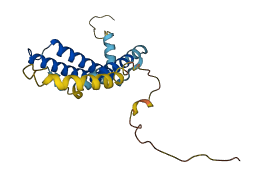
2 structures for Q08749
| Entry ID | Method | Resolution | Chain | Position | Source |
|---|---|---|---|---|---|
| 6LO8 | EM | 383 A | D | 1-192 | PDB |
| AF-Q08749-F1 | Predicted | AlphaFoldDB |
6 variants for Q08749
| Variant ID(s) | Position | Change | Description | Diseaes Association | Provenance |
|---|---|---|---|---|---|
| s15-875292 | 10 | V>A | No | SGRP | |
| s15-875278 | 15 | T>A | No | SGRP | |
| s15-875003 | 106 | I>M | No | SGRP | |
| s15-874981 | 114 | L>I | No | SGRP | |
| s15-874938 | 128 | S>T | No | SGRP | |
| s15-874885 | 146 | A>S | No | SGRP |
No associated diseases with Q08749
No regional properties for Q08749
| Type | Name | Position | InterPro Accession |
|---|---|---|---|
| No domain, repeats, and functional sites for Q08749 | |||
4 GO annotations of cellular component
| Name | Definition |
|---|---|
| integral component of membrane | The component of a membrane consisting of the gene products and protein complexes having at least some part of their peptide sequence embedded in the hydrophobic region of the membrane. |
| mitochondrial inner membrane | The inner, i.e. lumen-facing, lipid bilayer of the mitochondrial envelope. It is highly folded to form cristae. |
| mitochondrion | A semiautonomous, self replicating organelle that occurs in varying numbers, shapes, and sizes in the cytoplasm of virtually all eukaryotic cells. It is notably the site of tissue respiration. |
| TIM22 mitochondrial import inner membrane insertion complex | A multi-subunit complex embedded in the mitochondrial inner membrane that mediates the inner membrane insertion of multi-transmembrane spanning proteins that contain internal targeting elements. In yeast cells, TIM22 is a 300-kDa complex, consisting of four membrane integral subunits, Tim22, Tim54, Tim18 and Sdh3, and a peripheral chaperone complex consisting of the small TIM proteins, Tim9-Tim10-Tim12. |
No GO annotations of molecular function
| Name | Definition |
|---|---|
| No GO annotations for molecular function |
6 GO annotations of biological process
| Name | Definition |
|---|---|
| apoptotic process | A programmed cell death process which begins when a cell receives an internal (e.g. DNA damage) or external signal (e.g. an extracellular death ligand), and proceeds through a series of biochemical events (signaling pathway phase) which trigger an execution phase. The execution phase is the last step of an apoptotic process, and is typically characterized by rounding-up of the cell, retraction of pseudopodes, reduction of cellular volume (pyknosis), chromatin condensation, nuclear fragmentation (karyorrhexis), plasma membrane blebbing and fragmentation of the cell into apoptotic bodies. When the execution phase is completed, the cell has died. |
| cellular response to oxidative stress | Any process that results in a change in state or activity of a cell (in terms of movement, secretion, enzyme production, gene expression, etc.) as a result of oxidative stress, a state often resulting from exposure to high levels of reactive oxygen species, e.g. superoxide anions, hydrogen peroxide (H2O2), and hydroxyl radicals. |
| protein insertion into mitochondrial inner membrane | The processes mediating the insertion of proteins into the mitochondrial inner membrane. Mitochondrial inner membrane proteins can get inserted from the cytosol, by crossing the outer membrane and being guided by an inner membrane translocase complex into their final destination in the inner membrane. Some proteins present in the intermembrane space can get inserted into the inner mitochondrial membrane. Finally, some proteins are inserted into the inner membrane from the matrix side of the membrane. |
| protein transmembrane transport | The process in which a protein is transported across a membrane. |
| response to arsenic-containing substance | Any process that results in a change in state or activity of a cell or an organism (in terms of movement, secretion, enzyme production, gene expression, etc.) as a result of an arsenic stimulus from compounds containing arsenic, including arsenates, arsenites, and arsenides. |
| response to osmotic stress | Any process that results in a change in state or activity of a cell or an organism (in terms of movement, secretion, enzyme production, gene expression, etc.) as a result of a stimulus indicating an increase or decrease in the concentration of solutes outside the organism or cell. |
2 homologous proteins in AiPD
| UniProt AC | Gene Name | Protein Name | Species | Evidence Code |
|---|---|---|---|---|
| Q9VCI5 | SdhD | Succinate dehydrogenase [ubiquinone] cytochrome b small subunit, mitochondrial | Drosophila melanogaster (Fruit fly) | PR |
| O62215 | sdhd-1 | Putative succinate dehydrogenase [ubiquinone] cytochrome b small subunit, mitochondrial | Caenorhabditis elegans | PR |
| 10 | 20 | 30 | 40 | 50 | 60 |
| MLLFPGLKPV | LNASTVIVNP | VRAVFPGLVL | STKRSFYSIN | RLNAENKIND | IANTSKEASS |
| 70 | 80 | 90 | 100 | 110 | 120 |
| SVQMFKPPEF | SQFKDSYQKD | YERIAKYTLI | PLTMVPFYAS | FTGGVINPLL | DASLSSIFLI |
| 130 | 140 | 150 | 160 | 170 | 180 |
| YLQYGFTSCI | IDYIPKEKYP | RWHKLALYCL | YGGSMLSLYG | IYELETKNNG | FVDLVKKLWN |
| 190 | |||||
| ENDDHLYIFG | RN |