Q08654
Gene name |
trpGD (trpD, TM_0141) |
Protein name |
Bifunctional protein TrpGD |
Names |
|
Species |
Thermotoga maritima (strain ATCC 43589 / DSM 3109 / JCM 10099 / NBRC 100826 / MSB8) |
KEGG Pathway |
tma:TM0141 |
EC number |
2.4.2.18: Pentosyltransferases |
Protein Class |
|
Descriptions
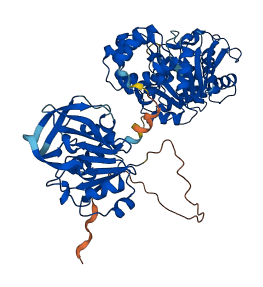
The autoinhibited protein was predicted that may have potential autoinhibitory elements via cis-regPred.
Autoinhibitory domains (AIDs)
Target domain |
|
Relief mechanism |
|
Assay |
cis-regPred |
Accessory elements
No accessory elements
Autoinhibited structure

Activated structure
1 structures for Q08654
| Entry ID | Method | Resolution | Chain | Position | Source |
|---|---|---|---|---|---|
| AF-Q08654-F1 | Predicted | AlphaFoldDB |
No variants for Q08654
| Variant ID(s) | Position | Change | Description | Diseaes Association | Provenance |
|---|---|---|---|---|---|
| No variants for Q08654 | |||||
No associated diseases with Q08654
4 regional properties for Q08654
| Type | Name | Position | InterPro Accession |
|---|---|---|---|
| domain | Glycosyl transferase, family 3 | 321 - 573 | IPR000312 |
| domain | Anthranilate synthase/para-aminobenzoate synthase like domain | 47 - 233 | IPR006221 |
| domain | Glycosyl transferase family 3, N-terminal domain | 252 - 313 | IPR017459 |
| domain | Glutamine amidotransferase | 49 - 232 | IPR017926 |
Functions
| Description | ||
|---|---|---|
| EC Number | 2.4.2.18 | Pentosyltransferases |
| Subcellular Localization |
|
|
| PANTHER Family | ||
| PANTHER Subfamily | ||
| PANTHER Protein Class | ||
| PANTHER Pathway Category | No pathway information available | |
No GO annotations of cellular component
| Name | Definition |
|---|---|
| No GO annotations for cellular component |
3 GO annotations of molecular function
| Name | Definition |
|---|---|
| anthranilate phosphoribosyltransferase activity | Catalysis of the reaction: N-(5-phospho-beta-D-ribosyl)anthranilate + diphosphate = 5-phospho-alpha-D-ribose 1-diphosphate + anthranilate. |
| anthranilate synthase activity | Catalysis of the reaction: chorismate + L-glutamine = anthranilate + pyruvate + L-glutamate. |
| magnesium ion binding | Binding to a magnesium (Mg) ion. |
2 GO annotations of biological process
| Name | Definition |
|---|---|
| glutamine metabolic process | The chemical reactions and pathways involving glutamine, 2-amino-4-carbamoylbutanoic acid. |
| tryptophan biosynthetic process | The chemical reactions and pathways resulting in the formation of tryptophan, the chiral amino acid 2-amino-3-(1H-indol-3-yl)propanoic acid; tryptophan is synthesized from chorismate via anthranilate. |
No homologous proteins in AiPD
| UniProt AC | Gene Name | Protein Name | Species | Evidence Code |
|---|---|---|---|---|
| No homologous proteins | ||||
| 10 | 20 | 30 | 40 | 50 | 60 |
| MAPGRSGYRL | RFRSGARISG | DSEQTQGFVQ | EPGSCAEDPG | GIVLKRVIVI | DNYDSFVYNI |
| 70 | 80 | 90 | 100 | 110 | 120 |
| VQYIGEVEPD | CEIEVFRNDE | ITIEEIERKN | PTHIVISPGP | GRPEEAGISV | DVVRHFSGKV |
| 130 | 140 | 150 | 160 | 170 | 180 |
| PILGVCLGHQ | VIGYAFGGKI | VHAKRILHGK | TSKIVHNGKG | VFSGVKNPLV | ATRYHSLVVE |
| 190 | 200 | 210 | 220 | 230 | 240 |
| EASLPEVLEI | TAKSDDGEIM | GLQHKEHPTF | GVQFHPESVL | TEEGKRIIKN | FLNIQDIQVK |
| 250 | 260 | 270 | 280 | 290 | 300 |
| KVSEETEIDI | VSALKKLVEF | EDLTFEESRQ | VMNFIMSGNA | TDAQIAGFLV | ALRMKEETGD |
| 310 | 320 | 330 | 340 | 350 | 360 |
| ELGGMASVMR | EKSIHIKAPS | PRTVDTCGTG | GDGFGTFNIS | TTTAFVVAAA | GIPVAKHGNR |
| 370 | 380 | 390 | 400 | 410 | 420 |
| SVSSKVGSAD | VLEAGGYKLE | KTPEEMEREL | KETGFSFLFA | PLLHPAMKHV | MPARRQLKIR |
| 430 | 440 | 450 | 460 | 470 | 480 |
| TAFNLLGPIT | NPARVKYQVV | GVFDLSFASK | LATALQRLGT | ERSAVVNGGF | TDELTTCGKN |
| 490 | 500 | 510 | 520 | 530 | 540 |
| NLLLVTQEEI | VPMVLDPEEL | GLKSGDPEEL | KGPSDPKEAY | RMMESVLKGE | ASRTQVETVA |
| 550 | 560 | 570 | 580 | ||
| LNAGVVFWLV | GECDTIKDGV | GKALDLIRTG | EAYKKLREVM | DYQKTLGNS |