Q08496
Gene name |
DIA2 (YOR080W, YOR29-31) |
Protein name |
Protein DIA2 |
Names |
Digs into agar protein 2 |
Species |
Saccharomyces cerevisiae (strain ATCC 204508 / S288c) (Baker's yeast) |
KEGG Pathway |
sce:YOR080W |
EC number |
|
Protein Class |
|
Descriptions
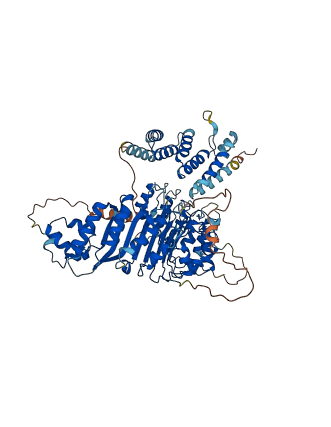
The autoinhibited protein was predicted that may have potential autoinhibitory elements via cis-regPred.
Autoinhibitory domains (AIDs)
Target domain |
|
Relief mechanism |
|
Assay |
cis-regPred |
Accessory elements
No accessory elements
Autoinhibited structure

Activated structure
3 structures for Q08496
| Entry ID | Method | Resolution | Chain | Position | Source |
|---|---|---|---|---|---|
| 7PMK | EM | 320 A | L | 1-732 | PDB |
| 7PMN | EM | 320 A | L | 1-732 | PDB |
| AF-Q08496-F1 | Predicted | AlphaFoldDB |
29 variants for Q08496
| Variant ID(s) | Position | Change | Description | Diseaes Association | Provenance |
|---|---|---|---|---|---|
| s15-474611 | 6 | N>Y | No | SGRP | |
| s15-474623 | 10 | A>T | No | SGRP | |
| s15-474755 | 54 | M>V | No | SGRP | |
| s15-474770 | 59 | A>S | No | SGRP | |
| s15-475034 | 147 | N>H | No | SGRP | |
| s15-475070 | 159 | N>H | No | SGRP | |
| s15-475116 | 174 | L>S | No | SGRP | |
| s15-475127 | 178 | K>Q | No | SGRP | |
| s15-475143 | 183 | K>R | No | SGRP | |
| s15-475157 | 188 | V>F | No | SGRP | |
| s15-475173 | 193 | P>L | No | SGRP | |
| s15-475172 | 193 | P>S | No | SGRP | |
| s15-475194 | 200 | S>T | No | SGRP | |
| s15-475270 | 225 | K>N | No | SGRP | |
| s15-475526 | 311 | I>V | No | SGRP | |
| s15-475610 | 339 | T>A | No | SGRP | |
| s15-475650 | 352 | P>L | No | SGRP | |
| s15-475811 | 406 | S>P | No | SGRP | |
| s15-475818 | 408 | A>V | No | SGRP | |
| s15-475842 | 416 | V>A | No | SGRP | |
| s15-476011 | 472 | M>I | No | SGRP | |
| s15-476051 | 486 | L>I | No | SGRP | |
| s15-476111 | 506 | S>T | No | SGRP | |
| s15-476171 | 526 | V>I | No | SGRP | |
| s15-476207 | 538 | D>N | No | SGRP | |
| s15-476329 | 578 | D>E | No | SGRP | |
| s15-476381 | 596 | P>S | No | SGRP | |
| s15-476399 | 602 | T>A | No | SGRP | |
| s15-476519 | 642 | V>I | No | SGRP |
No associated diseases with Q08496
6 regional properties for Q08496
| Type | Name | Position | InterPro Accession |
|---|---|---|---|
| repeat | Leucine-rich repeat | 581 - 601 | IPR001611-1 |
| repeat | Leucine-rich repeat | 647 - 669 | IPR001611-2 |
| domain | F-box domain | 204 - 251 | IPR001810 |
| repeat | Leucine-rich repeat, cysteine-containing subtype | 579 - 615 | IPR006553-1 |
| repeat | Leucine-rich repeat, cysteine-containing subtype | 616 - 641 | IPR006553-2 |
| repeat | Leucine-rich repeat, cysteine-containing subtype | 645 - 670 | IPR006553-3 |
3 GO annotations of cellular component
| Name | Definition |
|---|---|
| chromosome, telomeric region | The end of a linear chromosome, required for the integrity and maintenance of the end. A chromosome telomere usually includes a region of telomerase-encoded repeats the length of which rarely exceeds 20 bp each and that permits the formation of a telomeric loop (T-loop). The telomeric repeat region is usually preceded by a sub-telomeric region that is gene-poor but rich in repetitive elements. Some telomeres only consist of the latter part (for eg. D. melanogaster telomeres). |
| nucleus | A membrane-bounded organelle of eukaryotic cells in which chromosomes are housed and replicated. In most cells, the nucleus contains all of the cell's chromosomes except the organellar chromosomes, and is the site of RNA synthesis and processing. In some species, or in specialized cell types, RNA metabolism or DNA replication may be absent. |
| SCF ubiquitin ligase complex | A ubiquitin ligase complex in which a cullin from the Cul1 subfamily and a RING domain protein form the catalytic core; substrate specificity is conferred by a Skp1 adaptor and an F-box protein. SCF complexes are involved in targeting proteins for degradation by the proteasome. The best characterized complexes are those from yeast and mammals (with core subunits named Cdc53/Cul1, Rbx1/Hrt1/Roc1). |
1 GO annotations of molecular function
| Name | Definition |
|---|---|
| DNA replication origin binding | Binding to a DNA replication origin, a unique DNA sequence of a replicon at which DNA replication is initiated and proceeds bidirectionally or unidirectionally. |
9 GO annotations of biological process
| Name | Definition |
|---|---|
| invasive growth in response to glucose limitation | A growth pattern exhibited by budding haploid cells under certain growth conditions, in which cells retain the typical axial budding pattern of haploids, but become elongated and fail to separate after division; during growth on a solid substrate, this results in penetration of cells into the agar medium. An example of this process is found in Saccharomyces cerevisiae. |
| mitotic intra-S DNA damage checkpoint signaling | A mitotic cell cycle checkpoint that slows DNA synthesis in response to DNA damage by the prevention of new origin firing and the stabilization of slow replication fork progression. |
| protein ubiquitination | The process in which one or more ubiquitin groups are added to a protein. |
| protein-containing complex disassembly | The disaggregation of a protein-containing macromolecular complex into its constituent components. |
| regulation of DNA replication | Any process that modulates the frequency, rate or extent of DNA replication. |
| SCF-dependent proteasomal ubiquitin-dependent protein catabolic process | The chemical reactions and pathways resulting in the breakdown of a protein or peptide by hydrolysis of its peptide bonds, initiated by the covalent attachment of ubiquitin, with ubiquitin-protein ligation catalyzed by an SCF (Skp1/Cul1/F-box protein) complex, and mediated by the proteasome. |
| silent mating-type cassette heterochromatin assembly | Repression of transcription at silent mating-type loci by alteration of the structure of chromatin. |
| subtelomeric heterochromatin assembly | The compaction of chromatin into heterochromatin at the subtelomeric region. |
| ubiquitin-dependent protein catabolic process | The chemical reactions and pathways resulting in the breakdown of a protein or peptide by hydrolysis of its peptide bonds, initiated by the covalent attachment of a ubiquitin group, or multiple ubiquitin groups, to the protein. |
No homologous proteins in AiPD
| UniProt AC | Gene Name | Protein Name | Species | Evidence Code |
|---|---|---|---|---|
| No homologous proteins | ||||
| 10 | 20 | 30 | 40 | 50 | 60 |
| MSSPGNSGVA | IDSTVLKAIE | LGTRLFKSGE | YLQAKRIFTN | ALRVCDSYSQ | EQIMRIRNAY |
| 70 | 80 | 90 | 100 | 110 | 120 |
| QLDTARPDNK | RLYHPRYIKI | LDNICACYEK | LNDLKSCLDV | SQRLLKLEPG | NIKCYIRCTR |
| 130 | 140 | 150 | 160 | 170 | 180 |
| TLIKLKDWKR | AYKTCSRGLQ | LCNNDSNHLR | QQKQFIKNNM | VQKQDGKRSY | IDPLEETKIA |
| 190 | 200 | 210 | 220 | 230 | 240 |
| KKKKNNNVLE | SLPKKKIKGS | TKKTDLVGNL | PIEILPIIFQ | RFTTKELVTL | SLVCNKWRDK |
| 250 | 260 | 270 | 280 | 290 | 300 |
| ILYHLDCFQE | FNLAPINFKN | FVKFMDFLQQ | NFTRTYRKYI | LSQVKVSSRI | TSEELRITQL |
| 310 | 320 | 330 | 340 | 350 | 360 |
| LFSKMPKCIN | IERLILSMPT | LTTTQIFKLM | VRGGTDFFTR | LLELSLMITY | RPDKQHELEI |
| 370 | 380 | 390 | 400 | 410 | 420 |
| LQTCPLLKKI | ELIFVNSLVP | IFDGNNSVGR | DGSFNVMARH | TNMQISTADN | DEQGIVEEKV |
| 430 | 440 | 450 | 460 | 470 | 480 |
| IYSELEKITL | ICDKKKIKNF | PLCRALLRGQ | FPLLQKLTIT | GVTFPMNNQD | IMNFQWLLNF |
| 490 | 500 | 510 | 520 | 530 | 540 |
| PDLKELWIED | NDNCELSKFL | QLLKFSNVWK | NLEKLTFREN | KLYPIVNLDE | DQPVTNDDEV |
| 550 | 560 | 570 | 580 | 590 | 600 |
| PSMLFYKENL | QNLEKLDLMG | TSISGSALTR | LCEQEYLDGR | KLRSLNIGNC | PNIQFPNNHA |
| 610 | 620 | 630 | 640 | 650 | 660 |
| HTARMILDVN | AVLKRLSKLE | EINLSHLSSL | NDSTMKSFII | NVPFLENLKR | LDISHNFEIT |
| 670 | 680 | 690 | 700 | 710 | 720 |
| GISIYEFLKK | FQMDHDNEAG | GQPLAYLNID | GCSQVSHITV | NMIRAQNLVT | QVDCVYERDV |
| 730 | |||||
| WRKFGINSYS | YS |