Q08457
Gene name |
SLD7 (YOR060C, YOR29-11) |
Protein name |
Mitochondrial morphogenesis protein SLD7 |
Names |
Synthetic lethality with DPB11-24 mutation protein 7 |
Species |
Saccharomyces cerevisiae (strain ATCC 204508 / S288c) (Baker's yeast) |
KEGG Pathway |
sce:YOR060C |
EC number |
|
Protein Class |
|
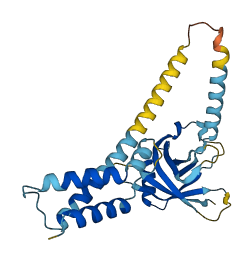
Descriptions
The autoinhibited protein was predicted that may have potential autoinhibitory elements via cis-regPred.
Autoinhibitory domains (AIDs)
Target domain |
|
Relief mechanism |
|
Assay |
cis-regPred |
Accessory elements
No accessory elements
Autoinhibited structure

Activated structure
2 structures for Q08457
| Entry ID | Method | Resolution | Chain | Position | Source |
|---|---|---|---|---|---|
| 3X38 | X-ray | 180 A | A/B/C/D | 178-257 | PDB |
| AF-Q08457-F1 | Predicted | AlphaFoldDB |
5 variants for Q08457
| Variant ID(s) | Position | Change | Description | Diseaes Association | Provenance |
|---|---|---|---|---|---|
| s15-441138 | 10 | F>L | No | SGRP | |
| s15-440885 | 94 | F>S | No | SGRP | |
| s15-440749 | 139 | D>E | No | SGRP | |
| s15-440658 | 170 | E>K | No | SGRP | |
| s15-440526 | 214 | I>V | No | SGRP |
No associated diseases with Q08457
7 GO annotations of cellular component
| Name | Definition |
|---|---|
| chromosome, centromeric region | The region of a chromosome that includes the centromeric DNA and associated proteins. In monocentric chromosomes, this region corresponds to a single area of the chromosome, whereas in holocentric chromosomes, it is evenly distributed along the chromosome. |
| cytoplasm | The contents of a cell excluding the plasma membrane and nucleus, but including other subcellular structures. |
| DNA replication preinitiation complex | A protein-DNA complex assembled at eukaryotic DNA replication origins immediately prior to the initiation of DNA replication. The preinitiation complex is formed by the assembly of additional proteins onto an existing prereplicative complex. In budding yeast, the additional proteins might include Cdc45p, Sld2p, Sld3p, Dpb11p, DNA polymerases, and others; in fission yeast the GINS complex is present. |
| endoplasmic reticulum | The irregular network of unit membranes, visible only by electron microscopy, that occurs in the cytoplasm of many eukaryotic cells. The membranes form a complex meshwork of tubular channels, which are often expanded into slitlike cavities called cisternae. The ER takes two forms, rough (or granular), with ribosomes adhering to the outer surface, and smooth (with no ribosomes attached). |
| nuclear envelope | The double lipid bilayer enclosing the nucleus and separating its contents from the rest of the cytoplasm; includes the intermembrane space, a gap of width 20-40 nm (also called the perinuclear space). |
| nucleus | A membrane-bounded organelle of eukaryotic cells in which chromosomes are housed and replicated. In most cells, the nucleus contains all of the cell's chromosomes except the organellar chromosomes, and is the site of RNA synthesis and processing. In some species, or in specialized cell types, RNA metabolism or DNA replication may be absent. |
| spindle pole | Either of the ends of a spindle, where spindle microtubules are organized; usually contains a microtubule organizing center and accessory molecules, spindle microtubules and astral microtubules. |
No GO annotations of molecular function
| Name | Definition |
|---|---|
| No GO annotations for molecular function |
3 GO annotations of biological process
| Name | Definition |
|---|---|
| cell cycle | The progression of biochemical and morphological phases and events that occur in a cell during successive cell replication or nuclear replication events. Canonically, the cell cycle comprises the replication and segregation of genetic material followed by the division of the cell, but in endocycles or syncytial cells nuclear replication or nuclear division may not be followed by cell division. |
| DNA replication | The cellular metabolic process in which a cell duplicates one or more molecules of DNA. DNA replication begins when specific sequences, known as origins of replication, are recognized and bound by initiation proteins, and ends when the original DNA molecule has been completely duplicated and the copies topologically separated. The unit of replication usually corresponds to the genome of the cell, an organelle, or a virus. The template for replication can either be an existing DNA molecule or RNA. |
| regulation of DNA-templated DNA replication initiation | Any process that modulates the frequency, rate or extent of initiation of DNA-dependent DNA replication; the process in which DNA becomes competent to replicate. In eukaryotes, replication competence is established in early G1 and lost during the ensuing S phase. |
No homologous proteins in AiPD
| UniProt AC | Gene Name | Protein Name | Species | Evidence Code |
|---|---|---|---|---|
| No homologous proteins | ||||
| 10 | 20 | 30 | 40 | 50 | 60 |
| MSRKLCTLNF | TLSGKQGSLV | IRDIQLWSNR | PTASKSTSEL | RGQFIQYVDL | AKLPLWVRST |
| 70 | 80 | 90 | 100 | 110 | 120 |
| NMNTYRCYST | SATAQAYFKS | KLRNANRGIV | IELFDKVDQR | SQEPAYLIIF | RENTELNCFQ |
| 130 | 140 | 150 | 160 | 170 | 180 |
| VDLTMKHEFD | GQVTKLKQDI | GKTRASVSKE | GSIDIIIQQS | QQRKIGTKTE | VYRNVHINDK |
| 190 | 200 | 210 | 220 | 230 | 240 |
| RLQFNETLSK | LILGGLRLRG | ISNSITDYQK | LYKITFDAAE | FTHRDELKRI | SMGSGEEVSF |
| 250 | |||||
| ESLQETVETL | LKLFTKS |