Q08109
Gene name |
HRD1 (DER3, YOL013C) |
Protein name |
ERAD-associated E3 ubiquitin-protein ligase HRD1 |
Names |
HMG-CoA reductase degradation protein 1, RING-type E3 ubiquitin transferase HRD1 |
Species |
Saccharomyces cerevisiae (strain ATCC 204508 / S288c) (Baker's yeast) |
KEGG Pathway |
sce:YOL013C |
EC number |
2.3.2.27: Aminoacyltransferases |
Protein Class |
|
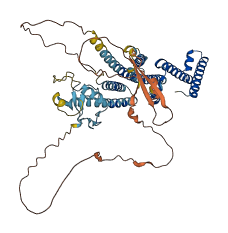
Descriptions
The autoinhibited protein was predicted that may have potential autoinhibitory elements via cis-regPred.
Autoinhibitory domains (AIDs)
Target domain |
|
Relief mechanism |
|
Assay |
cis-regPred |
Accessory elements
No accessory elements

10 variants for Q08109
| Variant ID(s) | Position | Change | Description | Diseaes Association | Provenance |
|---|---|---|---|---|---|
| s15-303001 | 12 | I>M | No | SGRP | |
| s15-302114 | 308 | L>S | No | SGRP | |
| s15-302018 | 340 | Q>R | No | SGRP | |
| s15-301680 | 453 | S>P | No | SGRP | |
| s15-301662 | 459 | V>M | No | SGRP | |
| s15-301659 | 460 | P>S | No | SGRP | |
| s15-301632 | 469 | M>V | No | SGRP | |
| s15-301622 | 472 | R>T | No | SGRP | |
| s15-301569 | 490 | G>S | No | SGRP | |
| s15-301494 | 515 | I>L | No | SGRP |
No associated diseases with Q08109
1 regional properties for Q08109
| Type | Name | Position | InterPro Accession |
|---|---|---|---|
| domain | Zinc finger, RING-type | 348 - 400 | IPR001841 |
Functions
| Description | ||
|---|---|---|
| EC Number | 2.3.2.27 | Aminoacyltransferases |
| Subcellular Localization |
|
|
| PANTHER Family | ||
| PANTHER Subfamily | ||
| PANTHER Protein Class | ||
| PANTHER Pathway Category | No pathway information available | |
6 GO annotations of cellular component
| Name | Definition |
|---|---|
| endoplasmic reticulum | The irregular network of unit membranes, visible only by electron microscopy, that occurs in the cytoplasm of many eukaryotic cells. The membranes form a complex meshwork of tubular channels, which are often expanded into slitlike cavities called cisternae. The ER takes two forms, rough (or granular), with ribosomes adhering to the outer surface, and smooth (with no ribosomes attached). |
| endoplasmic reticulum membrane | The lipid bilayer surrounding the endoplasmic reticulum. |
| Hrd1p ubiquitin ligase complex | A multiprotein complex that recognizes and ubiquitinates proteins with misfolded luminal and membrane domains during ER-associated protein degradation (ERAD). In S. cerevisiae, this complex contains the ubiquitin ligase Hrd1p. In mammals, this complex contains the ubiquitin ligase HRD1 (Synoviolin) or AMFR (gp78). |
| Hrd1p ubiquitin ligase ERAD-L complex | A multiprotein complex that recognizes and ubiquitinates proteins with misfolded luminal domains during ER-associated protein degradation (ERAD). In S. cerevisiae, this complex contains the ubiquitin ligase Hrd1p. |
| Hrd1p ubiquitin ligase ERAD-M complex | A multiprotein complex that recognizes and ubiquitinates proteins with misfolded membrane domains during ER-associated protein degradation (ERAD). In S. cerevisiae, this complex contains the ubiquitin ligase Hrd1p. |
| integral component of membrane | The component of a membrane consisting of the gene products and protein complexes having at least some part of their peptide sequence embedded in the hydrophobic region of the membrane. |
4 GO annotations of molecular function
| Name | Definition |
|---|---|
| identical protein binding | Binding to an identical protein or proteins. |
| metal ion binding | Binding to a metal ion. |
| ubiquitin protein ligase activity | Catalysis of the transfer of ubiquitin to a substrate protein via the reaction X-ubiquitin + S -> X + S-ubiquitin, where X is either an E2 or E3 enzyme, the X-ubiquitin linkage is a thioester bond, and the S-ubiquitin linkage is an amide bond: an isopeptide bond between the C-terminal glycine of ubiquitin and the epsilon-amino group of lysine residues in the substrate or, in the linear extension of ubiquitin chains, a peptide bond the between the C-terminal glycine and N-terminal methionine of ubiquitin residues. |
| ubiquitin-protein transferase activity | Catalysis of the transfer of ubiquitin from one protein to another via the reaction X-Ub + Y --> Y-Ub + X, where both X-Ub and Y-Ub are covalent linkages. |
7 GO annotations of biological process
| Name | Definition |
|---|---|
| endoplasmic reticulum unfolded protein response | The series of molecular signals generated as a consequence of the presence of unfolded proteins in the endoplasmic reticulum (ER) or other ER-related stress; results in changes in the regulation of transcription and translation. |
| fungal-type cell wall organization | A process that is carried out at the cellular level which results in the assembly, arrangement of constituent parts, or disassembly of the fungal-type cell wall. |
| protein autoubiquitination | The ubiquitination by a protein of one or more of its own amino acid residues, or residues on an identical protein. Ubiquitination occurs on the lysine residue by formation of an isopeptide crosslink. |
| protein K48-linked ubiquitination | A protein ubiquitination process in which a polymer of ubiquitin, formed by linkages between lysine residues at position 48 of the ubiquitin monomers, is added to a protein. K48-linked ubiquitination targets the substrate protein for degradation. |
| retrograde protein transport, ER to cytosol | The directed movement of unfolded or misfolded proteins from the endoplasmic reticulum to the cytosol through the translocon. |
| ubiquitin-dependent ERAD pathway | The series of steps necessary to target endoplasmic reticulum (ER)-resident proteins for degradation by the cytoplasmic proteasome. Begins with recognition of the ER-resident protein, includes retrotranslocation (dislocation) of the protein from the ER to the cytosol, protein ubiquitination necessary for correct substrate transfer, transport of the protein to the proteasome, and ends with degradation of the protein by the cytoplasmic proteasome. |
| ubiquitin-dependent protein catabolic process | The chemical reactions and pathways resulting in the breakdown of a protein or peptide by hydrolysis of its peptide bonds, initiated by the covalent attachment of a ubiquitin group, or multiple ubiquitin groups, to the protein. |
No homologous proteins in AiPD
| UniProt AC | Gene Name | Protein Name | Species | Evidence Code |
|---|---|---|---|---|
| No homologous proteins | ||||
| 10 | 20 | 30 | 40 | 50 | 60 |
| MVPENRRKQL | AIFVVVTYLL | TFYCVYSATK | TSVSFLQVTL | KLNEGFNLMV | LSIFILLNST |
| 70 | 80 | 90 | 100 | 110 | 120 |
| LLWQLLTKLL | FGELRLIEHE | HIFERLPFTI | INTLFMSSLF | HERYFFTVAF | FGLLLLYLKV |
| 130 | 140 | 150 | 160 | 170 | 180 |
| FHWILKDRLE | ALLQSINDST | TMKTLIFSRF | SFNLVLLAVV | DYQIITRCIS | SIYTNQKSDI |
| 190 | 200 | 210 | 220 | 230 | 240 |
| ESTSLYLIQV | MEFTMLLIDL | LNLFLQTCLN | FWEFYRSQQS | LSNENNHIVH | GDPTDENTVE |
| 250 | 260 | 270 | 280 | 290 | 300 |
| SDQSQPVLND | DDDDDDDDRQ | FTGLEGKFMY | EKAIDVFTRF | LKTALHLSML | IPFRMPMMLL |
| 310 | 320 | 330 | 340 | 350 | 360 |
| KDVVWDILAL | YQSGTSLWKI | WRNNKQLDDT | LVTVTVEQLQ | NSANDDNICI | ICMDELIHSP |
| 370 | 380 | 390 | 400 | 410 | 420 |
| NQQTWKNKNK | KPKRLPCGHI | LHLSCLKNWM | ERSQTCPICR | LPVFDEKGNV | VQTTFTSNSD |
| 430 | 440 | 450 | 460 | 470 | 480 |
| ITTQTTVTDS | TGIATDQQGF | ANEVDLLPTR | TTSPDIRIVP | TQNIDTLAMR | TRSTSTPSPT |
| 490 | 500 | 510 | 520 | 530 | 540 |
| WYTFPLHKTG | DNSVGSSRSA | YEFLITNSDE | KENGIPVKLT | IENHEVNSLH | GDGGEQIAKK |
| 550 | |||||
| IVIPDKFIQH | I |