Q07794
Gene name |
RTT109 |
Protein name |
Histone acetyltransferase RTT109 |
Names |
Regulator of Ty1 transposition protein 109 |
Species |
Saccharomyces cerevisiae (strain ATCC 204508 / S288c) (Baker's yeast) |
KEGG Pathway |
sce:YLL002W |
EC number |
2.3.1.48: Transferring groups other than amino-acyl groups |
Protein Class |
|
Descriptions
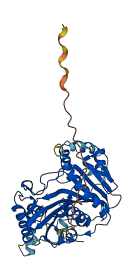
The autoinhibited protein was predicted that may have potential autoinhibitory elements via cis-regPred.
Autoinhibitory domains (AIDs)
Target domain |
|
Relief mechanism |
|
Assay |
cis-regPred |
Accessory elements
No accessory elements
Autoinhibited structure

Activated structure
11 structures for Q07794
| Entry ID | Method | Resolution | Chain | Position | Source |
|---|---|---|---|---|---|
| 2RIM | X-ray | 220 A | A | 1-436 | PDB |
| 2ZFN | X-ray | 190 A | A | 1-436 | PDB |
| 3CZ7 | X-ray | 200 A | PDB | ||
| 3Q33 | X-ray | 280 A | A | 1-436 | PDB |
| 3Q35 | X-ray | 330 A | A | 1-436 | PDB |
| 3Q66 | X-ray | 270 A | C | 1-436 | PDB |
| 3Q68 | X-ray | 270 A | C | 1-436 | PDB |
| 3QM0 | X-ray | 310 A | A | 1-436 | PDB |
| 6F0Y | NMR | - | B | 419-433 | PDB |
| 6O22 | Other | - | C | 1-436 | PDB |
| AF-Q07794-F1 | Predicted | AlphaFoldDB |
10 variants for Q07794
| Variant ID(s) | Position | Change | Description | Diseaes Association | Provenance |
|---|---|---|---|---|---|
| s12-146306 | 6 | F>Y | No | SGRP | |
| s12-146572 | 95 | N>D | No | SGRP | |
| s12-146587 | 100 | V>I | No | SGRP | |
| s12-146788 | 167 | E>K | No | SGRP | |
| s12-146795 | 169 | P>L | No | SGRP | |
| s12-146800 | 171 | F>L | No | SGRP | |
| s12-147004 | 239 | Q>K | No | SGRP | |
| s12-147059 | 257 | R>K | No | SGRP | |
| s12-147400 | 371 | D>N | No | SGRP | |
| s12-147584 | 432 | A>V | No | SGRP |
No associated diseases with Q07794
1 regional properties for Q07794
| Type | Name | Position | InterPro Accession |
|---|---|---|---|
| domain | Ribosomal protein S10 domain | 63 - 160 | IPR027486 |
Functions
| Description | ||
|---|---|---|
| EC Number | 2.3.1.48 | Transferring groups other than amino-acyl groups |
| Subcellular Localization |
|
|
| PANTHER Family | ||
| PANTHER Subfamily | ||
| PANTHER Protein Class | ||
| PANTHER Pathway Category | No pathway information available | |
3 GO annotations of cellular component
| Name | Definition |
|---|---|
| chromatin | The ordered and organized complex of DNA, protein, and sometimes RNA, that forms the chromosome. |
| H3 histone acetyltransferase complex | A multisubunit complex that catalyzes the acetylation of histone H3. |
| nucleus | A membrane-bounded organelle of eukaryotic cells in which chromosomes are housed and replicated. In most cells, the nucleus contains all of the cell's chromosomes except the organellar chromosomes, and is the site of RNA synthesis and processing. In some species, or in specialized cell types, RNA metabolism or DNA replication may be absent. |
7 GO annotations of molecular function
| Name | Definition |
|---|---|
| H3 histone acetyltransferase activity | Catalysis of the reaction: acetyl-CoA + histone H3 = CoA + acetyl-histone H3. |
| histone acetyltransferase activity (H3-K14 specific) | Catalysis of the reaction: acetyl-CoA + histone H3 L-lysine (position 14) = CoA + histone H3 N6-acetyl-L-lysine (position 14). |
| histone acetyltransferase activity (H3-K23 specific) | Catalysis of the reaction: acetyl-CoA + histone H3 L-lysine (position 23) = CoA + histone H3 N6-acetyl-L-lysine (position 23). |
| histone acetyltransferase activity (H3-K27 specific) | Catalysis of the reaction: acetyl-CoA + histone H3 L-lysine (position 27) = CoA + histone H3 N6-acetyl-L-lysine (position 27). |
| histone acetyltransferase activity (H3-K56 specific) | Catalysis of the reaction: acetyl-CoA + histone H3 L-lysine (position 56) = CoA + histone H3 N6-acetyl-L-lysine (position 56). |
| histone acetyltransferase activity (H3-K9 specific) | Catalysis of the reaction: acetyl-CoA + histone H3 L-lysine (position 9) = CoA + histone H3 N6-acetyl-L-lysine (position 9). |
| peptide-lysine-N-acetyltransferase activity | Catalysis of the reaction: acetyl-CoA + lysine in peptide = CoA + N-acetyl-lysine-peptide. |
18 GO annotations of biological process
| Name | Definition |
|---|---|
| cellular response to DNA damage stimulus | Any process that results in a change in state or activity of a cell (in terms of movement, secretion, enzyme production, gene expression, etc.) as a result of a stimulus indicating damage to its DNA from environmental insults or errors during metabolism. |
| histone acetylation | The modification of a histone by the addition of an acetyl group. |
| histone H3 acetylation | The modification of histone H3 by the addition of an acetyl group. |
| histone H3-K14 acetylation | The modification of histone H3 by the addition of an acetyl group to a lysine residue at position 14 of the histone. |
| histone H3-K23 acetylation | The modification of histone H3 by the addition of an acetyl group to a lysine residue at position 23 of the histone. |
| histone H3-K27 acetylation | The modification of histone H3 by the addition of an acetyl group to a lysine residue at position 27 of the histone. |
| histone H3-K56 acetylation | The modification of histone H3 by the addition of an acetyl group to a lysine residue at position 56 of the histone. |
| histone H3-K9 acetylation | The modification of histone H3 by the addition of an acetyl group to a lysine residue at position 9 of the histone. |
| maintenance of rDNA | Any process involved in sustaining the fidelity and copy number of rDNA repeats. |
| negative regulation of transposition, RNA-mediated | Any process that decreases the frequency, rate or extent of RNA-mediated transposition. RNA-mediated transposition is a type of transpositional recombination which occurs via an RNA intermediate. |
| nucleosome assembly | The aggregation, arrangement and bonding together of a nucleosome, the beadlike structural units of eukaryotic chromatin composed of histones and DNA. |
| peptidyl-lysine acetylation | The acetylation of peptidyl-lysine. |
| protein acetylation | The addition of an acetyl group to a protein amino acid. An acetyl group is CH3CO-, derived from acetic |
| regulation of double-strand break repair via nonhomologous end joining | Any process that modulates the frequency, rate or extent of double-strand break repair via nonhomologous end joining. |
| regulation of gene expression | Any process that modulates the frequency, rate or extent of gene expression. Gene expression is the process in which a gene's coding sequence is converted into a mature gene product (protein or RNA). |
| regulation of transcription by RNA polymerase II | Any process that modulates the frequency, rate or extent of transcription mediated by RNA polymerase II. |
| regulation of transcription from RNA polymerase II promoter in response to stress | Any process that modulates the frequency, rate or extent of transcription from an RNA polymerase II promoter as a result of a stimulus indicating the organism is under stress. The stress is usually, but not necessarily, exogenous (e.g. temperature, humidity, ionizing radiation). |
| replication-born double-strand break repair via sister chromatid exchange | The repair of a replication-born double-strand DNA break in which the DNA molecule is repaired using the homologous sequence of the sister chromatid which serves as a template to repair the breaks. |
No homologous proteins in AiPD
| UniProt AC | Gene Name | Protein Name | Species | Evidence Code |
|---|---|---|---|---|
| No homologous proteins | ||||
| 10 | 20 | 30 | 40 | 50 | 60 |
| MSLNDFLSSV | LPVSEQFEYL | SLQSIPLETH | AVVTPNKDDK | RVPKSTIKTQ | HFFSLFHQGK |
| 70 | 80 | 90 | 100 | 110 | 120 |
| VFFSLEVYVY | VTLWDEADAE | RLIFVSKADT | NGYCNTRVSV | RDITKIILEF | ILSIDPNYYL |
| 130 | 140 | 150 | 160 | 170 | 180 |
| QKVKPAIRSY | KKISPELISA | ASTPARTLRI | LARRLKQSGS | TVLKEIESPR | FQQDLYLSFT |
| 190 | 200 | 210 | 220 | 230 | 240 |
| CPREILTKIC | LFTRPASQYL | FPDSSKNSKK | HILNGEELMK | WWGFILDRLL | IECFQNDTQA |
| 250 | 260 | 270 | 280 | 290 | 300 |
| KLRIPGEDPA | RVRSYLRGMK | YPLWQVGDIF | TSKENSLAVY | NIPLFPDDPK | ARFIHQLAEE |
| 310 | 320 | 330 | 340 | 350 | 360 |
| DRLLKVSLSS | FWIELQERQE | FKLSVTSSVM | GISGYSLATP | SLFPSSADVI | VPKSRKQFRA |
| 370 | 380 | 390 | 400 | 410 | 420 |
| IKKYITGEEY | DTEEGAIEAF | TNIRDFLLLR | MATNLQSLTG | KREHRERNQP | VPASNINTLA |
| 430 | |||||
| ITMLKPRKKA | KALPKT |