Q07353
Gene name |
AN3 |
Protein name |
Naringenin,2-oxoglutarate 3-dioxygenase |
Names |
FHT, Flavanone-3-hydroxylase, F3H |
Species |
Petunia hybrida (Petunia) |
KEGG Pathway |
|
EC number |
1.14.11.9: With 2-oxoglutarate as one donor, and incorporation of one atom each of oxygen into both donors |
Protein Class |
|
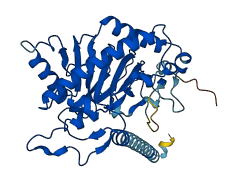
Descriptions
The autoinhibited protein was predicted that may have potential autoinhibitory elements via cis-regPred.
Autoinhibitory domains (AIDs)
Target domain |
|
Relief mechanism |
|
Assay |
cis-regPred |
Accessory elements
No accessory elements
Autoinhibited structure

Activated structure
1 structures for Q07353
| Entry ID | Method | Resolution | Chain | Position | Source |
|---|---|---|---|---|---|
| AF-Q07353-F1 | Predicted | AlphaFoldDB |
No variants for Q07353
| Variant ID(s) | Position | Change | Description | Diseaes Association | Provenance |
|---|---|---|---|---|---|
| No variants for Q07353 | |||||
No associated diseases with Q07353
Functions
| Description | ||
|---|---|---|
| EC Number | 1.14.11.9 | With 2-oxoglutarate as one donor, and incorporation of one atom each of oxygen into both donors |
| Subcellular Localization |
|
|
| PANTHER Family | ||
| PANTHER Subfamily | ||
| PANTHER Protein Class | ||
| PANTHER Pathway Category | No pathway information available | |
No GO annotations of cellular component
| Name | Definition |
|---|---|
| No GO annotations for cellular component |
3 GO annotations of molecular function
| Name | Definition |
|---|---|
| L-ascorbic acid binding | Binding to L-ascorbic acid, (2R)-2-[(1S)-1,2-dihydroxyethyl]-4-hydroxy-5-oxo-2,5-dihydrofuran-3-olate; L-ascorbic acid is vitamin C and has co-factor and anti-oxidant activities in many species. |
| metal ion binding | Binding to a metal ion. |
| naringenin 3-dioxygenase activity | Catalysis of the reaction: naringenin + 2-oxoglutarate + O2 = dihydrokaempferol + succinate + CO2. |
3 GO annotations of biological process
| Name | Definition |
|---|---|
| coumarin biosynthetic process | The chemical reactions and pathways resulting in the formation of coumarins, a class of compounds derived from the phenylacrylic skeleton of cinnamic acids. |
| flavonoid biosynthetic process | The chemical reactions and pathways resulting in the formation of flavonoids, a group of phenolic derivatives containing a flavan skeleton. |
| response to molecule of fungal origin | Any process that results in a change in state or activity of an organism (in terms of movement, secretion, enzyme production, gene expression, etc.) as a result of a stimulus by molecules of fungal origin such as chito-octamer oligosaccharide. |
No homologous proteins in AiPD
| UniProt AC | Gene Name | Protein Name | Species | Evidence Code |
|---|---|---|---|---|
| No homologous proteins | ||||
| 10 | 20 | 30 | 40 | 50 | 60 |
| IPRVTPSTLT | ALAEEKTLQT | SFIRDEDERP | KVAYNQFSNE | IPIISLEGID | DETGKRAEIC |
| 70 | 80 | 90 | 100 | 110 | 120 |
| DKIVKACEDW | GVFQVVDHGV | DAEVISQMTT | FAKEFFALPP | EEKLRFDMSG | GKKGGFIVSS |
| 130 | 140 | 150 | 160 | 170 | 180 |
| HLQGEVVQDW | REIVTYFSYP | TRARDYSRWP | DKPEGWIAVT | QKYSEKLMEL | ACKLLDVLSE |
| 190 | 200 | 210 | 220 | 230 | 240 |
| AMGLEKEALT | KACVDMDQKV | VVNFYPKCPE | PDLTLGLKRH | TDPGTITLLL | QDQVGGLQAT |
| 250 | 260 | 270 | 280 | 290 | 300 |
| KDNGKTWITV | QPVEGAFVVN | LGDHGHFLSN | GRFKNADHQA | VVNSNSSRLS | IATFQNPAPE |
| 310 | 320 | 330 | 340 | 350 | 360 |
| AIVYPLKIRE | GEKSIMDEPI | TFAEMYRRKM | SKDLELARLK | KQAKEQQLQA | EVAAEKAKLE |
| SKPIEEILA |