Q07139
Gene name |
Ect2 (mKIAA4037) |
Protein name |
Protein ECT2 |
Names |
Epithelial cell-transforming sequence 2 oncogene |
Species |
Mus musculus (Mouse) |
KEGG Pathway |
mmu:13605 |
EC number |
|
Protein Class |
|
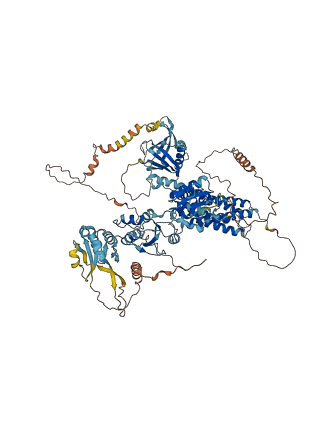
Descriptions
The autoinhibited protein was predicted that may have potential autoinhibitory elements via cis-regPred.
Autoinhibitory domains (AIDs)
Target domain |
|
Relief mechanism |
|
Assay |
cis-regPred |
Accessory elements
No accessory elements
Autoinhibited structure

Activated structure
2 structures for Q07139
| Entry ID | Method | Resolution | Chain | Position | Source |
|---|---|---|---|---|---|
| 2COU | NMR | - | A | 266-361 | PDB |
| AF-Q07139-F1 | Predicted | AlphaFoldDB |
36 variants for Q07139
| Variant ID(s) | Position | Change | Description | Diseaes Association | Provenance |
|---|---|---|---|---|---|
| rs3388622042 | 8 | P>T | No | EVA | |
| rs13471671 | 11 | S>T | No | EVA | |
| rs13471672 | 28 | E>G | No | EVA | |
| rs3388627367 | 49 | V>D | No | EVA | |
| rs3388615960 | 49 | V>I | No | EVA | |
| rs3388620536 | 96 | K>Q | No | EVA | |
| rs3388620547 | 164 | L>F | No | EVA | |
| rs3388622083 | 166 | F>L | No | EVA | |
| rs3388623943 | 170 | P>L | No | EVA | |
| rs3388620521 | 186 | F>V | No | EVA | |
| rs222433650 | 244 | Y>F | No | EVA | |
| rs3388620538 | 247 | W>* | No | EVA | |
| rs3388616632 | 305 | D>N | No | EVA | |
| rs3388615981 | 336 | W>* | No | EVA | |
| rs3388621596 | 338 | W>L | No | EVA | |
| rs3388626457 | 343 | M>K | No | EVA | |
| rs3388624584 | 376 | S>N | No | EVA | |
| rs3388626464 | 393 | E>D | No | EVA | |
| rs3388625532 | 398 | P>H | No | EVA | |
| rs3388623950 | 408 | E>K | No | EVA | |
| rs3388624149 | 430 | G>R | No | EVA | |
| rs3388624132 | 448 | P>T | No | EVA | |
| rs3392757529 | 465 | S>R | No | EVA | |
| rs3388627940 | 532 | I>V | No | EVA | |
| rs3388622074 | 560 | M>K | No | EVA | |
| rs3388627933 | 710 | V>I | No | EVA | |
| rs3388626472 | 716 | S>G | No | EVA | |
| rs225049698 | 718 | H>Q | No | EVA | |
| rs3388621986 | 761 | P>T | No | EVA | |
| rs3388624183 | 782 | S>R | No | EVA | |
| rs3402727867 | 804 | M>V | No | EVA | |
| rs3388620529 | 835 | K>* | No | EVA | |
| rs3388612937 | 850 | A>T | No | EVA | |
| rs3388627379 | 852 | R>W | No | EVA | |
| rs13471670 | 872 | L>V | No | EVA | |
| rs3388624166 | 877 | L>Q | No | EVA |
No associated diseases with Q07139
4 regional properties for Q07139
| Type | Name | Position | InterPro Accession |
|---|---|---|---|
| domain | Dbl homology (DH) domain | 452 - 641 | IPR000219 |
| conserved_site | Guanine-nucleotide dissociation stimulator, CDC24, conserved site | 589 - 614 | IPR001331 |
| domain | BRCT domain | 174 - 251 | IPR001357-1 |
| domain | BRCT domain | 266 - 354 | IPR001357-2 |
Functions
12 GO annotations of cellular component
| Name | Definition |
|---|---|
| bicellular tight junction | An occluding cell-cell junction that is composed of a branching network of sealing strands that completely encircles the apical end of each cell in an epithelial sheet; the outer leaflets of the two interacting plasma membranes are seen to be tightly apposed where sealing strands are present. Each sealing strand is composed of a long row of transmembrane adhesion proteins embedded in each of the two interacting plasma membranes. |
| cell cortex | The region of a cell that lies just beneath the plasma membrane and often, but not always, contains a network of actin filaments and associated proteins. |
| cell-cell junction | A cell junction that forms a connection between two or more cells of an organism; excludes direct cytoplasmic intercellular bridges, such as ring canals in insects. |
| centralspindlin complex | A heterotetrameric protein complex playing a key role in the formation of the central spindle in mitosis. Made up of two molecules each of a mitotic kinesin (ZEN-4 in Caenorhabditis elegans or MKLP1 in mammals) and of two molecules each of a GTPase activating protein (GAP) factor (CYK-4 in Caenorhabditis elegans or MgcRacGAP in mammals). |
| cleavage furrow | The cleavage furrow is a plasma membrane invagination at the cell division site. The cleavage furrow begins as a shallow groove and eventually deepens to divide the cytoplasm. |
| cytoplasm | The contents of a cell excluding the plasma membrane and nucleus, but including other subcellular structures. |
| cytosol | The part of the cytoplasm that does not contain organelles but which does contain other particulate matter, such as protein complexes. |
| midbody | A thin cytoplasmic bridge formed between daughter cells at the end of cytokinesis. The midbody forms where the contractile ring constricts, and may persist for some time before finally breaking to complete cytokinesis. |
| mitotic spindle | A spindle that forms as part of mitosis. Mitotic and meiotic spindles contain distinctive complements of proteins associated with microtubules. |
| nuclear body | Extra-nucleolar nuclear domains usually visualized by confocal microscopy and fluorescent antibodies to specific proteins. |
| nucleoplasm | That part of the nuclear content other than the chromosomes or the nucleolus. |
| nucleus | A membrane-bounded organelle of eukaryotic cells in which chromosomes are housed and replicated. In most cells, the nucleus contains all of the cell's chromosomes except the organellar chromosomes, and is the site of RNA synthesis and processing. In some species, or in specialized cell types, RNA metabolism or DNA replication may be absent. |
4 GO annotations of molecular function
| Name | Definition |
|---|---|
| GTPase activator activity | Binds to and increases the activity of a GTPase, an enzyme that catalyzes the hydrolysis of GTP. |
| guanyl-nucleotide exchange factor activity | Stimulates the exchange of GDP to GTP on a signaling GTPase, changing its conformation to its active form. Guanine nucleotide exchange factors (GEFs) act by stimulating the release of guanosine diphosphate (GDP) to allow binding of guanosine triphosphate (GTP), which is more abundant in the cell under normal cellular physiological conditions. |
| protein homodimerization activity | Binding to an identical protein to form a homodimer. |
| small GTPase binding | Binding to a small monomeric GTPase. |
21 GO annotations of biological process
| Name | Definition |
|---|---|
| activation of GTPase activity | Any process that initiates the activity of an inactive GTPase through the replacement of GDP by GTP. |
| activation of protein kinase activity | Any process that initiates the activity of an inactive protein kinase. |
| bicellular tight junction assembly | The aggregation, arrangement and bonding together of a set of components to form a tight junction, an occluding cell-cell junction that is composed of a branching network of sealing strands that completely encircles the apical end of each cell in an epithelial sheet. |
| cell differentiation | The process in which relatively unspecialized cells, e.g. embryonic or regenerative cells, acquire specialized structural and/or functional features that characterize the cells, tissues, or organs of the mature organism or some other relatively stable phase of the organism's life history. Differentiation includes the processes involved in commitment of a cell to a specific fate and its subsequent development to the mature state. |
| cell morphogenesis | The developmental process in which the size or shape of a cell is generated and organized. |
| cellular response to calcium ion | Any process that results in a change in state or activity of a cell (in terms of movement, secretion, enzyme production, gene expression, etc.) as a result of a calcium ion stimulus. |
| cellular response to hydrogen peroxide | Any process that results in a change in state or activity of a cell (in terms of movement, secretion, enzyme production, gene expression, etc.) as a result of a hydrogen peroxide (H2O2) stimulus. |
| cellular response to ionizing radiation | Any process that results in a change in state or activity of a cell (in terms of movement, secretion, enzyme production, gene expression, etc.) as a result of a ionizing radiation stimulus. Ionizing radiation is radiation with sufficient energy to remove electrons from atoms and may arise from spontaneous decay of unstable isotopes, resulting in alpha and beta particles and gamma rays. Ionizing radiation also includes X-rays. |
| intracellular signal transduction | The process in which a signal is passed on to downstream components within the cell, which become activated themselves to further propagate the signal and finally trigger a change in the function or state of the cell. |
| mitotic cytokinesis | A cell cycle process that results in the division of the cytoplasm of a cell after mitosis, resulting in the separation of the original cell into two daughter cells. |
| nervous system development | The process whose specific outcome is the progression of nervous tissue over time, from its formation to its mature state. |
| positive regulation of apoptotic process | Any process that activates or increases the frequency, rate or extent of cell death by apoptotic process. |
| positive regulation of cytokinesis | Any process that activates or increases the frequency, rate or extent of the division of the cytoplasm of a cell, and its separation into two daughter cells. |
| positive regulation of GTPase activity | Any process that activates or increases the activity of a GTPase. |
| positive regulation of neuron differentiation | Any process that activates or increases the frequency, rate or extent of neuron differentiation. |
| positive regulation of protein import into nucleus | Any process that activates or increases the frequency, rate or extent of movement of proteins from the cytoplasm into the nucleus. |
| protein homooligomerization | The process of creating protein oligomers, compounds composed of a small number, usually between three and ten, of identical component monomers. Oligomers may be formed by the polymerization of a number of monomers or the depolymerization of a large protein polymer. |
| protein transport | The directed movement of proteins into, out of or within a cell, or between cells, by means of some agent such as a transporter or pore. |
| regulation of attachment of spindle microtubules to kinetochore | Any process that modulates the frequency, rate or extent of the attachment of spindle microtubules to the kinetochore. |
| regulation of cytokinesis, actomyosin contractile ring assembly | Any process that modulates the frequency, rate or extent of cytokinesis, actomyosin contractile ring assembly. |
| regulation of protein kinase activity | Any process that modulates the frequency, rate or extent of protein kinase activity. |
| 10 | 20 | 30 | 40 | 50 | 60 |
| MADDSVLPSP | SEITSLADSS | VFDSKVAEMS | KENLCLASTS | NVDEEMPQVE | ARVIMVQDAG |
| 70 | 80 | 90 | 100 | 110 | 120 |
| KQEELLKALK | TIKIMEVPVI | KIKESCPGKS | EEKLIKSIIN | MEMKVPCVKM | DSMEEFESLD |
| 130 | 140 | 150 | 160 | 170 | 180 |
| SPEFENIFVV | TDFQNSVFND | LYKADCRIVG | PPVILNCAQR | GEPLPFSCRP | LYCTSMLNLV |
| 190 | 200 | 210 | 220 | 230 | 240 |
| LCFTGFRKKE | ELVKLVTLVH | HMGGVIRKEC | NSKVTHLVAN | CTQGEKFRVA | VSLGTPIMKP |
| 250 | 260 | 270 | 280 | 290 | 300 |
| EWIYKAWERR | NEQCFCAAVD | DFRNEFKVPP | FQDCILSFLG | FSDEEKHSME | EMTEMQGGSY |
| 310 | 320 | 330 | 340 | 350 | 360 |
| LPVGDERCTH | LIVEENTVKD | LPFEPSKKLF | VVKQEWFWGS | IQMDARAGET | MYLYEKANTP |
| 370 | 380 | 390 | 400 | 410 | 420 |
| ELKKSVSLLS | LSTPNSNRKR | RRLKETLAQL | SRETDLSPFP | PRKRPSAEHS | LSIGSLLDIS |
| 430 | 440 | 450 | 460 | 470 | 480 |
| NTPESSIHYG | ETPKSCAKSS | RSSTPVPPKQ | SARWQVAKEL | YQTESNYVNI | LATIIQLFQV |
| 490 | 500 | 510 | 520 | 530 | 540 |
| PLEEEGQRGG | PILAPEEIKT | IFGSIPDIFD | VHMKIKDDLE | DLIANWDESR | SIGDIFLKYA |
| 550 | 560 | 570 | 580 | 590 | 600 |
| KDLVKTYPPF | VNFFEMSKEM | IIKCEKQKPR | FHAFLKINQA | KPECGRQSLV | ELLIRPVQRL |
| 610 | 620 | 630 | 640 | 650 | 660 |
| PSVALLLNDL | KKHTADENPD | KSTLEKAIGS | LKEVMTHINE | DKRKTEAQKQ | IFDVVYEVDG |
| 670 | 680 | 690 | 700 | 710 | 720 |
| CPANLLSSHR | SLVQRVETVS | LGEHPCDRGE | QVTLFLFNDC | LEIARKRHKV | IGTFRSPHDR |
| 730 | 740 | 750 | 760 | 770 | 780 |
| TRPPASLKHI | HLMPLSQIKK | VLDIRETEDC | HNAFALLVRP | PTEQANVLLS | FQMTSEELPK |
| 790 | 800 | 810 | 820 | 830 | 840 |
| ESWLKMLCRH | VANTICKADA | ENLMYVADPE | SFEVNTKDMD | STLSRASRAI | KKTSKKVTRA |
| 850 | 860 | 870 | 880 | 890 | 900 |
| FSFSKTPKRA | LRMALSSSHS | SEGRSPPSSG | KLAVSRLSST | SSLAGIPSPS | LVSLPSFFER |
| 910 | |||||
| RSHTLSRSTT | HLI |