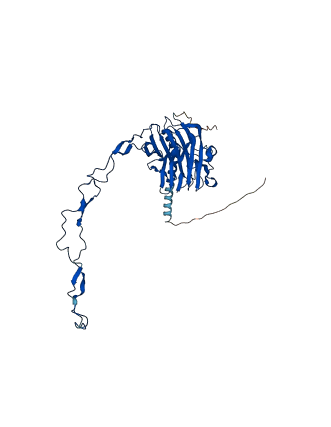
Descriptions
The autoinhibited protein was predicted that may have potential autoinhibitory elements via cis-regPred.
Autoinhibitory domains (AIDs)
Target domain |
|
Relief mechanism |
|
Assay |
cis-regPred |
Accessory elements
No accessory elements
Autoinhibited structure

Activated structure
1 structures for Q06814
| Entry ID | Method | Resolution | Chain | Position | Source |
|---|---|---|---|---|---|
| AF-Q06814-F1 | Predicted | AlphaFoldDB |
No variants for Q06814
| Variant ID(s) | Position | Change | Description | Diseaes Association | Provenance |
|---|---|---|---|---|---|
| No variants for Q06814 | |||||
No associated diseases with Q06814
3 regional properties for Q06814
| Type | Name | Position | InterPro Accession |
|---|---|---|---|
| conserved_site | Calreticulin/calnexin, conserved site | 96 - 111 | IPR018124-1 |
| conserved_site | Calreticulin/calnexin, conserved site | 128 - 136 | IPR018124-2 |
| conserved_site | Calreticulin/calnexin, conserved site | 240 - 252 | IPR018124-3 |
1 GO annotations of cellular component
| Name | Definition |
|---|---|
| endoplasmic reticulum lumen | The volume enclosed by the membranes of the endoplasmic reticulum. |
3 GO annotations of molecular function
| Name | Definition |
|---|---|
| calcium ion binding | Binding to a calcium ion (Ca2+). |
| carbohydrate binding | Binding to a carbohydrate, which includes monosaccharides, oligosaccharides and polysaccharides as well as substances derived from monosaccharides by reduction of the carbonyl group (alditols), by oxidation of one or more hydroxy groups to afford the corresponding aldehydes, ketones, or carboxylic acids, or by replacement of one or more hydroxy group(s) by a hydrogen atom. Cyclitols are generally not regarded as carbohydrates. |
| unfolded protein binding | Binding to an unfolded protein. |
1 GO annotations of biological process
| Name | Definition |
|---|---|
| protein folding | The process of assisting in the covalent and noncovalent assembly of single chain polypeptides or multisubunit complexes into the correct tertiary structure. |
No homologous proteins in AiPD
| UniProt AC | Gene Name | Protein Name | Species | Evidence Code |
|---|---|---|---|---|
| No homologous proteins | ||||
| 10 | 20 | 30 | 40 | 50 | 60 |
| MLSILLTLLL | SKYALGHEVW | FSETFPNESI | ENWVQSTYNA | EKQGEFKVEA | GKSPVDPIED |
| 70 | 80 | 90 | 100 | 110 | 120 |
| LGLKTTQDAR | FYGIARKISE | PFSNRGKTMV | LQFTVKFDKT | VSCGGAYIKL | LGSDIDPKKF |
| 130 | 140 | 150 | 160 | 170 | 180 |
| HGESPYKIMF | GPDICGMATK | KVHVIFNYKG | KNHLIKKEIP | CKDDLKTHLY | TLIVNPNNKY |
| 190 | 200 | 210 | 220 | 230 | 240 |
| EVLVDNAKVE | EGSLEDDWDM | LPPKKIDDPN | DKKPDDWVDE | QFIDDPDDKK | PDNWDQPKTI |
| 250 | 260 | 270 | 280 | 290 | 300 |
| PDMDAKKPDD | WDDAMDGEWE | RPQKDNPEYK | GEWTPRRIDN | PKYKGEWKPV | QIDNPEYKHD |
| 310 | 320 | 330 | 340 | 350 | 360 |
| PELYVLNDIG | YVGFDLWQVD | SGSIFDNILI | TDSPDFAKEE | GERLWRKRYD | AEVAKEQSSA |
| 370 | 380 | 390 | |||
| KDDKEEAEET | KERKELPYDA | KASDEPSGDH | DEL |