Q06705
Gene name |
CSR1 (SFH2, YLR380W) |
Protein name |
Phosphatidylinositol transfer protein CSR1 |
Names |
CHS5 SPA2 rescue protein 1, SEC14 homolog protein 2 |
Species |
Saccharomyces cerevisiae (strain ATCC 204508 / S288c) (Baker's yeast) |
KEGG Pathway |
sce:YLR380W |
EC number |
|
Protein Class |
|
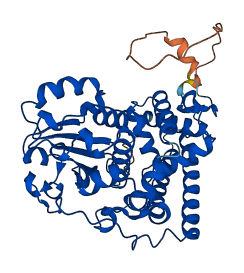
Descriptions
The autoinhibited protein was predicted that may have potential autoinhibitory elements via cis-regPred.
Autoinhibitory domains (AIDs)
Target domain |
|
Relief mechanism |
|
Assay |
cis-regPred |
Accessory elements
No accessory elements
Autoinhibited structure

Activated structure
5 structures for Q06705
| Entry ID | Method | Resolution | Chain | Position | Source |
|---|---|---|---|---|---|
| 7WVT | X-ray | 150 A | A | 2-408 | PDB |
| 7WWD | X-ray | 239 A | A | 2-408 | PDB |
| 7WWE | X-ray | 220 A | A | 2-408 | PDB |
| 7WWG | X-ray | 340 A | A | 2-408 | PDB |
| AF-Q06705-F1 | Predicted | AlphaFoldDB |
2 variants for Q06705
| Variant ID(s) | Position | Change | Description | Diseaes Association | Provenance |
|---|---|---|---|---|---|
| s12-878842 | 187 | R>S | No | SGRP | |
| s12-879266 | 329 | V>I | No | SGRP |
No associated diseases with Q06705
6 GO annotations of cellular component
| Name | Definition |
|---|---|
| cytosol | The part of the cytoplasm that does not contain organelles but which does contain other particulate matter, such as protein complexes. |
| endoplasmic reticulum | The irregular network of unit membranes, visible only by electron microscopy, that occurs in the cytoplasm of many eukaryotic cells. The membranes form a complex meshwork of tubular channels, which are often expanded into slitlike cavities called cisternae. The ER takes two forms, rough (or granular), with ribosomes adhering to the outer surface, and smooth (with no ribosomes attached). |
| endosome | A vacuole to which materials ingested by endocytosis are delivered. |
| lipid droplet | An intracellular non-membrane-bounded organelle comprising a matrix of coalesced lipids surrounded by a phospholipid monolayer. May include associated proteins. |
| mitochondrion | A semiautonomous, self replicating organelle that occurs in varying numbers, shapes, and sizes in the cytoplasm of virtually all eukaryotic cells. It is notably the site of tissue respiration. |
| prospore membrane | The prospore membrane is a double-membraned structure that extends from the cytoplasmic face of the spindle pole bodies to encompass the spindle pole bodies and the four nuclear lobes that are formed during meiosis. It helps isolate the meiotic nuclei from the cytoplasm during spore formation and serves as a foundation for the formation of the spore walls. An example of this component is found in Schizosaccharomyces pombe. |
1 GO annotations of molecular function
| Name | Definition |
|---|---|
| phosphatidylinositol transfer activity | Removes phosphatidylinositol from a membrane or a monolayer lipid particle, transports it through the aqueous phase while protected in a hydrophobic pocket, and brings it to an acceptor membrane or lipid particle. |
8 GO annotations of biological process
| Name | Definition |
|---|---|
| Golgi to plasma membrane protein transport | The directed movement of proteins from the Golgi to the plasma membrane in transport vesicles that move from the trans-Golgi network to the plasma membrane. |
| Golgi to plasma membrane transport | The directed movement of substances from the Golgi to the plasma membrane in transport vesicles that move from the trans-Golgi network to the plasma membrane, where they fuse and release their contents by exocytosis. |
| negative regulation of fatty acid biosynthetic process | Any process that stops, prevents, or reduces the frequency, rate or extent of the chemical reactions and pathways resulting in the formation of fatty acids. |
| negative regulation of phosphatidylglycerol biosynthetic process | Any process that stops, prevents or reduces the frequency, rate or extent of phosphatidylglycerol biosynthetic process. |
| phosphatidylinositol metabolic process | The chemical reactions and pathways involving phosphatidylinositol, any glycophospholipid in which a sn-glycerol 3-phosphate residue is esterified to the 1-hydroxyl group of 1D-myo-inositol. |
| phospholipid catabolic process | The chemical reactions and pathways resulting in the breakdown of phospholipids, any lipid containing phosphoric acid as a mono- or diester. |
| phospholipid transport | The directed movement of phospholipids into, out of or within a cell, or between cells, by means of some agent such as a transporter or pore. Phospholipids are any lipids containing phosphoric acid as a mono- or diester. |
| positive regulation of phosphatidylcholine biosynthetic process | Any process that activates or increases the frequency, rate or extent of phosphatidylcholine biosynthetic process. |
No homologous proteins in AiPD
| UniProt AC | Gene Name | Protein Name | Species | Evidence Code |
|---|---|---|---|---|
| No homologous proteins | ||||
| 10 | 20 | 30 | 40 | 50 | 60 |
| MSFDRQLTED | QEVVLKQIWT | HLFHLWQVPV | DGTHIFPNNS | LHSSSTPAKK | KKSSWFSKLQ |
| 70 | 80 | 90 | 100 | 110 | 120 |
| SSDHTQDSSE | AAEAAHLYEK | GKIHKALANL | DPQTTKKQFW | HDIKNETPDA | TILKFIRARK |
| 130 | 140 | 150 | 160 | 170 | 180 |
| WNADKTIAML | GHDLYWRKDT | INKIINGGER | AVYENNETGV | IKNLELQKAT | IQGYDNDMRP |
| 190 | 200 | 210 | 220 | 230 | 240 |
| VILVRPRLHH | SSDQTEQELE | KFSLLVIEQS | KLFFKENYPA | STTILFDLNG | FSMSNMDYAP |
| 250 | 260 | 270 | 280 | 290 | 300 |
| VKFLITCFEA | HYPESLGHLL | IHKAPWIFNP | IWNIIKNWLD | PVVASKIVFT | KNIDELHKFI |
| 310 | 320 | 330 | 340 | 350 | 360 |
| QPQYIPRYLG | GENDNDLDHY | TPPDGSLDVH | LKDTETRAMI | EKEREELVEQ | FLTVTAQWIE |
| 370 | 380 | 390 | 400 | ||
| HQPLNDPAYI | QLQEKRVQLS | TALCENYSKL | DPYIRSRSVY | DYNGSLKV |