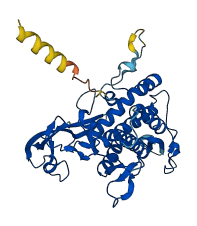
Descriptions
The autoinhibited protein was predicted that may have potential autoinhibitory elements via cis-regPred.
Autoinhibitory domains (AIDs)
Target domain |
|
Relief mechanism |
|
Assay |
cis-regPred |
Accessory elements
No accessory elements
Autoinhibited structure

Activated structure
1 structures for Q06442
| Entry ID | Method | Resolution | Chain | Position | Source |
|---|---|---|---|---|---|
| AF-Q06442-F1 | Predicted | AlphaFoldDB |
No variants for Q06442
| Variant ID(s) | Position | Change | Description | Diseaes Association | Provenance |
|---|---|---|---|---|---|
| No variants for Q06442 | |||||
No associated diseases with Q06442
1 regional properties for Q06442
| Type | Name | Position | InterPro Accession |
|---|---|---|---|
| conserved_site | Wnt protein, conserved site | 217 - 226 | IPR018161 |
1 GO annotations of cellular component
| Name | Definition |
|---|---|
| extracellular region | The space external to the outermost structure of a cell. For cells without external protective or external encapsulating structures this refers to space outside of the plasma membrane. This term covers the host cell environment outside an intracellular parasite. |
1 GO annotations of molecular function
| Name | Definition |
|---|---|
| signaling receptor binding | Binding to one or more specific sites on a receptor molecule, a macromolecule that undergoes combination with a hormone, neurotransmitter, drug or intracellular messenger to initiate a change in cell function. |
2 GO annotations of biological process
| Name | Definition |
|---|---|
| anatomical structure development | The biological process whose specific outcome is the progression of an anatomical structure from an initial condition to its mature state. This process begins with the formation of the structure and ends with the mature structure, whatever form that may be including its natural destruction. An anatomical structure is any biological entity that occupies space and is distinguished from its surroundings. Anatomical structures can be macroscopic such as a carpel, or microscopic such as an acrosome. |
| Wnt signaling pathway | The series of molecular signals initiated by binding of a Wnt protein to a frizzled family receptor on the surface of the target cell and ending with a change in cell state. |
No homologous proteins in AiPD
| UniProt AC | Gene Name | Protein Name | Species | Evidence Code |
|---|---|---|---|---|
| No homologous proteins | ||||
| 10 | 20 | 30 | 40 | 50 | 60 |
| MATTHLTAAL | ALLCALLQVD | IEASSWWSLA | MNPVQIPEAY | IVGAQPLCSQ | LPGLSPGQKK |
| 70 | 80 | 90 | 100 | 110 | 120 |
| LCQLYQDHMP | YIGEGAKTGI | KECQYQFRHR | RWNCSTVDNA | SVFGRVMQIG | SRETAFTYSI |
| 130 | 140 | 150 | 160 | 170 | 180 |
| SAAGVVNAVS | RACREGELST | CGCSRAARPK | DLQRDWLWGG | CGDNLEYGYR | FAKEFVDARE |
| 190 | 200 | 210 | 220 | 230 | 240 |
| REKIHTKGSY | ESSRTLMNIH | NNEAGRRTVY | NLADAACKCH | GVSGSCSLKT | CWLQLADFRK |
| 250 | 260 | 270 | 280 | 290 | 300 |
| VGDFLKEKYD | SAASMRLNAR | GKLVQVNSRF | NPPTTNDLVY | VDTSPDYCVR | NESTGSLGTQ |
| 310 | 320 | 330 | 340 | 350 | |
| GRLCNKTSEG | MDGCELMCCG | RGYDQFKTVQ | TERCHCKFHW | CCYVKCKKCT | EIVDQFVCK |