Q06385
Gene name |
VPS74 (YDR372C, D9481.15) |
Protein name |
Vacuolar protein sorting-associated protein 74 |
Names |
|
Species |
Saccharomyces cerevisiae (strain ATCC 204508 / S288c) (Baker's yeast) |
KEGG Pathway |
sce:YDR372C |
EC number |
|
Protein Class |
|
Descriptions
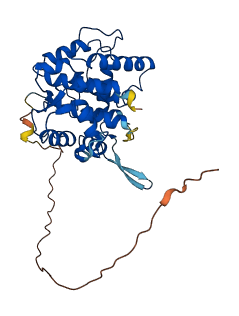
The autoinhibited protein was predicted that may have potential autoinhibitory elements via cis-regPred.
Autoinhibitory domains (AIDs)
Target domain |
|
Relief mechanism |
|
Assay |
cis-regPred |
Accessory elements
No accessory elements
Autoinhibited structure

Activated structure
4 structures for Q06385
| Entry ID | Method | Resolution | Chain | Position | Source |
|---|---|---|---|---|---|
| 2ZIH | X-ray | 280 A | A/B/C/D | 1-345 | PDB |
| 2ZII | X-ray | 305 A | A/B/C/D | 60-345 | PDB |
| 4TU3 | X-ray | 319 A | A | 1-345 | PDB |
| AF-Q06385-F1 | Predicted | AlphaFoldDB |
3 variants for Q06385
| Variant ID(s) | Position | Change | Description | Diseaes Association | Provenance |
|---|---|---|---|---|---|
| s04-1222046 | 32 | I>M | No | SGRP | |
| s04-1222041 | 34 | N>S | No | SGRP | |
| s04-1221964 | 60 | D>N | No | SGRP |
No associated diseases with Q06385
No regional properties for Q06385
| Type | Name | Position | InterPro Accession |
|---|---|---|---|
| No domain, repeats, and functional sites for Q06385 | |||
Functions
10 GO annotations of cellular component
| Name | Definition |
|---|---|
| cytoplasm | The contents of a cell excluding the plasma membrane and nucleus, but including other subcellular structures. |
| cytosol | The part of the cytoplasm that does not contain organelles but which does contain other particulate matter, such as protein complexes. |
| extrinsic component of membrane | The component of a membrane consisting of gene products and protein complexes that are loosely bound to one of its surfaces, but not integrated into the hydrophobic region. |
| Golgi apparatus | A membrane-bound cytoplasmic organelle of the endomembrane system that further processes the core oligosaccharides (e.g. N-glycans) added to proteins in the endoplasmic reticulum and packages them into membrane-bound vesicles. The Golgi apparatus operates at the intersection of the secretory, lysosomal, and endocytic pathways. |
| Golgi cisterna | Any of the thin, flattened membrane-bounded compartments that form the central portion of the Golgi complex. |
| Golgi cisterna membrane | The lipid bilayer surrounding any of the thin, flattened compartments that form the central portion of the Golgi complex. |
| Golgi medial cisterna | The middle Golgi cisterna (or cisternae). |
| Golgi membrane | The lipid bilayer surrounding any of the compartments of the Golgi apparatus. |
| nucleus | A membrane-bounded organelle of eukaryotic cells in which chromosomes are housed and replicated. In most cells, the nucleus contains all of the cell's chromosomes except the organellar chromosomes, and is the site of RNA synthesis and processing. In some species, or in specialized cell types, RNA metabolism or DNA replication may be absent. |
| trans-Golgi network | The network of interconnected tubular and cisternal structures located within the Golgi apparatus on the side distal to the endoplasmic reticulum, from which secretory vesicles emerge. The trans-Golgi network is important in the later stages of protein secretion where it is thought to play a key role in the sorting and targeting of secreted proteins to the correct destination. |
2 GO annotations of molecular function
| Name | Definition |
|---|---|
| enzyme binding | Binding to an enzyme, a protein with catalytic activity. |
| phosphatidylinositol-4-phosphate binding | Binding to phosphatidylinositol-4-phosphate, a derivative of phosphatidylinositol in which the inositol ring is phosphorylated at the 4' position. |
9 GO annotations of biological process
| Name | Definition |
|---|---|
| endoplasmic reticulum unfolded protein response | The series of molecular signals generated as a consequence of the presence of unfolded proteins in the endoplasmic reticulum (ER) or other ER-related stress; results in changes in the regulation of transcription and translation. |
| Golgi organization | A process that is carried out at the cellular level which results in the assembly, arrangement of constituent parts, or disassembly of the Golgi apparatus. |
| Golgi to plasma membrane protein transport | The directed movement of proteins from the Golgi to the plasma membrane in transport vesicles that move from the trans-Golgi network to the plasma membrane. |
| Golgi vesicle budding | The evagination of the Golgi membrane, resulting in formation of a vesicle. |
| protein N-linked glycosylation | A protein glycosylation process in which a carbohydrate or carbohydrate derivative unit is added to a protein via the N4 atom of peptidyl-asparagine, the omega-N of arginine, or the N1' atom peptidyl-tryptophan. |
| protein O-linked mannosylation | The transfer of mannose from dolichyl activated mannose to the hydroxyl group of a seryl or threonyl residue of a protein acceptor molecule, to form an O-linked protein-sugar linkage. |
| protein retention in Golgi apparatus | The retention of proteins within the Golgi apparatus. Golgi-localized carbohydrate-modifying enzymes have a short N-terminal domain that faces the cytosol, a single transmembrane alpha helix, and a large C-terminal domain that faces the Golgi lumen and that contains the catalytic site. How the membrane-spanning alpha helix in a Golgi enzyme causes its localization and prevents its movement to the plasma membrane is not known. |
| regulation of phosphatidylinositol dephosphorylation | Any process that modulates the frequency, rate or extent of the chemical reaction involving the removal of one or more phosphate groups from a phosphatidylinositol. |
| retrograde vesicle-mediated transport, Golgi to endoplasmic reticulum | The directed movement of substances from the Golgi back to the endoplasmic reticulum, mediated by vesicles bearing specific protein coats such as COPI or COG. |
No homologous proteins in AiPD
| UniProt AC | Gene Name | Protein Name | Species | Evidence Code |
|---|---|---|---|---|
| No homologous proteins | ||||
| 10 | 20 | 30 | 40 | 50 | 60 |
| MSTLQRRRVN | RADSGDTSSI | HSSANNTKGD | KIANIAVDGD | DDNGTNKKIA | YDPEESKLRD |
| 70 | 80 | 90 | 100 | 110 | 120 |
| NINIPTLTLM | EEVLLMGLRD | REGYLSFWND | SISYALRGCI | IIELALRGKI | RILDDSARKR |
| 130 | 140 | 150 | 160 | 170 | 180 |
| FDLSERLIEV | IDSSKTGEVL | LDETLQLMKN | DEPLSISNWI | DLLSGETWNL | LKINYQLKQV |
| 190 | 200 | 210 | 220 | 230 | 240 |
| RERLAKGLVD | KGVLRTEMKN | FFLFDMATHP | IADASCKEAI | KRRVLSVLVS | RNMELSYNEY |
| 250 | 260 | 270 | 280 | 290 | 300 |
| FPETTSFKII | RTLALICGSY | GANVLENVLT | TLEYEKRDKA | ISRAEEIMAQ | FSQYPFDLEK |
| 310 | 320 | 330 | 340 | ||
| ETELGVSVNL | NKEVKEEIEN | NPGHDLQLEV | IAGVFEVFSR | MDMLL |